Baking for a group in one pudding dish
If you’re baking for several people in one dish, its diameter and height need to fit the usable oven cavity. BBC Good Food’s baked recipe serving eight uses a 1.5-litre dish.


A mini oven could work for a baked treacle sponge if your chosen dish fits and the appliance offers the heating setting specified in the recipe. BBC Good Food gives a 1.5-litre dish and 180 °C conventional heat or 160 °C fan for its baked recipe serving eight; these are recipe settings, not a guarantee that the dish will fit a particular appliance. The traditional steamed version, on the other hand, needs a pan or steamer and cannot simply be treated as an oven programme.
If you’re baking for several people in one dish, its diameter and height need to fit the usable oven cavity. BBC Good Food’s baked recipe serving eight uses a 1.5-litre dish.
When space is tight, you need to consider both the oven’s external dimensions and the clearances specified in its instructions. For example, the Steba KB M19 instructions require a 10 cm gap between the back of the appliance and the kitchen wall.
If you only bake occasionally, you can weigh up the features you need, the effort involved in cleaning and comparable energy figures against how you plan to use the appliance. The Verbraucherzentrale explains that energy figures are only useful for comparison when they are based on the same measurement method.
Start with the recipe and dish, then check the heating setting and where you’ll put the oven. This will help you choose a size that suits the number of people you’re baking for.
BBC Good Food’s baked recipe serving eight specifies a 1.5-litre dish and 180 °C conventional heat or 160 °C fan. These settings apply to this recipe.
| Buying criterion | What to check before buying | Who should consider this? |
|---|---|---|
| Dish and portions | Compare the dish, including its handles, with the oven’s internal width, depth and height, as well as the shelf position. Rommelsbacher gives a maximum dish diameter of 29 cm for the BGE 1580/E, while CASO Design gives 30 cm for the TO 26 SilverStyle; these diameter figures don’t tell you how much height is available. | When we’re baking for several people, we want to know whether our specific dish will fit, with enough room for the sponge to rise. Around 31% of consumers put dish size and portion count first. |
| Heating setting | Check the heating settings and temperature range of the exact model against your chosen recipe. BBC Good Food specifies 180 °C conventional heat or 160 °C fan for its baked recipe. | If I want to make a particular baked recipe, I need a suitable heating setting—and not one intended for steaming. Around 25% of consumers prioritise baking controls. |
| Where you’ll put it | Check the external dimensions and model-specific clearances, as well as access to a suitable socket. The Steba KB M19 instructions specify a 10 cm gap between the back of the appliance and the kitchen wall. | With limited worktop space, I want to allow for more than just the appliance itself; I also need to leave the required clearance. Around 19% of consumers focus mainly on space and safe positioning. |
| Cleaning | Look for a removable crumb tray, an accessible oven cavity and cleaning instructions in the manual. A crumb tray won’t replace a suitably sized dish or prevent spills from needing attention. | After baking a syrupy cake, I want to be able to clear away crumbs and splashes easily. Around 13% of consumers focus on the cleaning involved afterwards. |
| Purchase and running costs | Compare the features you need and only compare energy figures that use the same measurement method. The wattage alone doesn’t tell you how much electricity a baking session will use. | If I only bake occasionally, I want to weigh up the features and actual running costs against how I’ll use the appliance. Around 12% of consumers prioritise purchase and ongoing costs. |
A 21-litre WOLTU version is listed as 120 V; this specification doesn’t tell you anything about another model variant. The VDE says that 230 V and 50 Hz are standard in Germany.
Before choosing, compare the full model number, rated voltage, frequency and connection of the specific appliance with the intended place of use.
Even if a dish fits across, its height, the shelf position or the space needed for the sponge to rise can also be decisive.
Measure the dish you’ll actually use in every dimension and compare it with the usable oven cavity of the exact model.
Rated power is not the same as the energy used for a complete baking session. The Verbraucherzentrale points out that energy figures are only comparable when they use the same measurement method.
Don’t compare wattage figures with energy figures for a baking cycle, and don’t assume that a standard cycle will reflect the energy used for your recipe.
According to the manufacturer, the BGE 1580/E is a mini oven with a 30-litre capacity for dishes up to 29 cm in diameter.
According to the manufacturer, the TO 26 SilverStyle is a 26-litre model, with a stated maximum dish diameter of 30 cm.
The KB M19 is a more compact option; its usable internal dimensions need to be checked against your chosen dish.
At 60 litres, the TO 2073 is a considerably larger model for other baking tasks as well as a cake to share.
According to the manufacturer, the BF12rsz is a 32-litre option with several heating modes.
This selection includes appliances for baking a treacle sponge in a dish. The key considerations are still whether the dish fits, whether the oven offers the required heating setting and how much space you have where you’ll put it.
 No image available
A compact option for a smaller dish; check that your specific dish fits in the oven cavity before buying.
Listed in the product name: 10 L, pizza function and 100–230 °C.
 No image available
A larger stated capacity may be worth considering when baking for a group; still check the dish dimensions against the usable interior space.
Listed in the product name: 28 L, temperature control and timer.
 No image available
The larger stated capacity may be an option for baking for a group; check that your dish fits and that you have room for the specific appliance.
Listed in the product name: 32 L, 1.600 W, timer, crumb tray and 100–250 °C. Check the electrical details and specifications for the exact version before choosing.
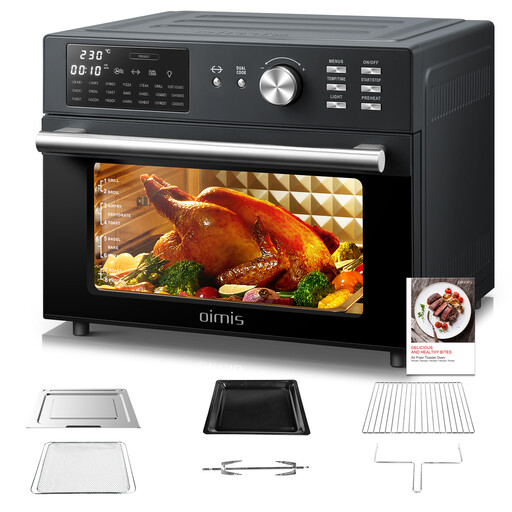 No image available
Worth considering as an oven for baking for a group if its features suit the way you’ll use it; check that your dish fits and that it offers the heating settings you need.
Listed in the product name: 30 L, 21 presets, rotisserie, dehydrator function and 1.800 W.
Not without changing it: BBC Good Food’s traditional recipe is steamed for 1½ hours in a covered 1-litre pudding basin. For a standard mini oven, choose a recipe specifically written for baking. The baked recipe serving eight specifies a 1.5-litre dish and 180 °C conventional heat or 160 °C fan.
Compare the diameter, height and depth of the dish you’ll actually use with the usable internal dimensions and shelf position of the specific model. A manufacturer’s maximum dish diameter doesn’t tell you whether there’ll be enough room above a tall dish.
Follow the instructions for the specific model. For the Steba KB M19, they require a 10 cm gap between the back of the appliance and the kitchen wall; the manufacturer lists a removable crumb tray for this model. Don’t assume the same positioning requirements apply to other ovens.
No. Rated power and the energy used for a complete baking session are different figures; a published standard cycle also won’t necessarily reflect the energy used for your recipe. The Verbraucherzentrale recommends comparing energy figures only when they use the same measurement method.
Electrical appliances covered by EU low-voltage rules must carry the CE mark; the Bundesnetzagentur advises checking the markings and manufacturer’s details. The VDE says that 230 V and 50 Hz are standard in Germany. Compare these details with the full model number and electrical specifications of the specific appliance. A version explicitly rated for 120 V is not designed to be connected directly to the standard 230 V mains supply.