What should you look for when buying?
First, decide how you’ll serve the later portion safely. Then compare the usable tray area for your fritters with the space available for the oven. Heating functions and ease of cleaning can help you narrow down your options further.
Each row in the table covers one primary consumer buying concern, with each concern assigned to just one row.
| Priority |
What to check when buying |
Who is this important for? |
| Serving food safely later |
Check whether your planned use allows you to monitor the temperature appropriately; don’t rely on the label ‘keep warm’ alone. |
If a portion is being served later, I don’t want to rely on the oven display; I want to keep a safe eye on the food’s temperature. Consumers for whom this is the main priority are estimated to account for around 36%. |
| Tray capacity |
Compare the tray and interior dimensions with your portion size, and check which accessories are actually included. |
When several people are eating, I want to fit as many fritters as possible on the tray and avoid extra batches. Consumers who prioritise tray capacity are estimated to account for around 29%. |
| Finding the right spot |
Check the appliance’s external dimensions and the installation requirements in the specific model’s manual against the space you have available. |
With limited worktop space, I’d first check whether the oven will fit in the intended spot with the required clearances. Consumers with this space constraint are estimated to account for around 21%. |
| Cleaning and running costs |
Check whether the crumb tray is removable, read the cleaning instructions and, where available, compare energy consumption data on a like-for-like basis. |
With frequent use, I want the crumb tray and interior to be easy to clean, and to get a sense of the ongoing running costs. Consumers with this priority are estimated to account for around 14%. |
Mini ovens at Joybuy for small and larger batches
Our selection includes mini ovens for cooking vegetable fritters, from compact models for smaller batches to ovens with more interior space or several shelf positions.
 No image available
WOLTU BF12sz mini oven, 32 l, black
For several portions and repeated batches; compare the tray area with the size and number of your fritters.
32 l; temperature control from 100 to 250 °C and a 60-minute timer. A baking tray, wire rack and removable crumb tray are listed.
External dimensions: 52.3 × 36 × 32.2 cm.
View at Joybuy
 No image available
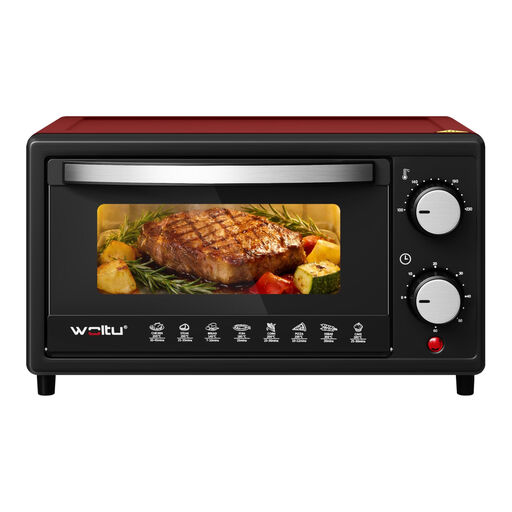
WOLTU mini oven, 10 l, red
For smaller batches and compact kitchens; the product description recommends it for 1–2 people.
10 l; top and bottom heat, a temperature range of 100 to 230 °C and a timer of up to 60 minutes. A baking tray and wire rack are listed.
Dimensions: 37 × 26.5 × 21 cm.
View at Joybuy
 No image available
WOLTU mini convection oven, 28 l, black
For shoppers planning several batches and comparing shelf positions.
28 l; three shelf positions, temperature control from 100 to 230 °C and a timer of up to 60 minutes. A baking tray, wire rack and crumb tray are listed.
Top heat, bottom heat and combined heating functions are listed. Having several shelf positions doesn’t in itself mean you can use several trays at once.
View at Joybuy
Frequently asked questions about mini ovens for vegetable fritters
Can I simply leave cooked fritters in the switched-off oven until the next mealtime?
Don’t rely on this to keep them hot. Germany’s Federal Institute for Risk Assessment recommends keeping heated food at a minimum of 60 °C throughout when holding it hot. If you can’t keep it safely hot, cool it, store it in the fridge and reheat it thoroughly later. An oven setting alone doesn’t confirm the food’s temperature.
What if I want to serve the fritters later, straight from the fridge?
Germany’s Federal Institute for Risk Assessment recommends reheating prepared food to above 70 °C throughout for at least two minutes. The oven temperature you set doesn’t show the temperature inside the fritters.
How should I plan for space and cleaning?
Compare the specific model’s external dimensions with the space you have available, and follow the installation and cleaning instructions in the manual. If you’ll be cooking frequent batches, also check whether the crumb tray is removable and which tray is actually included.
What rights do I have when buying online from a business seller?
For most online purchases in the EU, you generally have 14 days from delivery to change your mind, although exceptions apply and you may have to pay the cost of returning the item. Your Europe, the European Union’s information portal, explains how this right differs from the legal guarantee: goods are generally covered by a minimum two-year guarantee from the seller, starting when you receive them. This is separate from any voluntary manufacturer’s warranty.


