Batch cooks with a large dish
If you want to make several portions of lasagne in one go, first check that your entire oven dish will fit on the rack and through the door.


Measure your oven dish, including its handles and the height of the filled dish, then check it against the rack, shelf position and door opening of the specific mini oven. Capacity in litres or the dimensions of a supplied baking tray don’t guarantee a suitable fit. Larger dishes may need a roomier appliance, provided you have enough space for it; compact models are better suited to smaller batches, as long as their heating mode works for your recipe. Plan cooling and freezing separately from buying the oven: the German Federal Institute for Risk Assessment recommends cooling warm food quickly to below 7 °C for longer-term storage.
If you want to make several portions of lasagne in one go, first check that your entire oven dish will fit on the rack and through the door.
Even if you’re happy to bake smaller batches, make sure you have a suitable spot for the appliance, room for the door to open and the clearances required in the instructions.
If you’re following a particular recipe, check that the oven actually lets you select the heating mode it requires.
For a batch of lasagne, first make sure your dish will fit. Then consider the heating mode you need and whether you have a suitable spot for the oven.
The priorities below are for choosing a mini oven to batch-cook vegetable lasagne.
| Consideration | What to check when buying | Who is it important to? |
|---|---|---|
| Dish size and batch size | Compare the outside dimensions of your dish, including handles, and the height of the filled lasagne with the rack, shelf position and door opening of the specific model. Baking tray dimensions don’t guarantee that an oven dish will fit. | If I’m batch-cooking several portions, my dish needs to fit in one go; around 36% of consumers put dish and batch size first. |
| Heating mode and recipe | Check the heating mode, temperature range and timer against your recipe. Don’t assume that the fan can always be switched off. | If you follow a specific recipe, you’ll want to be able to select the heating mode it requires; around 29% of consumers prioritise a match between recipe and heating mode. |
| Space | Measure your worktop and the surrounding area, and follow the set-up instructions for the specific model. Rommelsbacher specifies a minimum worktop width of 55 cm, including the feet, for the BG 1805/E. | With limited worktop space, there must be enough room for the appliance, the open door and the required clearances; around 21% of consumers put available space first. |
| Operation and cleaning | Check the timer, removable crumb tray and care instructions for the specific model. Calculate electricity costs using only comparable consumption figures and your own tariff. | If ease of use, cleaning and running costs matter most to me, I look at the features and reliable consumption figures; around 14% of consumers prioritise operation and cleaning. |
A baking tray may have different usable dimensions from the rack; with lasagne, you also need to allow for the handles and the height of the filled dish.
Measure your dish all the way round and check the relevant internal dimensions of the specific oven.
The feet, door opening and required clearances can rule out a spot that looks suitable at first glance. Rommelsbacher specifies a minimum worktop width of 55 cm, including the feet, for the BG 1805/E.
Check the space and surrounding area against the instructions for the specific model.
Steba describes the KB 27 U.2 as having a permanently operating fan; according to their manufacturers, other models offer different selectable heating modes.
Check the available settings against your recipe.
The rated power isn’t the same as the measured energy used for a complete baking cycle.
Compare consumption figures only on a like-for-like basis, and factor in your electricity tariff. The German consumer advice centre explains consumption figures per standard baking cycle for ovens.
The 30-litre BG 1550 and 42-litre BG 1805/E offer different capacities to consider when checking whether an oven dish will fit.
Severin describes the 42-litre TO 2058 as a baking and toasting oven, making it a useful option to consider for larger dishes.
The TO 26 SilverStyle is worth considering for smaller lasagne dishes.
With a 20-litre capacity, the KB 27 U.2 is a compact option to consider for smaller dishes and several baking cycles.
This Joybuy selection includes medium-sized countertop ovens and a compact model for smaller batches. For each one, check that your dish fits and that the heating mode meets your needs.
 No image available
The 32-litre model is an option for medium-sized dishes; check that your oven dish fits the specific appliance.
100–250 °C; timer up to 60 minutes; crumb tray; product details state that it is suitable for baking and grilling; 1600 W.
 No image available
The selectable heating modes may be useful if your lasagne recipe calls for a particular type of heat; check them against the appliance instructions.
28 litres; top heat, bottom heat or both; 100–230 °C; timer up to 60 minutes.
 No image available
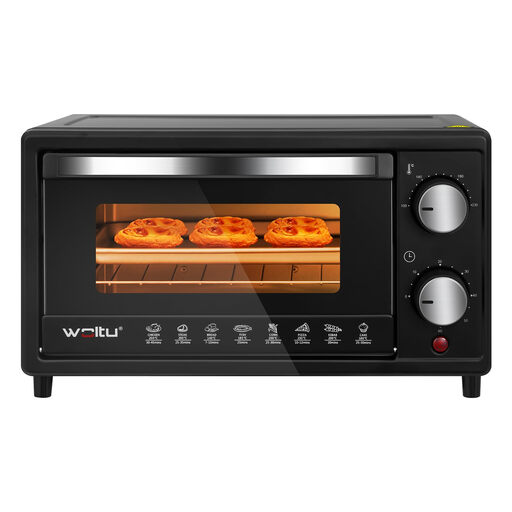
According to the product description, the 10-litre model is designed for 1–2 people, so it’s better suited to small portions than a larger batch for the freezer.
100–230 °C; timer; top and bottom heating elements.
No. Measure the outside of your dish, including the handles, and also check the rack, shelf height and door opening. Rommelsbacher specifically gives 38.5 × 31.5 cm as the outside dimensions of the original baking tray for the BG 1805/E.
For longer-term storage, cool warm food quickly to below 7 °C, as recommended by the German Federal Institute for Risk Assessment. The Federal Centre for Nutrition recommends using suitable, labelled freezer containers or bags for cooked food. When reheating, the German Federal Institute for Risk Assessment recommends reaching at least 70 °C throughout the food for two minutes; simply setting the oven to that temperature doesn’t confirm that the food itself has reached it.
No. The stated power rating and the energy used for a complete baking cycle are different things. To compare costs, you need consumption figures measured on a comparable basis, as well as your electricity tariff. The German consumer advice centre explains consumption figures per standard baking cycle for ovens.
According to the German Federal Environment Agency, old electrical appliances must not go in household rubbish; they need to be collected separately from unsorted household waste. Check with your local council to find out which collection points and return options are available in your area.