For 2D animation and manageable projects, a mini PC can work well on a small desk, provided the software and full specification are right. For demanding 3D scenes, the supported GPU and its video memory should matter more than choosing the smallest possible form factor. The Blender Foundation lists 8 GB RAM as the minimum and 32 GB as its recommendation, not as a guarantee for every project. A barebone requires extra components and set-up, and the GPU, storage and included items must match the specific variant.
Who is a compact animation desktop suitable for?
3D animator with limited workspace
If desk space is limited, look for a compact case and set-up, but don’t lose sight of the GPU and video memory needed for more complex scenes. The Blender Foundation notes that GPU rendering of complex scenes can be limited by available memory.
2D and motion designers
If you mainly create 2D animation or motion design, first check the requirements of your software and plug-ins, as well as how much memory your projects use. Apple lists different unified memory capacities for the Mac mini (2024), depending on the M4 configuration.
Buyers looking for an upgradeable mini PC
If you plan to add components yourself, it’s important to check whether your chosen variant is a kit or a fully equipped PC. ASUS offers different NUC 14 Pro configurations, while Notebookcheck notes that the barebone it tested needed additional RAM, an SSD and an operating system.
What should you look for when choosing one?
For an animation desktop on a small desk, the key things to consider are its footprint, suitable 3D graphics, project storage and everything included in the box.
| Priority |
What to check before buying |
Who should pay particular attention? |
| Footprint and workspace |
Dimensions of the specific variant, plus room for ports and ventilation. |
If I want to fit a monitor and input devices on a small desk, I also need to allow space for cables and airflow. Around 36% of consumers put footprint first. |
| GPU for 3D animation |
GPU model, video memory and support for the renderer you use. |
For more complex 3D scenes, I want to know whether my graphics hardware is suited to my renderer and its memory requirements. Around 29% of consumers prioritise 3D graphics capability. |
| Memory |
RAM specification of the exact variant and the requirements of your software and plug-ins. |
If several projects or large files are part of my workflow, the memory should suit the software I use. Around 21% of consumers put project memory first. |
| What’s included |
Check whether RAM, an SSD, an operating system and the necessary peripherals are included with the specific SKU. |
If you want to set up your computer without buying extra components, check carefully whether you’re comparing a kit with a fully configured PC. Around 14% of consumers focus primarily on what’s included. |
The Blender Foundation lists 8 GB RAM as the minimum for Blender and recommends 32 GB. When rendering complex scenes on a GPU, limited video memory can be a constraint. These figures don’t replace checking the requirements of your own project and renderer.
Common buying misconceptions
-
“Tiny” automatically means dedicated graphics
A workstation range may offer different graphics configurations. The range name alone doesn’t tell you which GPU is included in a particular variant.
Check the listing for the exact GPU model and its memory.
-
A barebone is ready to use
The ASUS NUC 14 Pro barebone tested needed RAM and an SSD to be installed before it could be used. An operating system also had to be factored in. Other variants may come with different specifications.
Check what’s included with the exact configuration before comparing a kit with a fully configured PC.
Depending on the kit, you may need to add and set up RAM, an SSD and an operating system.
-
Meeting the minimum requirements guarantees a smooth workflow
The Blender Foundation distinguishes between minimum and recommended specifications. When rendering complex scenes on a GPU, the available video memory can also become a limiting factor.
Choose RAM and a GPU to suit your software, renderer and typical project size, rather than relying on the minimum needed to get started.
Key brands at a glance
Apple
The Mac mini (2024) is a compact option if your animation software and plug-ins run on macOS.
- Apple lists M4 and M4 Pro configurations with different amounts of unified memory.
- The form factor and manufacturer specifications don’t prove how well it will render a particular project or whether all plug-ins are compatible. Unified memory is not the same as a separate VRAM specification.
ASUS
The NUC 14 Pro family may suit buyers choosing between a fully equipped mini PC and a kit.
- ASUS offers variants with different inclusions and specifications.
- A Notebookcheck review describes a barebone that needed RAM, an SSD and an operating system before it could be used. This does not apply to every NUC 14 Pro configuration.
Lenovo
The ThinkStation P3 Tiny is a compact workstation range, and the graphics specification of the exact configuration needs particular attention.
- Lenovo describes an NVIDIA graphics option for the range.
- The German P3 Tiny Gen 2 configuration reviewed lists integrated graphics. The specification of one variant cannot be assumed to apply to the entire range.
Joybuy products for a small desk
The Joybuy options below are mini PCs for animation on a small desk. Whether they suit your workflow depends on your software, project size and the specification of the particular variant.
 No image available
SOYO Y5Pro mini PC, Intel Core i5-8250U/8350U, 8 GB DDR4, 256 GB SATA SSD, Windows 11
It may suit a small workspace if your software can run on this specific configuration. The title lists 8 GB DDR4 and a 256 GB SATA SSD. The Blender Foundation lists 8 GB as the minimum and recommends 32 GB.
View at Joybuy
 No image available
ACEMAGIC E3B mini desktop, AMD Ryzen 7 7735HS, 24 GB LPDDR5, 512 GB NVMe SSD
Its compact form may help if desk space is limited; the product description gives dimensions of 128 × 128 × 41,3 mm. The title lists 24 GB LPDDR5 and a 512 GB NVMe SSD. Check that the memory is sufficient for your projects.
View at Joybuy
 No image available
MaxMini B3 mini PC, Intel N4100, 8 GB LPDDR4, 256 GB SSD
The mini PC form factor may suit a small workspace, provided the specification is sufficient for your animation projects. The title lists 8 GB LPDDR4, a 256 GB SSD and two HDMI ports. The Blender Foundation lists 8 GB as the minimum and recommends 32 GB.
For indoor use only. Use the original power adapter supplied, keep the ventilation openings clear and do not open the case.
View at Joybuy
 No image available
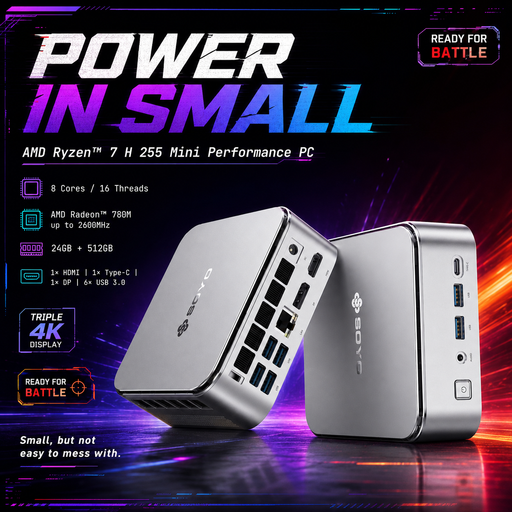
SOYO S4PLUS mini PC, Ryzen 7 H 255, Radeon 780M, 24 GB LPDDR5, 512 GB PCIe 3.0 SSD
The mini PC form factor can work well on a small desk. Check whether the graphics are suitable for your 3D renderer, software and projects. The title lists a Radeon 780M, 24 GB LPDDR5 and a 512 GB PCIe 3.0 SSD. The Blender Foundation recommends 32 GB RAM.
View at Joybuy
 No image available
FIREBAT F1 mini PC, AMD Ryzen 5 7640HS, Radeon 760M, 24 GB LPDDR5, 512 GB PCIe 4.0 SSD
The compact design can save desk space. For 3D work, check whether your renderer supports the listed Radeon 760M. The title also lists 24 GB LPDDR5 and a 512 GB PCIe 4.0 SSD. The Blender Foundation recommends 32 GB RAM.
View at Joybuy
Frequently asked questions
Is the smallest mini PC enough for Blender?
Not simply because of its size. Compare the specific configuration with the Blender Foundation’s minimum and recommended specifications, and, for GPU rendering, check the supported graphics hardware and scene size. A general specification does not guarantee sufficient performance for every project.
What do I need to add before setting up a barebone?
Check what’s included with the exact variant. The NUC 14 Pro barebone tested by Notebookcheck needed RAM and an SSD to be added, and an operating system also had to be factored in. ASUS offers other configurations with different inclusions.
How should I set up the computer on a small desk?
Measure the space needed by the specific variant and allow room for cables and clear ventilation openings. If a monitor and input devices aren’t included in the offer, remember to factor them in separately.
What should I look for when it comes to product safety?
Electrical and electronic equipment sold in the EU must meet the relevant product safety and CE requirements. The CE marking is not an independent performance test, so check the conformity information for the specific offer.
Are a warranty and statutory consumer rights the same thing?
No. For a consumer purchase in Germany, statutory rights are set out by law and generally apply against the seller; a manufacturer’s warranty is an additional voluntary benefit. Check the terms of any specific warranty separately.


