
Lieferung heute & morgen

Qualitätsgarantie

Willkommens-Angebote freischalten: KOSTENLOSE Lieferung | Bis zu 80 % RABATT | Kostenlose 30-Tage-JoyPlus-Testphase
App herunterladen
A Mini PC can replace a classic desktop PC while saving valuable desk space. However, a small form factor doesn't automatically mean it's the right system for you. What really matters are the processor, RAM, SSD, ports and how you plan to use it. If you only focus on low prices or high clock speeds, you can easily overlook important limitations.
A modern model name doesn't always mean a mini computer is suitable for every task. An older Intel Core Mini PC with four cores may be fine for word processing and video streaming, but it's only limitedly capable of heavy multitasking or modern gaming. With an AMD Ryzen Mini PC, you should also check which integrated graphics unit is used.
What matters:
A Mini PC with 16 GB of RAM is suitable for many office tasks, browser tabs and video calls. For large spreadsheets, virtual machines or creative applications, a Mini PC with 24 GB RAM or more may be a better choice. However, RAM is not the same as SSD capacity.
An SSD affects boot times and data access speeds, but it doesn't replace additional RAM. For office and home office use, 512 GB is often a practical starting point. If you store lots of media projects, games or local data, choose a Mini PC with SSD and sufficient expandability.
Multiple USB ports alone don't tell you much about everyday usability. Check whether the required standards are present and whether the video outputs match your existing setup. For a 4K Mini PC, you need to consider the HDMI version, DisplayPort, refresh rate and the number of monitors you can use simultaneously.
Also make sure Wi-Fi, Bluetooth, LAN speed and USB-C suit your needs. If you plan to use a Mini PC for office and home office, you'll benefit from multiple video outputs, Gigabit LAN and enough USB ports for a keyboard, mouse, headset and external drives.
For typical office tasks, education and streaming, a power-efficient processor in the lower or mid-range class is sufficient. A high-performance Mini PC with a modern Ryzen or Core platform is better suited if you run several applications at once, or plan to do photo editing, programming and more demanding multimedia projects.
A gaming Mini PC with integrated Radeon graphics can handle many e-sports titles and less demanding games. For professional 3D applications, CAD, rendering or simulations, however, a workstation with a dedicated graphics card is a more sensible choice.
Pay attention to the memory type and whether the RAM is replaceable. DDR5 RAM offers a modern platform with high transfer speeds. However, on compact devices the memory is sometimes soldered in place. In that case, the capacity must match your planned usage from the outset.
As a rough guide:
The Kingston FURY Beast RGB DDR5 32 GB Kit with 2 × 16 GB, 6000 MT/s and support for Intel XMP 3.0 and AMD EXPO is designed for desktop systems with compatible DDR5 DIMM slots. It is not a complete Mini PC, but it can be an option for a self-built compact desktop PC. Before buying, check the motherboard, the 42.23 mm height and BIOS compatibility.
A Mini PC with Windows 11 is ready to use for common applications straight out of the box. For businesses, Windows 11 Pro with features like BitLocker, Secure Boot and management options may be relevant. Also check whether a second M.2 slot, a SATA port or simple storage expansion is available.
For professional systems, certifications, power supply wattage, PCIe slots and spare parts availability also matter. A compact Mini PC is not automatically a workstation PC solution. For CAD, scientific calculations or GPU rendering, larger tower systems with a dedicated graphics card are often more suitable.

Why this product fits the profile: This compact computer with an Intel Core i5-8250U/8350U, 8 GB DDR4 and 256 GB SATA SSD is designed for basic office tasks, web browsing and media playback.
The specs clearly state the RAM, SSD capacity, two HDMI outputs, USB ports and the 105 × 113 × 45 mm chassis size.
Very compact form factor, Wi-Fi 5, Bluetooth 5.2, Gigabit LAN and HDMI outputs for two displays.
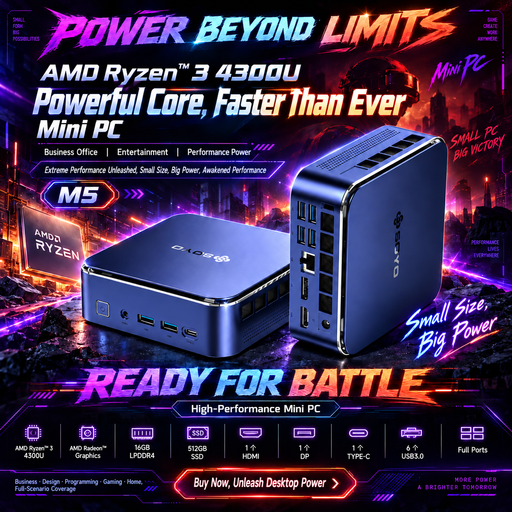
Why this product fits the profile: 16 GB LPDDR4, 512 GB SSD and three video outputs support typical work, study and multimedia scenarios.
The specifications list the exact display interfaces: HDMI 2.0, DisplayPort 1.4 and USB-C. This makes it easy to check compatibility for a 4K workstation.
16 GB RAM, 512 GB SATA SSD, six USB 3.0 ports and a 128 × 128 × 47.6 mm chassis.

Why this product fits the profile: This tower system is aimed at businesses and demanding users who need 32 GB DDR5, an NVIDIA RTX A400 and Windows 11 Pro.
The dedicated graphics card, 500 W power supply and clearly listed DisplayPort, HDMI and USB ports are documented in a way that makes sense for professional workstations.
Intel Core Ultra 7 265 with 20 cores, 32 GB DDR5 at 5,600 MHz, 512 GB NVMe SSD and NPU.

Why this product fits the profile: 24 GB DDR5, 1 TB PCIe 4.0 SSD, Radeon 880M graphics and several modern ports appeal to users with high multitasking and display demands.
The specs mention 4K support for up to four displays, USB4, HDMI 2.1, Oculink and two 2.5 Gb Ethernet ports.
10-core/20-thread processor, 24 GB DDR5, 1 TB SSD, Wi-Fi 6E and Radeon 880M.
We've put together a complete, regularly updated list of products that fully meet these strict selection criteria and the safety regulations in force in the EU.
For word processing, video calls, browser applications and cloud-based software, a device with 16 GB RAM, an SSD and at least two suitable video outputs is usually enough. If you run many applications at once or work with local data projects, 24 or 32 GB is a better choice.
The lifespan depends on cooling, workload, maintenance and upgradeability. A device with sufficient RAM capacity, an SSD and regular security updates can be used for several years. If the RAM is soldered in place, you should choose the initial configuration particularly carefully.
A compact computer often consumes less energy because the processor and graphics solution are designed for efficiency. However, the actual power consumption depends on the monitor, power supply, workload profile and connected devices. For a realistic assessment, look at the power draw both at idle and under load.