
Lieferung heute & morgen

Qualitätsgarantie

Willkommens-Angebote freischalten: KOSTENLOSE Lieferung | Bis zu 80 % RABATT | Kostenlose 30-Tage-JoyPlus-Testphase
App herunterladen
A Mini PC can replace a traditional tower when space is limited and you are looking for a quiet desktop PC for office work, streaming, studying or light gaming. However, its compact design alone says little about everyday usability, upgradeability or the range of connections available. If you focus only on processor names or particularly low prices, you could end up buying a device that no longer meets your requirements after a short time.
A modern AMD Ryzen or Intel Core processor may sound convincing at first. However, generation, number of cores, threads, clock speed, cooling and integrated graphics are also important. An older Intel Core i5 may be sufficient for office work and web applications, but it is not automatically equivalent to a newer AMD Ryzen 5 or Ryzen 7.
Four to six cores are usually enough for typical office tasks. If you use lots of browser windows, video conferences, image-editing software or several applications at the same time, you will benefit from more memory and additional threads.
The term 4K Mini PC often describes the possible video output rather than the ability to run modern games smoothly in 4K. 4K can be useful for office work, videos and compatible monitors. In games, however, the frame rate depends on the integrated GPU, memory and the graphics settings used.
You should also check claims such as “triple-screen” in practical terms. The available ports, their standards and the combination of outputs are all important. Not every USB-C port automatically transmits a video signal.
Many Mini Desktop PCs have soldered memory or only limited storage capacity. This is not necessarily a problem with an inexpensive device, but you should know about it before buying. If you want to install a larger SSD, more RAM or a dedicated graphics card later on, you will need a case designed accordingly.
The ASRock DESKMEET X600 occupies a special position here: it is described as a compact tower system with an AMD AM5 platform and a 500-watt power supply. The specific processor, memory and SSD configuration should be checked before purchase, as this is an expandable system solution rather than necessarily a fully equipped Mini PC.
For an office PC or home office PC, an efficient entry-level or mid-range processor is sufficient, provided it has at least 8 GB of RAM. For using several applications at once, 16 GB of RAM is a sensible guideline. Budget-conscious gamers should also pay attention to the integrated graphics. Radeon models such as the Radeon 760M or Radeon 780M may be suitable for light gaming; actual results depend on the game, resolution and graphics settings.
A Mini PC with 16 GB of RAM offers more headroom for video conferences, office programmes and numerous browser tabs than an 8 GB model. 24 GB of RAM may be worth considering for more demanding multitasking. A 512 GB SSD provides considerably more space for programmes and personal files than a 256 GB SATA SSD. With PCIe SSDs, the generation is also relevant: PCIe 4.0 can enable higher transfer speeds, while PCIe 3.0 may still be sufficient for office work, streaming and everyday use.
Before buying, compare the available ports with those at your workstation:
For a quiet desktop PC, the cooling design, case ventilation and the manufacturer’s noise-level specifications are also relevant. “Silent” in a product name is a useful indication, but it is not a standardised decibel rating.

Why this product suits the profile: With 8 GB DDR4, 256 GB of storage, two HDMI ports and Windows 11, this model is suitable for basic office, study and streaming tasks on a limited budget.
The specifications are clearly stated. Buyers can see in advance that 8 GB of RAM and 256 GB of storage are intended more for basic use than extensive multitasking.
Compact dimensions of 105 × 113 × 45 mm, two HDMI outputs and Windows 11.
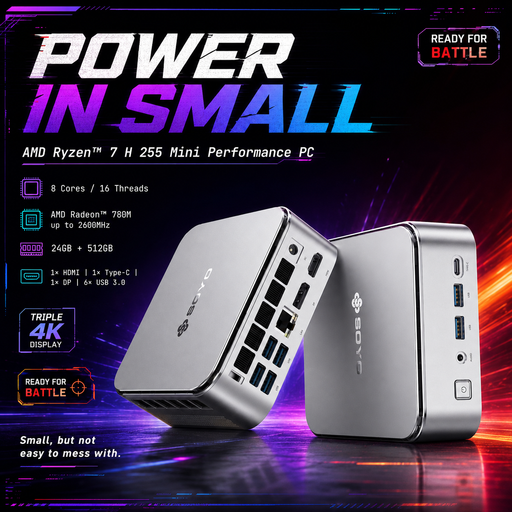
Why this product suits the profile: The AMD Ryzen 7 H 255 with 8 cores and 16 threads, 24 GB LPDDR5 and Radeon 780M is aimed at users who need more demanding multitasking and suitable gaming performance.
The RAM, SSD, graphics and video output specifications are clearly stated. This makes it easier to assess its suitability for several displays and applications.
24 GB LPDDR5-6400, 512 GB NVMe SSD, HDMI 2.0, DisplayPort 1.4 and USB-C.

Why this product suits the profile: Six cores, twelve threads, 16 GB LPDDR4 and a 512 GB SSD are well suited to home working, studying and business applications with several connected displays.
16 GB of RAM and a 512 GB SSD avoid an overly limited basic configuration. However, the stated support for 4K triple-screen output should still be checked against your own monitor connections.
AMD Ryzen 5 7430U, Wi-Fi 6, Bluetooth 5.2 and stated support for three 4K displays.

Why this product suits the profile: 24 GB LPDDR5, Radeon 760M, USB 4.0, HDMI 2.1 and 2.5 Gbit Ethernet will appeal to users looking for a compact gaming Mini PC with versatile connectivity.
The graphics specification is backed up by specific connectivity and storage details. For gaming, you should check the resolution, detail settings and actual system requirements for each game.
Ryzen 5 7640HS, 24 GB LPDDR5, 512 GB PCIe-4.0 SSD and Wi-Fi 6E.
We have put together a complete, regularly updated list of products that fully meet these strict selection criteria and the safety regulations applicable in the EU.
A suitable Mini PC is generally sufficient for word processing, spreadsheets, video conferences, email and web applications. We recommend 16 GB of RAM, an SSD and at least the ports required for your monitor, webcam, headset and external drives. If the device is used continuously, make sure that ventilation is not obstructed by a confined installation location.
Its service life depends on the components, temperature, software maintenance and workload. An SSD with sufficient capacity, enough memory and a case with a well-designed cooling system can extend its practical usability. Before buying, check whether the RAM or SSD can be replaced and how long security updates will be available for the pre-installed operating system.
A compact Mini PC is often designed for lower energy consumption than a powerful tower PC with a dedicated graphics card. However, actual consumption varies depending on the processor, power supply, monitors and workload. For a fair comparison, consider consumption both at idle and under typical working loads.