Designers with an existing monitor
If you’d like to keep using your current screen, a mini PC can be a compact computing solution. Check that the ports are compatible and that there’s room on your small desk for the power supply and cables too.


If you already have a suitable monitor, a mini PC can save space by doing away with a full-size computer case. However, check the ports, power supply, cables and specification of the exact model. If you’d rather choose the computer and screen together, an all-in-one may be a good option – but the display features and dimensions of the complete unit are key. The right specification depends mainly on the software and files you use: Adobe recommends at least 16 GB RAM for Photoshop 27.x or later, but this isn’t a universal requirement for designing landing pages in a browser.
If you’d like to keep using your current screen, a mini PC can be a compact computing solution. Check that the ports are compatible and that there’s room on your small desk for the power supply and cables too.
If you’re setting up a new workspace, you can choose a computer and display together in an all-in-one. Check the dimensions of the complete unit, and make sure the resolution and adjustment options suit your work.
If you use larger design files or Photoshop as well as creating landing pages, check the requirements for your software version and the computer’s actual installed specification.
A good fit if: You already have a suitable screen or want to choose one separately from your computer.
Things to consider: You’ll need to buy the monitor, peripherals and, if required, a mount separately. Make sure you plan for the right ports and space for the cables and power supply.
A good fit if: You want to buy the computer and screen together and set them up as a single unit.
Things to consider: You’re tied to the display that comes with the device. An FHD display doesn’t automatically guarantee the colour accuracy needed for professional design sign-off.
When choosing a desktop PC for designing landing pages on a small desk, your decision mainly depends on what you already have in your workspace and which programmes you actually use.
| What matters | What to check before buying | Who should consider it? |
|---|---|---|
| Space and positioning | Dimensions of the case and screen, port locations, and space for the power supply and cables. Only plan for VESA mounting if you have a compatible mount. | If I want to keep as much of my work surface clear as possible, I need to consider the space taken up by my entire setup. Around 36% of consumers put available desk space first. |
| Screen for layouts and previews | Check your existing monitor and ports. For an all-in-one, compare the size and resolution of the specific display. FHD alone doesn’t prove colour accuracy. | If I want to create and review layouts on a suitable screen, the display needs to match my work. Around 29% of consumers prioritise the screen. |
| Software and files | Check the operating system and requirements of the programmes you actually use. Distinguish between the installed RAM and any stated upgrade options. | If I use larger files or Photoshop as well as working on landing pages, I compare the specification with my software requirements. Around 21% of consumers prioritise their software workflow. |
| What’s included and the complete package | For the exact model, check the operating system, monitor, keyboard, mouse, cables and any mounting accessories individually. | If I want a workspace that’s ready to use straight away, I want to know in advance which parts I’ll still need. Around 14% of consumers prioritise a complete package. |
A compact computer case doesn’t tell you how much space the screen, cables, power supply and any mount will take up.
Mark out the full setup using your actual desk measurements, and check where the ports are located.
The FHD resolution listed for the HP OmniStudio 24-cv0752ng doesn’t prove that its display is colour-accurate enough for professional sign-off.
If accurate colour matters, look for separate specifications for the specific screen.
A ranking of compact computers isn’t a ranking of the best options for landing page design. Figma and Photoshop have different requirements, documented separately.
Compare the exact configuration with the programmes and files you use, as well as the monitor connection you need.
The A5 Pro 2026 Edition is a compact Windows mini PC for a workspace with a separate monitor.
The Cubi NUC 1M range has documented mounting and connectivity options for compact workspaces.
The Mac mini with M6 is a compact macOS option for a workspace with a separate monitor and compatible software.
HP offers all-in-one PCs, among other products, for people who want to choose their computer and screen together.
The ThinkCentre M Tiny range includes compact Windows desktop configurations for workspaces with a separate screen.
These models are mini PCs for a workspace with a separately chosen monitor. Before buying, check that the operating system, ports and exact specification suit your programmes.
 No image available
A macOS option for a workspace with a separately chosen monitor.
12-core CPU, 12-core GPU, Thunderbolt 4, HDMI, 2.5GbE, Wi-Fi 7 and Bluetooth 6.
 No image available
A macOS option for a workspace with a separately chosen screen, with the same selection of ports as the other M6 configuration listed here.
12-core CPU, 12-core GPU, Thunderbolt 4, HDMI, 2.5GbE, Wi-Fi 7 and Bluetooth 6.
 No image available
A Windows 11 Pro model for a workspace with an external monitor. Check that the ports are compatible with your existing display.
Case: 128 × 128 × 41,3 mm. Three display outputs: HDMI, DisplayPort and USB-C with DisplayPort output. Two M.2 2280 slots, with up to 4 TB according to the product name.
 No image available
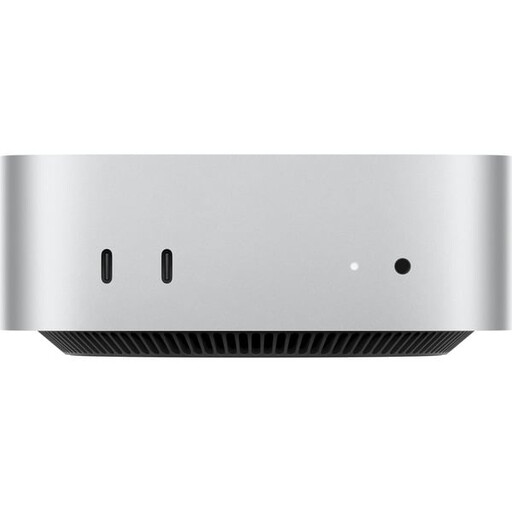
A macOS model for use with a separately chosen screen. Check that the ports are compatible with your monitor.
12-core CPU, 12-core GPU and silver finish.
 No image available
A macOS model for use with a separately chosen screen. Check the display connections for your planned setup.
18-core CPU, 20-core GPU, 2.5-Gbps Ethernet and silver finish. The stated footprint is 12,7 × 12,7 cm.
No. Adobe recommends 16 GB or more for Photoshop 27.x and later; that isn’t a general minimum requirement for designing landing pages in a browser. Large Figma files can also run into memory limits specific to the application.
Compare the VESA specification and mounting accessories for the exact PC with your monitor. Also allow space and access for the power supply and cables. MSI lists VESA 100 × 100 mm for the Cubi NUC 1M range.
Check how much memory the file is using and, if necessary, reduce or split up its contents. Simply adding more physical RAM won’t necessarily remove the per-browser-tab memory limit described by Figma.