
Lieferung heute & morgen

Qualitätsgarantie

Willkommens-Angebote freischalten: KOSTENLOSE Lieferung | Bis zu 80 % RABATT | Kostenlose 30-Tage-JoyPlus-Testphase
App herunterladen
A spontaneous movie night in the bedroom, your favourite series projected onto the ceiling, or a small-scale presentation – a mini projector with Wi-Fi promises flexible, large-screen entertainment. However, the market is crowded, and many devices don't live up to their advertising claims. Before you make a purchasing decision, it's crucial to understand the common pitfalls that often lead to disappointment and unnecessary expenses.
As your Joybuy Product Recommendation Officer, I'll help you navigate the marketing noise and identify the features that truly matter for a satisfying experience.
Many compact projectors entice customers with impressive specifications, but these often hide technical shortcomings that severely limit their everyday usability.
To avoid a bad purchase, you should focus on objective technical parameters that ensure smooth performance.
The only reliable metric for image brightness is ANSI lumens. This standardised measurement indicates how bright the projected image actually appears on the screen. For use in dimmed living rooms or bedrooms, a value between 200 and 500 ANSI lumens is generally sufficient to produce a clear and vibrant image. Ignore all other brightness specifications.
For smooth streaming of services like Netflix or YouTube in HD quality, a modern wireless connection is essential.
A projector with Android OS transforms the device into a standalone media hub. You can install apps directly from an app store and don't need an external source device like a laptop or streaming stick. Look for a recent Android version (e.g., Android 11) to ensure broad app compatibility.
Another feature crucial for user-friendliness is automatic keystone correction. This function automatically aligns the image vertically when the projector is placed at an angle to the wall. This saves time and makes setup, especially for ceiling projection, hassle-free.
Based on the criteria above, it's possible to identify devices that are well-suited for modern use cases, such as flexible streaming throughout the house.
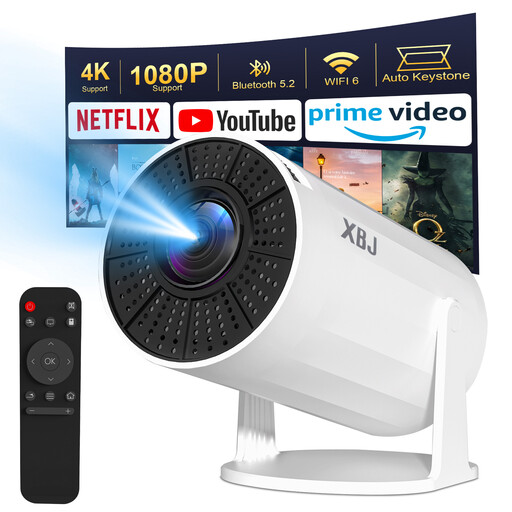
Why This Fits Their Persona: Thanks to its integrated Android 11 system and 180° rotating stand, this model is ideal for streaming directly onto the bedroom ceiling without any extra devices. The small projector is quick to set up and ready to use.
It specifies a brightness of 200 ANSI lumens, uses Wi-Fi 6 for a stable connection, and features automatic vertical keystone correction, which solves the most common problems from the outset.
Integrated Android 11 for direct app access; the rotating stand allows for effortless ceiling projection. Supports decoding of 1080p projector content.
We have compiled a complete, real-time list of products that fully satisfy these strict selection criteria and UK safety regulations.
For use in indoor spaces that can be darkened (e.g., living rooms or bedrooms), a value of 200 to 500 ANSI lumens is generally sufficient for a vibrant and clearly visible image. For use in daylight or brighter environments, significantly higher values are required, which are typically only achieved by larger and more expensive home cinema projectors.
That depends on the operating system and the manufacturer's licensing agreements. A projector with Android provides the technical foundation, but not all devices are officially certified for apps like Netflix. Models with recent Android versions and direct access to the Google Play Store offer the best chances here. When in doubt, an external streaming stick (e.g., Amazon Fire TV Stick) can always be used via the HDMI port.
Most modern mini projectors use an LED light source instead of a traditional projector lamp. These LED units have a very long lifespan, often stated by manufacturers as 20,000 to 30,000 hours. With four hours of daily use, this equates to a lifespan of over 13 years. Therefore, the lamp generally does not need to be replaced.