
Lieferung heute & morgen

Qualitätsgarantie

Willkommens-Angebote freischalten: KOSTENLOSE Lieferung | Bis zu 80 % RABATT | Kostenlose 30-Tage-JoyPlus-Testphase
App herunterladen
A mini sewing machine for beginners can be useful at home for hemming, small repairs and creative DIY projects. Many models look similar at first glance, but differ considerably in terms of operation, power supply and stitch functions. If you focus only on compact dimensions or a high number of stitch patterns, you may overlook important details.
This buying guide explains which features matter to sewing beginners, hobby sewers, families and craft enthusiasts, and which product profiles suit different requirements.
The specification “12 stitch patterns” sounds comprehensive. However, what matters is which patterns are actually included and whether the machine also supports reverse sewing. A reverse function helps secure the beginning and end of a seam. Without it, threads often have to be sewn in by hand.
Buyers should also check whether the stitch width and stitch length are fixed or adjustable. On basic mini models, these settings are sometimes preset. This can make the machine easier to operate, but limits adjustment for different fabrics.
A small electric sewing machine is designed for lightweight to medium-weight fabrics. Cotton, linen, thin blended fabrics and doll’s clothing are typical applications. Several layers of denim, very stretchy fabrics or thick upholstery fabrics, on the other hand, may require greater needle-piercing power and a more robust feed mechanism.
Specifications such as “suitable for denim” should therefore be considered in the context of the intended use. A model may be sufficient for occasional hems on lightweight denim; for regular repairs involving several thick layers, a conventional sewing machine may be more suitable.
A battery-powered sewing machine does not depend on a socket and can be used on the go or during group craft projects. It is important to check whether batteries are included and how many are required. Some models use four AA batteries, which must be purchased separately.
The controls also vary: some machines start at the press of a button, while others additionally support a foot pedal. Having a choice between slow and fast speeds can be particularly helpful when sewing as a beginner.
For basic tasks, a mini sewing machine should be able to produce at least a straight utility stitch. Additional zigzag or decorative stitches are useful for DIY projects. A sewing machine with reverse sewing makes it easier to reinforce seams.
You should also look out for:
Integrated LED lighting can make the sewing area easier to see. However, it is no substitute for good room lighting.
A portable sewing machine should stand securely on a level, non-slip surface. An integrated carry handle, anti-slip base and clear work table are practical features. Check the dimensions before buying: a model measuring around 28 × 12 × 24 cm takes up considerably less space than a full-size household machine, but should still stand firmly on the table.
There are three common power supply options:
Always use only the power source specified by the manufacturer. With machines offering two operating modes, do not connect the adapter and use the battery option at the same time.
For beginners, the practical accessories should include at least a bobbin, needle and threading guide. Frequent sewing will require additional needles, spare bobbins and thread. A 36-piece coloured thread spool set can be useful for repairs, doll’s clothing and simple DIY projects. View the thread spool set for sewing machines.
Children should always use the machine under supervision. Needles, moving parts and the foot pedal require clear instruction. Before threading, cleaning or changing the needle, the machine must be switched off and disconnected from the power supply.
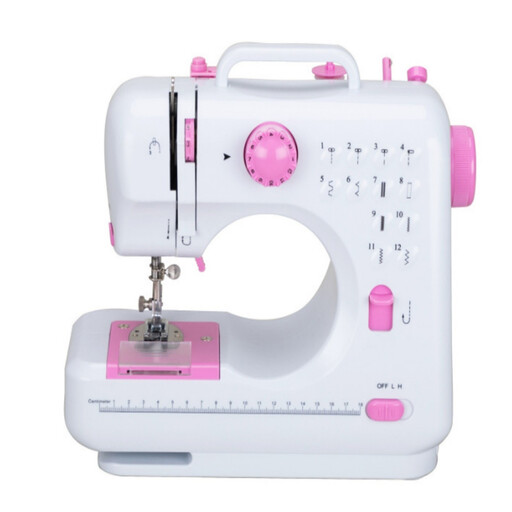
Why this product suits the profile: According to the product description, this compact model offers twelve integrated stitch patterns, two speed settings, and both mains and battery operation. This makes it suitable for first sewing attempts, simple hems and small craft projects.
The product description lists specific functions rather than focusing solely on its compact design: LED light, thread cutter, anti-slip base and two speed settings.
12 stitch patterns, dual power supply and button-operated speed selection.

Why this product suits the profile: According to the product information, this model is aimed at users who want reverse sewing, LED lighting, a thread cutter and two operating methods alongside multiple stitch patterns.
The reverse function and dual-thread construction address two common weaknesses of basic machines: unsecured seam ends and unclear stitch guidance.
12 integrated patterns, reverse sewing, foot pedal or button operation, plus adapter and battery operation.

Why this product suits the profile: According to the product description, this compact model offers mains and battery operation, a foot pedal, and slow and fast speed settings for basic repairs and sewing on the go.
The product information explicitly states that it has a fixed stitch and no reverse function. This makes it easier to assess its range of use realistically before buying.
Foot pedal, two speed settings, battery operation with four AA batteries and marked threading direction.
For repairing clothing, making simple alterations and hemming, a machine with reverse sewing and several utility stitches is a sensible choice. For doll’s clothing, decorations or lightweight fabrics, a smaller machine with simple button controls may be sufficient.
Parents who want to sew with their children should look for a low speed setting, easy-to-understand controls and a safe working environment. A sewing machine for children should not be used without supervision. For regular projects involving multiple layers of fabric, the needle type, fabric feed and motor power are more important than having the smallest possible housing.
We have put together a complete, regularly updated list of products that fully meet these strict selection criteria and the safety regulations applicable in the EU.
Models with a printed threading guide, automatic bobbin holder and just a few controls make it easier to get started. Read the instructions before first use and practise on a scrap of fabric. This allows you to check the thread tension, needle position and speed.
Its service life depends on fabric thickness, care, frequency of use and correct operation. A mini machine is designed for basic household and craft tasks. Regular cleaning, suitable needles and avoiding fabric layers that are too thick can help protect the mechanical components.
Battery operation involves ongoing costs for replacement AA batteries. For longer sewing sessions, mains operation is usually more practical, provided a suitable adapter is available. The battery option is particularly suitable for short repairs, mobile use or projects in places without a socket.