
Lieferung heute & morgen

Qualitätsgarantie

Willkommens-Angebote freischalten: KOSTENLOSE Lieferung | Bis zu 80 % RABATT | Kostenlose 30-Tage-JoyPlus-Testphase
App herunterladen
The challenge with cyanoacrylate adhesives, commonly known as super glue, often isn't their bonding strength but their shelf life after opening. The curing process is initiated by humidity in the air. Once a tube is opened, the remaining adhesive inside begins to slowly polymerise, which frequently leads to a clogged nozzle or the entire contents becoming unusable before the next use. Super Glue Mini tubes present an engineered solution to this problem by portioning the adhesive into small, individually sealed units. This ensures that fresh, flowable adhesive is available for every application.
Selecting the right super glue depends on two primary factors: the consistency of the adhesive and the materials to be bonded. The wrong choice can lead to inadequate adhesion or a messy bond line.
The viscosity of the adhesive determines its flow properties and, consequently, its suitability for different applications.
Liquid Super Glue: This variant has a very low viscosity, similar to water. Its key advantage is its capillary action. The adhesive can independently penetrate the finest cracks and gaps, resulting in an inconspicuous and extensive bond on smooth, precisely fitting surfaces. It is particularly suitable for materials like hard plastic, metal, and rubber, where the parts to be joined fit together exactly.
Gel Super Glue: Gel adhesives are thixotropic, meaning they become more fluid under pressure but retain their gel-like consistency at rest. This makes them drip-free and ideal for working on vertical surfaces or overhead. They can also fill small gaps and unevenness to a certain extent. This makes them the preferred choice for porous materials like ceramic or wood, as well as for joints that are not perfectly flat.
Not every super glue adheres equally well to every material.
Bonding Plastic: Most super glues work well on common plastics such as ABS, PVC, acrylic (PMMA), and polystyrene. However, for low-surface-energy plastics like polyethylene (PE) and polypropylene (PP), often used for bottles or food containers, adhesion is often insufficient without a special primer.
Bonding Ceramics: For broken porcelain or ceramics, a gel super glue is often the better choice. It fills the material's microscopic pores and bridges the often slightly irregular break line, resulting in a more stable bond.
Water-Resistant Super Glue: Some cyanoacrylate formulations are classified as water-resistant or even dishwasher-safe. This property is crucial when repairing items that regularly come into contact with water, such as mugs, dishes, or bathroom accessories. The exact resistance can be found in the manufacturer's technical data sheets.
Based on technical specifications and application benefits, we have analysed two products for precision repairs.
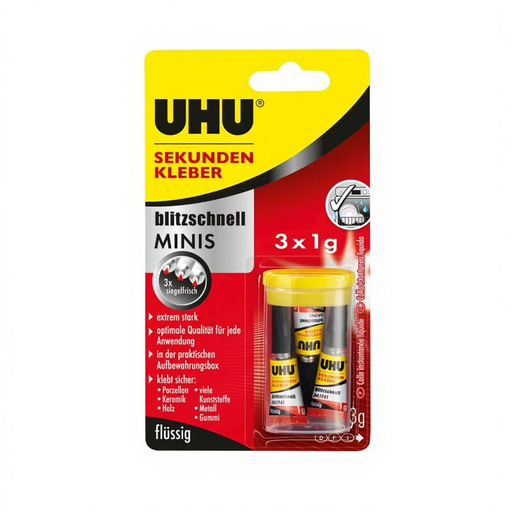
Why We Recommend This Product
This product addresses the core problem of drying out through its packaging in three separate 1-gram tubes. The liquid formulation is optimised for specific repair tasks where maximum penetration depth and an invisible bond line are critical. The included storage box is a practical detail that simplifies the organisation of the small tubes.
Advantages (Pros)
Who It's For
Users who need to bond precisely fitting, non-porous parts made of materials like hard plastic, metal, or rubber. Ideal for repairs where the bond line should remain as inconspicuous as possible.
View Product: UHU Super Glue Mini Liquid 3 x 1g
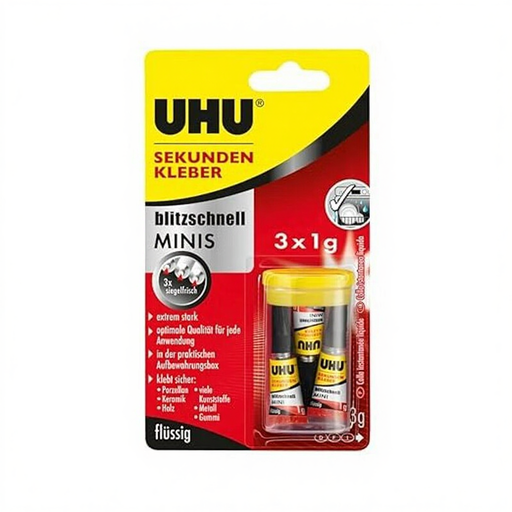
Why We Recommend This Product
The gel formulation of this adhesive offers controlled, drip-free application. This is a decisive advantage when working on vertical surfaces or with materials where the adhesive must not run. The 3-pack format also maximises the product's usability.
Advantages (Pros)
Who It's For
Individuals who want to bond ceramics or work on objects where the adhesive must not run. It is the first choice for repairs on vertical surfaces.
View Product: UHU Super Glue Gel Ultra Fast Minis 3x1g
UHU super glue in mini tubes covers a wide range of everyday repairs. However, for larger projects, structural bonds, or special material combinations, other types of adhesives such as 2-part epoxy adhesives, wood glues, or special plastic adhesives may be necessary. These often offer higher final strength or are better suited for flexible materials.
You can find a broader selection of adhesives for various applications in our Adhesives category.
1. What is the shelf life of super glue after opening? Once a tube is opened, its contents come into contact with air moisture, which initiates the curing process. The shelf life is therefore limited, often lasting only a few weeks to months, depending on storage and how well it's sealed. Super Glue Mini tubes bypass this problem, as each unit remains sealed until use. Unopened tubes can last for several years if stored in a cool, dry place.
2. Can you use super glue to bond any type of plastic? No. Cyanoacrylate adhesives bond excellently to many common plastics like polystyrene (PS), acrylonitrile butadiene styrene (ABS), and polyvinyl chloride (PVC). However, on plastics with a waxy, oily surface, such as polyethylene (PE) and polypropylene (PP), the adhesion is very poor. For a durable bond on these materials, a special primer is usually required to increase the surface energy of the plastic.
3. What is the technical difference between liquid and gel super glue? The main difference lies in the viscosity and the resulting application behaviour. Liquid super glue is very thin and uses capillary action to creep into fine gaps, making it ideal for smooth, precisely fitting surfaces. Gel super glue is thick, does not drip, and can fill small irregularities. It is therefore better suited for porous materials, gap-filling bonds, and work on vertical surfaces.