
Lieferung heute & morgen

Qualitätsgarantie

Willkommens-Angebote freischalten: KOSTENLOSE Lieferung | Bis zu 80 % RABATT | Kostenlose 30-Tage-JoyPlus-Testphase
App herunterladen
A mini trampoline with a support bar can take up very little space in the living room, hobby room or children’s bedroom. Even so, models differ significantly in weight capacity, spring elements, noise levels and storage. Anyone who only focuses on the low price or a flashy product description will quickly overlook important details.
These three buying misconceptions are particularly common:
The maximum user weight is the key selection criterion. For a children’s trampoline, a model with 25 kg may be sufficient. Adults and fitness beginners, on the other hand, should choose a fitness trampoline for home use with enough headroom.
Use these categories as a guide:
The weight capacity generally applies to one person. Even with a model that has a higher total load, several people should not jump on it at the same time.
A rebounder trampoline works either with elastic resistance bands or with steel springs. Resistance bands can reduce noise levels on an indoor trampoline. This is particularly relevant in rented flats or when using it early in the morning or late in the evening. However, you shouldn’t expect a completely silent trampoline: body noise, the floor and the intensity of movement also affect the volume.
Steel springs offer a different rebound feel and are used in several fitness models. Here, make sure there is full spring coverage, a taut jumping mat and regular checks for wear. With both systems, damaged bands, springs or mats must be replaced before the next use.
The jumping surface must suit the user’s height and training style. A diameter of 36 inches corresponds to approximately 91.6 cm, while 40 and 48 inches are roughly 101.6 cm and 121.9 cm respectively. Larger models need more floor space but also offer more room to move.
Before setting it up, you should:
With a trampoline with an adjustable handle, the handle height should match the user’s size. Adult supervision is required for children. Somersaults and risky jumps are not intended for the indoor models mentioned here.
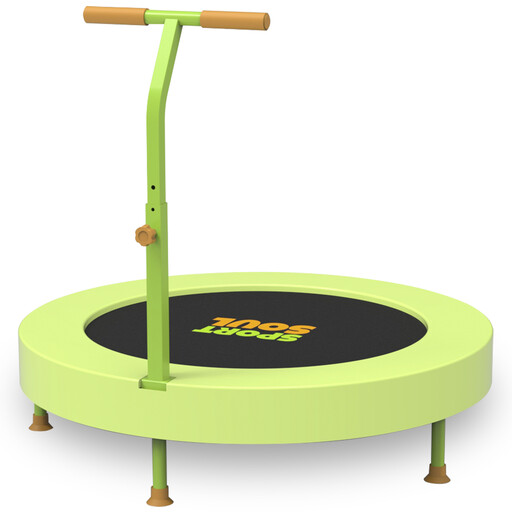
Why this product fits the profile: The 36-inch model is designed for children and light users with a maximum weight capacity of 25 kg. The T-shaped, adjustable support bar helps ensure controlled use in a home environment.
The weight limit is clearly stated as 25 kg. The model also uses 24 elastic resistance bands instead of steel springs and has an integrated foam cover.
Foldable frame, pre-assembled jumping mat and 24 bands; dimensions of approximately 91.6 × 91.6 cm.

Why this product fits the profile: This foldable mini trampoline is aimed at adults and fitness beginners who prefer a larger jumping surface and an adjustable support bar for home workouts.
The construction is rated for a maximum of 70 kg. Pre-assembled springs, mat and cover reduce assembly time; the spring cover sits over the jumping system.
Folding function, 36 steel springs, integrated foam cover and compliance with standards EN ISO 20957-1, GB 17498.1-2008 and ASTM F2276-10(2015).
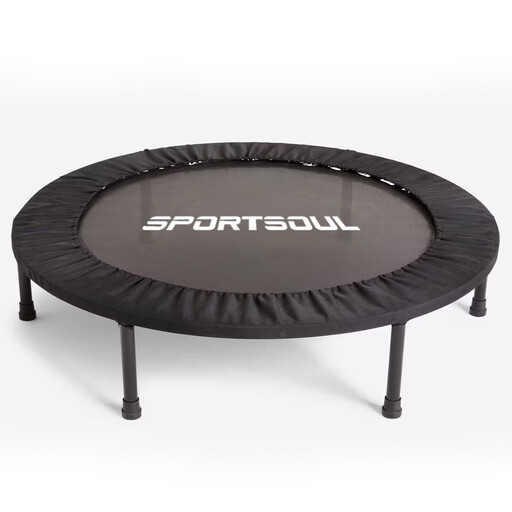
Why this product fits the profile: This model is designed for a maximum user weight of 100 kg and is suitable for adults who prefer a space-saving indoor trampoline without a support bar.
The maximum weight capacity is explicitly stated as 100 kg. Additionally, the feet have non-slip, noise-reducing covers.
36 steel springs, foldable storage, no assembly required according to the product description and stated compliance with EN ISO 20957-1.
Why this product fits the profile: With a stated weight capacity of 80 kg, it offers an alternative for adults looking for a foldable fitness trampoline with a support bar and a larger standing area.
The 80 kg limit clearly distinguishes its intended use from a children’s trampoline. The pre-assembled components make setup easier, but do not replace checking all connections.
48-inch version, 40 steel springs, integrated foam cover and adjustable support bar.
We’ve put together a complete, regularly updated list of products that fully meet these strict selection criteria and the safety regulations in force in the EU.
With the selected models, key components are already pre-assembled. In practice, this usually means: unfold the frame, attach the feet or support bar, and check all connections. Before first use, the trampoline should be placed on a level surface. A non-slip mat can protect the floor, but must not compromise stability.
A quiet trampoline with elastic bands can reduce operating noise. With steel springs, covers and noise-reducing foot caps help limit the volume in the room. After each use, check the mat, frame, springs or bands and foam cover for cracks, looseness and unusual deformation. Clean with a soft, slightly damp cloth and a mild detergent. Store the device in a dry, preferably sheltered place.
In addition to the diameter of the jumping surface, you need a safety distance from furniture and walls, as well as enough headroom. A 36-inch model measures approximately 91.6 cm, a 48-inch model approximately 121.9 cm. The exact setup and folded dimensions can be found in the respective product details.
The lifespan depends on the intensity of use, body weight, storage and care. Before each use, check all load-bearing and elastic parts. If there is visible damage to the mat, springs, bands, frame or padding, the trampoline must not be used further.
In operation, a mechanical mini trampoline normally requires no electricity. Running costs can arise from replacement parts such as springs, elastic bands, feet or a new jumping mat. Therefore, before buying, check whether these components are available from the respective supplier.