For occasional close-ups without changing lenses, a compact camera with a dedicated close-up mode may be enough. If you want wood details to fill the frame and the option to choose a different lens later, an interchangeable-lens camera with a suitable, compatible lens offers more room to expand. For a model that’s sharp from front to back, focus bracketing on a stable setup may be useful, while even lighting and a tailored white balance can help keep wood colours consistent. Manufacturer specifications tell you about a camera’s features, but not how it will capture your own model house.
Who photographs miniature wooden houses?
Model makers photographing entire scenes
If you want the façade and roof to appear sharp together, framing, depth of field and, where necessary, focus bracketing matter more than burst speed. Canon Academy explains that the area in focus becomes smaller as the camera gets closer to the subject.
Detail photographers
For wood grain, shingles or small windows, the close-up capability of the camera and lens you’ll actually use needs to suit the framing you want. Canon Deutschland, Sony Deutschland and Nikon Deutschland list different magnification ratios for some of their macro lenses.
Photographers working with changing artificial light
If you want wood colours to look consistent across several shots, it’s important to control the lighting and set the white balance to suit the light source. Nikon Deutschland recommends checking the white balance and switching off any lights you don’t need.
What should you look for when choosing?
Compact camera with a close-up mode
A good fit if: you want to photograph individual details or smaller scenes without changing lenses. Check the framing and space for lighting on the specific model you’re considering.
The trade-off: you can’t replace the fixed lens with a different macro lens later, and working very close to your subject can make lighting more difficult.
Interchangeable-lens camera with a standard zoom
A good fit if: you mainly want to capture whole houses and different views, with the option to expand your system later. Canon lists focus bracketing as a feature of the EOS R50.
The trade-off: a kit zoom isn’t automatically suitable for filling the frame with tiny details. Check the minimum focusing distance and magnification ratio of the included lens.
Interchangeable-lens camera with a macro lens
A good fit if: you want wood grain, shingles or windows to fill a large part of the frame. Choose a lens with a mount and close-up capability that suit your camera and the framing you want.
The trade-off: you’ll need to choose a compatible camera and macro lens. Focus bracketing requires a stable setup and may mean combining the shots afterwards.
| What you want to do |
What to check before buying |
Who is this important to? |
| Keep the whole house in focus |
Check whether the specific camera model offers focus bracketing or focus stacking; plan to use a stable setup for focus bracketing. |
If I want to keep the façade and roof sharp together, I need a suitable way to capture several focus planes. Around 36 % of consumers put sharpness from front to back first. |
| Make small architectural details look larger |
Check the magnification ratio, lens mount and the lens actually included. |
If I’m taking close-ups of grain, roof shingles or window frames, the lens needs to give me the framing I want. Around 29 % of consumers prioritise magnified architectural details. |
| Keep wood colours consistent |
Check the white balance on your model and keep the lighting as consistent as possible across a series of shots. Nikon Deutschland recommends switching off any lights you don’t need. |
If I’m comparing several shots taken in artificial light, I want to avoid colour shifts caused by changing lighting. Around 21 % of consumers put consistent wood colours first. |
| Weigh up the complete setup |
Check what’s included and whether you’ll need a lens, a stable support, lighting and a way to combine focus-bracketed shots. |
If I want to keep things straightforward, the workflow matters as well as the camera body. Around 14 % of consumers prioritise keeping the overall setup manageable. |
Common selection mistakes
-
Assuming “macro” in the name guarantees every kind of close-up
The camera body or kit name alone won’t tell you how large small components will appear with the included lens. A standard zoom and a separately available macro lens are different products.
First decide on the framing you want, then check the magnification ratio, mount and what’s included with the specific lens.
Depending on the framing you want, you may need to buy an additional compatible lens.
-
Stopping down further and further to keep everything sharp
At short focusing distances, the area in focus remains limited; stopping down too far can increase diffraction blur. Canon Academy also highlights the limited depth of field when photographing close-up subjects.
If your model is stationary and your setup is stable, check whether focus bracketing could work for your workflow.
Taking extra shots may mean spending time combining them afterwards.
-
Confusing camera stabilisation with a stable focus-bracketing setup
When focus bracketing, you should keep the framing as consistent as possible between shots. A camera feature won’t automatically stabilise your entire tabletop setup.
Use a stable support for your camera and model, and check separately whether the camera takes individual shots or combines them in-camera.
Depending on your setup, you may need a suitable tripod or another stable support.
Key brands at a glance
Canon
The EOS R50 is documented with an RF-S kit zoom for full-scene shots; for closer shots, you could choose a separate RF lens.
- Canon lists focus bracketing for the EOS R50 and support for RF and RF-S lenses.
- The RF 35mm F1.8 Macro is a separate lens; Canon gives it a magnification ratio of 1:2. These manufacturer specifications don’t tell you how it will perform with your own model house.
OM SYSTEM
The Tough TG-7 is a compact camera with close-up modes, while the OM-5 Mark II is an interchangeable-lens camera with Focus Stacking.
- OM SYSTEM describes in-camera Focus Stacking for the TG-7 and Focus Stacking for the OM-5 Mark II.
- The M.Zuiko 60mm F2.8 Macro is a separate lens; OM SYSTEM lists a magnification ratio of 1:1. Check what’s included with the specific kit.
Sony
The ZV-E10 II is an E-mount interchangeable-lens camera. You can choose a separate close-up lens as an alternative to the kit zoom.
- The documented kit includes the E PZ 16–50 mm F3.5–5.6 OSS II. Sony also offers a separate E 30mm F3,5 Macro with a 1:1 magnification ratio for E-mount APS-C.
- There’s no evidence that the macro lens is included with the kit mentioned here. Video features don’t prove an advantage for photographing stationary models.
Nikon
The Z50II is a Z-system camera body that can be paired with a separately selected macro lens.
- Nikon lists a 20.9-megapixel DX sensor for the Z50II and a magnification ratio of 1:1 for the separate NIKKOR Z MC 50mm f/2.8.
- The lens specifications don’t demonstrate an advantage in artificial light or confirm that the lens is included with a camera kit.
PENTAX
The WG-8 is a compact camera with a fixed zoom lens and manufacturer-described macro lighting.
- PENTAX describes a ring light for macro photography that can be used when photographing small subjects.
- Check whether the lighting suits the effect you want with your own model house. Its rugged construction isn’t a proven photographic advantage for a dry tabletop setup.
Related products at Joybuy
Joybuy cameras related to this topic; check whether the features listed suit your subject and shooting distance.
 No image available
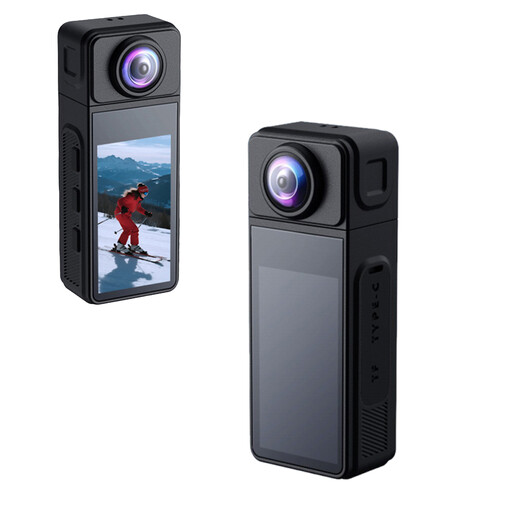
NAXSIR 2K mini action camera with 270° rotating wide-angle lens, magnetic mount and electronic image stabilisation
The described one-click photo function and tripod socket may be useful for individual shots set up on a tripod. Before buying, check that the angle of view and close-focus capability suit your model house.
The product title lists a 270° rotating wide-angle lens, magnetic mount and electronic image stabilisation.
The description lists a 1/4-inch tripod socket. Check that the shooting distance and framing you want are suitable for your miniature.
View at Joybuy
Frequently asked questions
Do I definitely need a macro lens to photograph the whole model house?
No. What matters is whether the lens you’re actually using can give you the framing you want from your shooting distance. For very small details that need to fill the frame, check the stated magnification ratio of a suitable lens; 1:1 and 1:2 are different specifications.
How do I start a focus-bracketed series with a stationary model?
Set up your camera and model securely, and keep the framing as consistent as possible between shots. Check whether your specific camera model takes individual images at different focus points or combines them itself; OM SYSTEM describes a Focus Stacking sub-mode for the TG-7.
What can I do if the wood looks too warm or different from shot to shot under household lights?
Keep the light sources you use as consistent as possible and adjust the white balance to suit the lighting. For indoor lighting, Nikon Deutschland recommends checking the white balance and switching off any lights you don’t need.
Who is responsible if there’s a fault, and what applies to online cancellations?
When you buy from a trader as a consumer, your statutory rights relating to a fault are against the seller, not automatically the manufacturer; Verbraucherzentrale gives two years as the general period. For an online distance purchase, information from the European Union states that you generally have a 14-day right to cancel from the date of delivery, although exceptions apply. A voluntary manufacturer’s warranty is separate.


