Which cameras are right for different types of photographer?

Detail photographers

If you want brushstrokes, faces or surfaces on tiny figures to fill the frame, magnification matters, as does having room to light your subject. Canon Germany explains magnification; details about the lens and working distance help you assess a specific combination.

Diorama photographers

When photographing a whole figure or scene on a table, consider which areas you want to keep in focus. The Canon Academy describes how to set up a stable tripod for focus stacking with stationary subjects.

Beginners looking for a simple set-up

If you want to get started with minimal equipment, check whether the supplied lens or the compact camera’s close-up mode will be enough for the shots you have in mind. A standard zoom isn’t automatically a macro lens.

What should you look for when buying?

Compact camera with close-up mode

A good fit if: You want to take close-ups of figures with a compact camera, without changing lenses. The OM SYSTEM TG-7 has a Microscope mode; Ricoh specifies a digital microscope function from 1 cm for the PENTAX WG-90.

Bear in mind: A short shooting distance doesn’t guarantee a 1:1 magnification ratio or leave enough room for light from the side.

System camera with standard zoom

A good fit if: You want to start by photographing whole figures or groups with different framing, and may add a macro lens later. The documented Canon EOS R50 and Nikon Z50II kits each include a standard zoom lens.

Bear in mind: The kit specifications don’t confirm 1:1 macro capability. Check the lens and what’s included with the specific offer.

System camera with macro lens

A good fit if: You want to magnify tiny details or choose a lens and framing to suit your subject. OM SYSTEM specifies a 1:1 magnification ratio for the M.Zuiko Digital ED 60mm F2.8 Macro; Sony specifies the same ratio for the SEL30M35.

Bear in mind: Assess the camera body and lens separately. For close-up photography with the SEL30M35, Sony specifies a distance of 2.4 cm between the front of the lens and the subject. This can make lighting more difficult on a small table.

What you need What to check before buying Who is this important to?
Magnify tiny details Check the magnification ratio of the specific lens or the close-up mode, and allow for the available working distance. Canon Germany explains that 1:1 reproduces small subjects at life size on the sensor. If I want to show painted details up close, I need both suitable magnification and room for lighting. Around 25% of consumers put detail magnification first.
Keep several depth planes in focus Check whether the specific combination supports focus stacking and how the images are combined. The Canon Academy describes using a stable tripod for aligned shots of a stationary subject. If I want a figure to be sharp from front to back, I need a stable set-up and may need to take several shots. Around 25% of consumers prioritise sharpness throughout.
Fit the camera and lighting on the table Distinguish between working distance and minimum focusing distance, and plan a test set-up with the figure, camera and lights. Sony explains these distances separately. If I don’t have much room on my table, the camera, figure and lights all need to fit together. Around 19% of consumers pay particular attention to a practical set-up.
Keep painted colours consistent Check the white balance and desired file format for the specific model, and use lighting that’s as even as possible. Nikon Germany recommends setting the white balance before shooting. When I photograph painted figures, I want their colours to look consistent under the same lighting. Around 19% of consumers prioritise colour reproduction.
Get started easily, with everything you need Check which camera, lens and charging accessories are included. A standard zoom in a kit isn’t automatically a macro lens. If I want to get started without having to look for extra accessories, I need to know exactly what’s in the set. Around 12% of consumers prioritise a straightforward start.

Which buying mistakes should you avoid?

  • Assuming the kit’s standard zoom is a macro lens

    The documented Canon EOS R50 and Nikon Z50II kits include standard zoom lenses. The macro specifications refer to other lenses, not automatically to what’s in the kit.

    Compare the full lens name in the offer with the magnification ratio you need for your subjects.

    For greater magnification of tiny details, you may need an additional macro lens that’s compatible with your camera system.

  • Confusing minimum focusing distance with the space in front of the lens

    Sony specifies a minimum focusing distance of 9.5 cm for the SEL30M35 and a distance of 2.4 cm between the front of the lens and the subject for close-up photography. The available working distance affects where you can position lights on a small table.

    Check the working distance and lighting set-up together, rather than comparing only the shortest focusing distance.

  • Assuming focus bracketing creates a finished, combined image

    Taking a series of focus shots and combining them are two different steps. For aligned shots of small, stationary models, the Canon Academy recommends using a tripod; OM SYSTEM lists Focus Stacking for the OM-5 Mark II.

    Check both the shooting function and how to create the finished image with your camera body and lens.

    Taking and processing the images can take extra time.

  • Confusing a manufacturer’s guarantee with your statutory rights

    A voluntary guarantee doesn’t replace your statutory rights if you buy faulty goods from a trader. The EU consumer portal Your Europe states that these purchases come with a minimum two-year legal guarantee from the date you receive the goods.

    Check the seller and guarantee terms separately. If something is faulty, your statutory rights against the seller are separate from the guarantee.

Which brands are worth considering for miniature photography?

The examples below refer to specific cameras and lenses. Suitability depends on the combination you choose and the set-up you have in mind.

OM SYSTEM

The TG-7 is a compact camera option with a Microscope mode; the OM-5 Mark II is a camera body with a dedicated Focus Stacking function.

  • OM SYSTEM specifies a 1:1 magnification ratio for the M.Zuiko Digital ED 60mm F2.8 Macro, sold separately.
  • Check the lens suitability and camera body functions separately for the combination you plan to use.

Canon

The EOS R50 kit with the RF-S 18–45 mm lens is a good starting point for varying the framing of whole figures.

  • Canon Germany specifies a 1:2 magnification ratio for the RF 35mm F1.8 MACRO IS STM, available separately.
  • This macro specification doesn’t apply to the kit’s standard zoom. For deep subjects, you’ll also need to consider depth of field at close range.

PENTAX / Ricoh Imaging

The WG-90 is a compact camera option for close-up shots without changing lenses.

  • Ricoh Imaging Europe specifies a digital microscope function from 1 cm and six macro LEDs for this model.
  • The close-up distance and LEDs alone don’t guarantee a 1:1 magnification ratio or colour reproduction that suits your lighting set-up.

Nikon

The Z50II kit with the Z DX 16–50 mm lens is a system camera option for starting out with flexible framing.

  • Nikon specifies a maximum magnification ratio of 1:1.5 on DX for the NIKKOR Z DX MC 35mm f/1.7, sold separately.
  • The kit we checked includes the standard zoom; Nikon notes that a charger isn’t included.

Sony

The APS-C E-mount system offers the α6700 camera body and the SEL30M35 macro lens, available separately.

  • Sony specifies a 1:1 magnification ratio for the SEL30M35.
  • For close-up photography, Sony specifies a distance of 2.4 cm between the front of the lens and the subject, so make sure you plan where to place your lights.

Cameras available at Joybuy

Joybuy’s camera selection for a compact tabletop set-up. Before buying, check that the close-up capability and framing suit your miniature subjects.
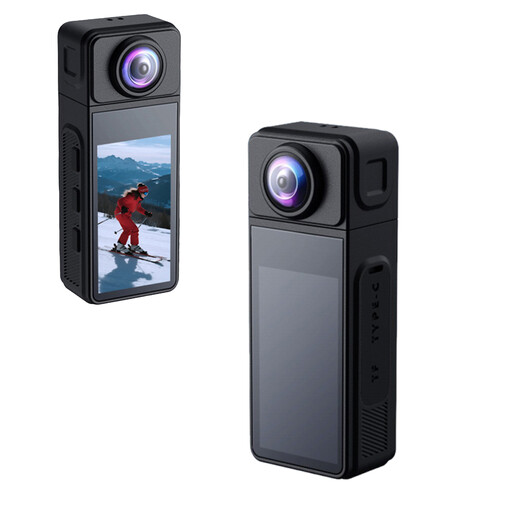
NAXSIR 2K Mini Action Camera with 270° Rotatable Wide-angle Lens

NAXSIR 2K Mini Action Camera, 270° Rotatable Wide-angle Lens

Its light weight and flexible lens positioning could be useful for a compact tabletop set-up. Before buying, check that its close-focusing capability and framing suit your figures.

The product description lists a weight of 35 g, a magnetic housing, a 1/4-inch thread, one-click photo capture and electronic image stabilisation.

Joybuy

Frequently asked questions

Does a minimum focusing distance of 1 cm automatically mean 1:1 macro?

No. The minimum focusing distance tells you how close you can get, while the magnification ratio describes how large the subject appears on the sensor. For tiny details, compare the stated magnification ratio and the available working distance for the specific lens, or check the compact camera’s close-up mode.

How can I get a miniature figure sharp from front to back?

If the figure is stationary, you can set up the camera on a stable surface and combine several aligned shots taken at different focus points. Check whether your specific camera and lens combination supports focus stacking, and how the images can then be combined.

How can I stop painted figures looking different under table lamps?

Keep the lighting as even as possible, set a suitable white balance and check it with a test shot. If the lighting changes, check the white balance again.

What else should I budget for besides the camera body?

First, check which lens and charging accessories are actually included. You may need a separate macro lens for highly magnified details. For focus stacking a stationary figure, the Canon Academy recommends using a tripod and combining the images.

What rights do I have when buying a camera from a trader in Germany?

For a qualifying online distance sale, you generally have 14 days from delivery to cancel, although exceptions and conditions on return costs apply. For faulty goods bought from a trader, the EU consumer portal Your Europe states that you’re entitled to a minimum two-year legal guarantee from the date you receive them. A voluntary manufacturer’s guarantee is separate; the same legal guarantee rules don’t apply in the same way to purchases from private individuals.