Families looking for snacks on the go
You want to take a small snack along for outings or childcare, while checking the age guidance and ingredients for the specific variety.


Mini rice cakes can be an occasional snack to take on the go once your baby is ready for solids, can sit upright while eating and is supervised. Check the age guidance and ingredients for the specific variety: a handy pack doesn’t make salted or very sweet rice cakes suitable for a baby starting solids. Rice products should not replace a varied diet of complementary foods, either.
You want to take a small snack along for outings or childcare, while checking the age guidance and ingredients for the specific variety.
You want to avoid added salt and a very sweet taste in foods for your baby. So you compare the ingredients list and nutritional information, rather than relying on the front of the pack alone.
You’re looking for an occasional snack, but don’t want to keep offering rice products. The Verbraucherzentrale (German consumer advice centre) points out that rice products can contain inorganic arsenic.
If you’re considering rice cakes as a snack for a baby who’s ready for solids, start by checking the age guidance and ingredients. Next, consider how easy the format will be to take with you. If you serve snacks regularly, variety matters too.
| What to consider | What to check | Who it matters to |
|---|---|---|
| Format and age guidance | Compare the size of the rice cakes, pack size and age guidance for the specific variety. Your baby’s readiness for solids is also essential. | I want to take a small portion with me when I’m out, without assuming that the age guidance means my baby is personally ready to eat it. This is a priority for about 42% of consumers. |
| Ingredients and sweetness | Check the ingredients list and nutritional information for added salt, sources of sugar and coatings. If your baby has allergies, check the allergen and may-contain information too. | When choosing a snack for a baby starting solids, I want to find a variety with no added salt and that isn’t very sweet. This is the main concern for around 33% of consumers. |
| Variety instead of always choosing rice | Plan to offer rice cakes as an occasional snack and check the ingredients and age guidance for alternatives too. | I don’t want to reach for rice at every snack time and am looking for suitable alternatives. This is the top priority for around 25% of consumers. |
Rice isn’t a gluten-containing grain. However, other ingredients and may-contain information can vary between varieties. According to the European Commission, gluten-containing cereals used as ingredients must be clearly labelled on food sold in the EU.
If your baby has a relevant allergy or coeliac disease, check the ingredients list, allergen labelling and, where applicable, the specific pack’s explicit gluten-free label.
The German Federal Centre for Nutrition explains that milk often remains the main source of nutrients during the second half of a baby’s first year. A rice cake is no substitute for a varied meal of complementary foods.
If needed, offer rice cakes as an occasional snack alongside a varied range of age-appropriate foods.
The Verbraucherzentrale points out that rice and rice products can contain inorganic arsenic. Switching between rice cake brands doesn’t change the type of grain.
Vary your choice of suitable grains and snacks too, rather than making rice cakes a daily staple.
Salted or coated rice cakes can have a different recipe from plain varieties. The Netzwerk Gesund ins Leben (Healthy Start – Young Family Network) recommends avoiding added salt and a very sweet taste in ready-made foods for babies starting solids.
Check each variety individually. Neither an organic label nor the word “natural” means you can skip checking the ingredients.
REWE’s range includes 35 g packs of Mini Apple Rice Cakes, as well as 100 g packs of gluten-free rice cakes.
EDEKA describes its 35 g Mini Apple Rice Cakes as suitable “from 8 months” and gluten-free.
ALDI SÜD stocks 50 g packs of MAMIA BIO Mini Apple Rice Cakes. For its BIO Mini Apple Rice Cakes, ALDI Nord gives the guidance “from 8 months” and “gluten-free”.
Kallo lists wholegrain rice and sea salt as ingredients in its “Organic Lightly Salted” variety and labels it gluten-free.
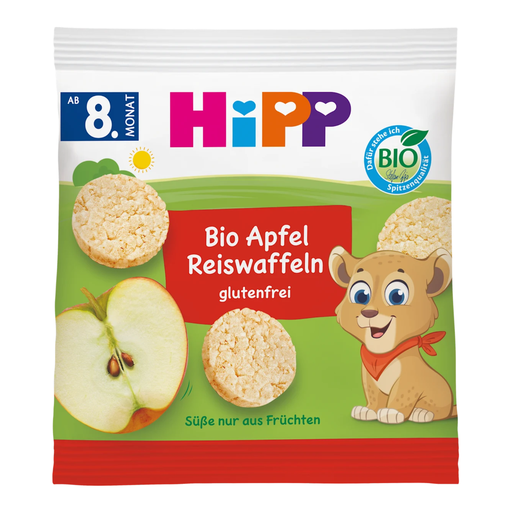
This selection features a small pack of apple rice cakes with age guidance. Check the specific listing to see whether the pack contains individually sealed portions and how easy it is to take just one portion with you.
 No image available
The 30 g pack could make a handy occasional snack to take with you, once your baby is ready for solids. The product name describes apple rice cakes and gives an age guidance of from 8 months. Check the current ingredients list and pack format before choosing. Your baby should sit upright and be supervised while eating.
What matters is whether your baby is ready for solids, not just the age guidance on the pack. The Netzwerk Gesund ins Leben describes baby-led weaning as babies picking up food themselves. Guidance such as “from 8 months” can help you choose a product, but it doesn’t replace your baby’s individual readiness for solids or the need to sit upright and be supervised while eating.
Rice cakes aren’t a good everyday choice if they reduce the variety in your baby’s diet. The Verbraucherzentrale points out that rice products can contain inorganic arsenic. So vary the grains you offer too, rather than just switching between rice cake brands.
No. The name “rice cake” doesn’t mean a product necessarily contains gluten. According to the European Commission, gluten-containing cereals used as ingredients must be clearly labelled on food sold in the EU. Check the ingredients and allergen labelling for the specific variety. Some products from EDEKA and ALDI Nord are explicitly labelled gluten-free.
Above all, check whether salt has been added or the variety tastes very sweet. The Netzwerk Gesund ins Leben recommends avoiding both in ready-made foods for babies starting solids. So check every variety for ingredients such as juice concentrate and chocolate or yoghurt coatings. If your baby has allergies, check the allergen and may-contain information too.