
Lieferung heute & morgen

Qualitätsgarantie

Willkommens-Angebote freischalten: KOSTENLOSE Lieferung | Bis zu 80 % RABATT | Kostenlose 30-Tage-JoyPlus-Testphase
App herunterladen
Mirror stickers offer a flexible, drill-free way to decorate walls and add depth to any room. However, not all products live up to their promises. Before making a decision, it's crucial to understand the common problems associated with low-quality mirror decals. This will ensure your wall decor is both aesthetically pleasing and durable.
Many buyers experience disappointment shortly after their purchase—a frustration that can be easily avoided by understanding key product features. Pay close attention to these three points:
To avoid the problems mentioned above, you should check three central features before buying. These largely determine the quality and functionality of your new mirror-effect wall decor.
Most mirror stickers are made of acrylic glass (PMMA) or, less commonly, PVC. Acrylic is generally the better choice as it is lighter, more shatterproof, and often clearer than glass. However, the decisive factor for good reflection quality is the material thickness.
A drill-free decorative mirror is only as good as its bond. The self-adhesive backing must be compatible with your wall's surface.
High-quality mirror decals always come with a protective film on the mirror side. This prevents scratches during shipping and installation. Only remove this film after the sticker is firmly attached to the wall. Thoroughly clean the wall surface of dust and grease before application to ensure optimal adhesion.
Here are some recommendations tailored to different needs and interior design styles.
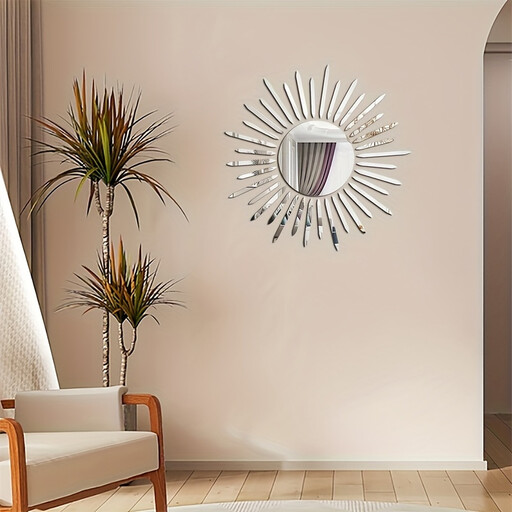
Why This Fits Their Persona: Ideal for those who see their wall as a canvas and want to make a modern, artistic statement that goes beyond a simple mirror. The design becomes the central focal point of the room.
Since the set consists of 37 individual pieces, the focus is on the overall artwork, not a perfect reflection. Minor distortions in individual elements are barely noticeable within the complex design.
Large-scale, impactful design; flexible arrangement of the pieces allows for custom layouts.
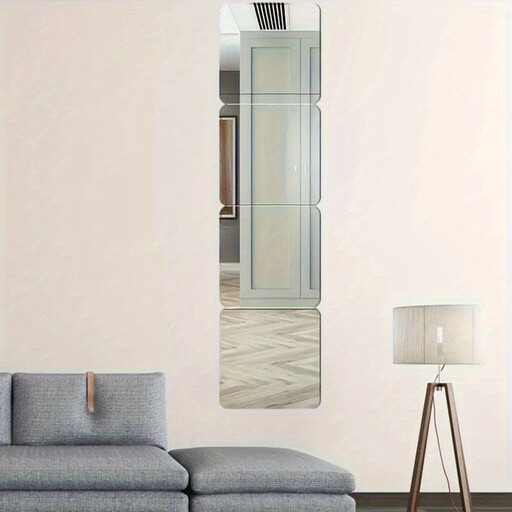
Why This Fits Their Persona: Perfect for functional use in small rooms, hallways, or on cabinet doors to create an illusion of space and light without the cost and effort of a real mirror.
The clear dimensions (20x20 cm) prevent any surprises regarding size. The tile format is less prone to large-scale distortion than a single large sticker and can better compensate for minor surface imperfections.
Modular, interlocking design; clean, functional shape for visually expanding a space.
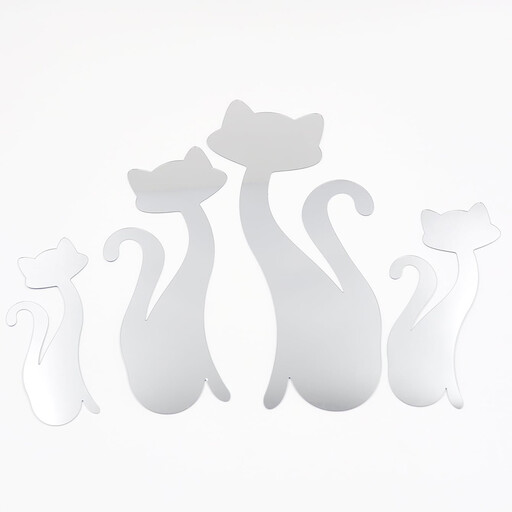
Why This Fits Their Persona: Ideal for adding a charming and personal touch to a child's room, reading nook, or hallway. The stickers serve as a delightful detail rather than a functional mirror.
With these purely decorative accents, a perfect, distortion-free reflection is not the main goal. The cute shape is the focus, which sets a different expectation for mirror quality from the outset.
Themed design (kittens); ideal for targeted, playful decoration; set of four pieces for flexible placement.
We have compiled a complete, up-to-date list of products that meet these strict selection criteria.
1. How do you remove mirror stickers without damaging the wall? To prevent damage, gently heat the sticker with a hairdryer on a low setting. The heat will soften the adhesive. Then, slowly peel the sticker off the wall at a shallow angle. Any remaining adhesive residue can often be removed with a mild cleaner or a bit of cooking oil.
2. Does an acrylic mirror reflect as well as a real glass mirror? No, an acrylic mirror typically does not achieve the perfect, distortion-free clarity of a real glass mirror. The quality of the reflection heavily depends on the material's thickness and the flatness of the surface. While the quality is often sufficient for decorative purposes and for visually enlarging a room, a glass mirror is the better choice for a makeup or shaving mirror.
3. On which surfaces do self-adhesive mirror tiles stick best? They adhere best to completely smooth, clean, and dry surfaces. This includes tiles, glass, metal, lacquered furniture, and smooth plastered walls. On rough or porous substrates like textured wallpaper, untreated wood, or concrete, adhesion is often not optimal, and the reflection may appear uneven.