For photographing folded textiles on a small table, a mirrorless camera kit with a standard zoom is a good starting point, provided the angle of view and camera height give you the framing you want and you can see the screen clearly from above. Consistent lighting and a controlled white balance are key to keeping fabric colours consistent; RAW files can give you more flexibility when editing. For seams and weave detail, check the close-focusing limits of the specific lens. Focus stacking is only an option with compatible lenses.
Who photographs folded textiles?
Shops with a range of fabric colours
If you photograph colour options for easy comparison, consistent lighting and a controlled white balance help you keep your images consistent. Canon Europe and Nikon Germany both highlight colour rendition, white balance and RAW as relevant aspects of product photography.
Flat-lay photographers with limited space
When photographing folded items on a small table, the available distance, the lens’s angle of view and how well you can see the screen all affect how easily you can control the top-down shot. Nikon Germany highlights framing as an important factor in flat-lay photography.
Photographers capturing fabric details
If you want to show the weave or seams, check how closely the lens can focus. For focus stacking, the camera and lens need to be compatible; OM SYSTEM lists the lenses that support it.
What should you look for when choosing?
First, check the framing from the camera height you’ll actually use. Then decide whether a standard zoom will cover your wider shots, or whether you’ll also need a close-up solution.
| What matters |
What to look for |
Who is it important to? |
| Consistent fabric colours |
Check whether white balance and RAW capture are available, and plan for consistent lighting. |
If you want to show several colour options consistently, a controllable colour workflow is key; around 33% of consumers in this area would prioritise fabric colours above all else. |
| Fitting the whole item in the frame |
Measure the fabric and the camera-to-subject distance available. Compare these with the kit lens’s angle of view, and check that you can see the screen from above. |
If you need to photograph the whole folded item in a confined space, pay particular attention to the angle of view and camera height; around 27% of consumers would prioritise fitting the whole item in the frame. |
| Weave and seams |
Compare the minimum focus distance and maximum magnification of the specific lens. If you plan to use focus stacking, check that the lens and camera are compatible. |
If you need to show small details clearly, close-focusing ability matters more than megapixel count alone; around 20% of consumers would prioritise fabric details above all else. |
| A repeatable workflow |
Check whether you can see the screen from your shooting position and exactly what’s included in the kit, such as the lens, charger and required memory card. |
If you photograph lots of similar items using the same set-up, you’ll need a workflow you can control easily and a kit with the right accessories; around 20% of consumers would consider this first. |
Common buying decisions
-
Comparing camera bodies by megapixel count alone
The sensor resolution doesn’t tell you how large a small fabric detail will appear when using the supplied lens.
For weave and seams, check the minimum focus distance and maximum magnification of the exact lens included in the offer.
For more powerful close-ups, you may need an additional lens designed for the job.
-
Assuming focus stacking works with every lens
On the OM-5 Mark II, focus stacking is limited to the compatible lenses listed by OM SYSTEM.
Check the full lens name against the compatibility information for the specific camera.
You may need a compatible lens that isn’t included in every kit.
-
Taking the kit contents for granted
Manufacturer accessory lists vary by kit: Canon lists a charger in the EOS R50 kit, while Nikon lists no charger for the Z50II kit VOA150K001. OM SYSTEM notes that you’ll need to buy an SD card separately for the OM-5 Mark II.
Before buying, check the contents of the exact version, as well as the power supply and memory card you’ll need.
Depending on the kit, you may need to budget for a charger or memory card separately.
Relevant brands and product ranges
Canon
The EOS R50 with RF-S 18–45 mm is an APS-C kit with a standard zoom for wider shots.
- Canon lists a 24.2 MP sensor and a fully articulated screen for the EOS R50.
- The minimum focus distance and magnification of the RF-S 18–45 mm vary with the focal length. Check the lens specifications if you want to take close-up shots.
Nikon
The Z50II kit with NIKKOR Z DX 16–50 mm VR is another DX combination suited to top-down shots.
- Nikon lists a 20.9 MP sensor, a tilting and rotating screen, and a minimum focus distance of 0.2 m for the lens.
- Nikon says the kit VOA150K001 doesn’t include a charger. digitalkamera.de’s review describes the kit as compact and notes that the Z50II doesn’t have sensor-shift stabilisation.
Sony
The α6400 ILCE6400AKB.CEC version pairs an APS-C body with the E PZ 16–50 mm OSS II.
- Sony gives the lens a 35 mm equivalent angle-of-view range of 24–75 mm and a maximum magnification of 0.215×.
- The minimum focusing distance is 0.25–0.3 m, depending on the zoom setting. These lens specifications don’t guarantee that every piece of fabric will fit in the frame at every camera height.
OM SYSTEM
The OM-5 Mark II with M.Zuiko 12–45 mm F4 PRO is a combination to consider if focus stacking is relevant to your planned use.
- OM SYSTEM lists focus stacking as a feature of the camera body and includes the 12–45 mm PRO lens among the compatible lenses.
- According to the manufacturer, a charger and SD card aren’t included with the OM-5 Mark II.
FUJIFILM
The X-S20 is an X-mount body, so you’ll need to choose a lens to suit wider shots or close-up details.
- FUJIFILM specifies a 26.1 MP sensor and 14-bit RAW for the X-S20.
- The body specifications don’t determine the angle of view or close-focusing ability; both depend on the lens you choose separately. Film simulations are creative looks, not proof of accurate fabric colours.
Joybuy products for textile photography
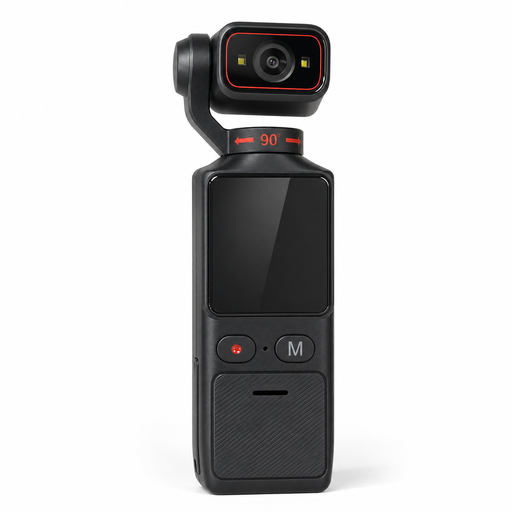
The option listed is described as a pocket camera, not a mirrorless interchangeable-lens camera. If you’re specifically looking for an interchangeable-lens system, check the product category before buying.
 No image available
4K pocket camera with electronic image stabilisation
The product name describes a pocket camera with electronic image stabilisation; it isn’t described as a mirrorless interchangeable-lens camera.
The title lists 4K, Wi-Fi, a 1.69-inch touchscreen and a 180° swivelling lens.
The product description lists adjustable white balance and exposure, as well as a 1/4-inch tripod socket. Check that this type of camera and its features suit your set-up.
View at Joybuy
Frequently asked questions
How can I check whether a lens will fit the folded textile on my table in the frame?
Measure the area you need to capture and the available distance between the camera and the fabric. Compare these measurements with the angle of view of the specific lens, then test the top-down shot. Focal length alone can’t guarantee the right framing without this information.
How can I avoid fabric colours changing between shots?
Keep your lighting and white balance as consistent as possible, and check the results using your actual fabrics. RAW files can give you more flexibility when editing, but they can’t replace careful lighting.
Do I definitely need a macro lens for seams and weave detail?
Not for every close-up. First check the minimum focus distance and maximum magnification of your current lens. If it can’t capture the detail large enough, consider a suitable close-up lens.
What should I check about power and accessories before buying?
Compare the contents of the exact kit version. A battery charger is listed for the Canon EOS R50 kit, but Nikon says the Z50II kit VOA150K001 doesn’t include one. OM SYSTEM says an SD card must be bought separately for the OM-5 Mark II.
What rights do you have when buying a camera online in Germany?
If you buy from a business as a consumer, European Union consumer information states that you generally have a legal guarantee of at least two years from the date you receive the goods. For a distance purchase, you generally have 14 days from delivery to withdraw from the contract; check the seller’s status and any applicable exceptions. These consumer rights don’t automatically apply to business purchases or purchases from a private individual.


