What to look for when buying
First, decide on your framing and shooting distance. Then you can work out whether a standard zoom will do or whether a macro lens would be a better choice. Finally, check how the lighting, sharpness and what’s included fit your plans.
| Priority |
What to check before buying |
Who it matters most to |
| Consistent paper colours |
Check the white balance and RAW support of the specific model. Keep the light source and setup as consistent as possible throughout a series. |
If you’re photographing several stars under the same light, you’ll want the paper colours to look consistent across the images. Around 25% of consumers rank this as their top priority. |
| Showing small details at a larger scale |
Compare the magnification ratio and minimum focusing distance of the compatible lens, as well as the working distance you’ll need. |
If you want folds or paper texture to be clearly visible, the lens’s magnification is more important than the camera name alone. Around 25% of consumers prioritise close-up details like these. |
| Keeping several layers in focus |
Use test shots to see whether your chosen aperture is enough or whether you’ll need to take and combine a focus stack. |
With a three-dimensional star, you may want both the front and back to be in focus at the same time. Around 20% of consumers make sharpness across several layers their top priority. |
| Avoiding banding under artificial light |
Test the camera under the LED or fluorescent light you’ll actually use, and compare the shutter options available on the model. |
If you’re shooting under a flickering light, check for possible banding before taking a whole series of photos. Around 20% of consumers prioritise band-free images under artificial light. |
| Checking what’s included in the kit |
Check the exact kit version and list of accessories, including the lens, battery and charger. You may need to buy a separate macro lens. |
If you want to know in advance exactly what you’ll need, the contents of the specific kit are important. Around 10% of consumers make a clear picture of the complete package their top priority. |
The percentages refer to the main buying priority for each of these use cases; they are not survey results. For the technical details, Canon Europe gives the RF-S 18-45mm a maximum magnification of 0.16× at 45 mm with autofocus, or 0.26× with manual focusing. This is not 1:1 macro photography, and applies only to this lens and these settings. Canon gives the separate RF 35mm F1.8 MACRO IS STM a magnification ratio of 1:2; Nikon gives the NIKKOR Z MC 50mm f/2.8 a ratio of 1:1.
Canon Europe notes that flickering LED or fluorescent lights can cause banding when using the electronic shutter. Test the light you’ll actually be using with the specific camera model. RAW files can give you more scope for colour correction later, but they’re no substitute for controlled lighting or checking your test shots.
Related products at Joybuy
The offers below include a Sony mirrorless system camera with a standard zoom and a compact digital camera. If you specifically need a mirrorless camera, only the Sony offer fits this category.
 No image available
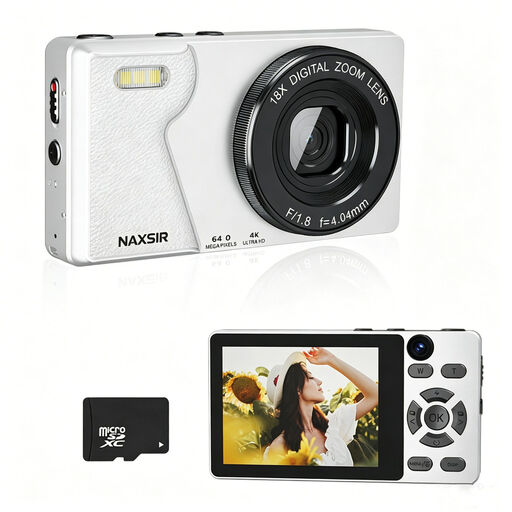
NAXSIR 4K Ultra HD digital camera, 64 MP, 18× digital zoom, 32-GB memory card
This is an alternative only if you’re not specifically looking for a mirrorless camera; the product name describes it as a compact digital camera.
The product name lists 64 MP photo resolution, 18× digital zoom and a 32-GB memory card. These specifications don’t prove that it’s suitable for macro shots of paper details.
Joybuy
 No image available
Sony Alpha 6100 APS-C mirrorless system camera with 16–50-mm Power Zoom lens
The standard zoom is useful for changing the framing of whole stars or arrangements; for small details, check the lens’s magnification ratio.
Listed features include a 16–50-mm Power Zoom lens, RAW files and a tilting screen. These specifications alone don’t prove any particular macro performance or colour rendition under your light.
Joybuy
Frequently asked questions
Do I need a 1:1 macro lens to photograph a whole paper star?
Not just because the star is made of paper. Choose based on the star’s size, the framing you want and your shooting distance; a standard zoom may be enough for the whole star. If you want small details to appear larger, compare the magnification ratio of a compatible lens.
How can I set up repeatable shots under artificial light?
Keep the light source and setup as consistent as possible, set the white balance to suit the light and check a test shot for colour shifts. If you edit RAW files, you can adjust the white balance later. With LED lighting, also check for banding.
Will focus stacking automatically give me a photo that’s sharp everywhere?
No. Taking several shots won’t automatically give you one finished image that’s sharp throughout. Focus stacking involves combining images taken at different focus distances afterwards; check how this step will fit into your workflow with the specific camera model.
What should I check about the kit, charger and warranty?
Check the exact kit version and what’s included. Nikon notes that its Z50II kit with a 16–50-mm VR lens does not include a charger. For consumer purchases from traders, EU consumer information states that the legal guarantee lasts for at least two years; this is separate from a voluntary manufacturer’s warranty.
What is the cancellation period for online purchases?
EU consumer information states that consumers generally have a 14-day cancellation period for online purchases, and notes that there are exceptions. Check the terms of the specific purchase; this period is separate from your statutory rights if goods are faulty.


