
Lieferung heute & morgen

Qualitätsgarantie

Willkommens-Angebote freischalten: KOSTENLOSE Lieferung | Bis zu 80 % RABATT | Kostenlose 30-Tage-JoyPlus-Testphase
App herunterladen
The right mixing bowl set can make preparing, storing and serving food in your kitchen easier. Many sets look similar at first glance, but can differ considerably in their materials, sizes, stability and ease of cleaning. So whether you enjoy cooking, are shopping for a family or love baking, it’s worth taking a closer look at what each product actually offers.
A large kitchen bowl set with ten or more pieces may sound versatile at first. What matters, though, is what’s actually included. A set with several bowls, a sieve, a grater and lids can be useful for meal prep. If you mainly mix dough, you’re more likely to need two or three bowls in different sizes, with enough depth.
Before you buy, check:
Bowls with a non-slip base can stay steadier while you mix. However, the base should sit flat, and the material should be suitable for your worktop. A silicone ring can also reduce noise when the bowl touches the worktop, but it’s no substitute for handling very heavy dough safely.
Stainless steel mixing bowls are easy to care for and are often marketed as durable kitchen essentials. But the material label alone tells you nothing about the thickness of the steel, the finish of the edges or what’s included. For stainless steel sets, details such as 304 stainless steel, smooth interiors and a neatly rolled rim are useful things to look for.
Product descriptions for food bowls should clearly state what they’re made from. For a stainless steel set, details such as food-grade stainless steel or 304 stainless steel are relevant. A reference to EU Regulation (EC) No 1935/2004 is another useful indication for products identified as suitable for food contact.
PP plastic bowls are lightweight and practical for everyday use. They’re often suitable for preparing and storing ingredients, but shouldn’t be used in the microwave or near high heat unless the manufacturer says otherwise. Ceramic bowls, on the other hand, are better suited to serving and individual portions, but can break if knocked.
Deep mixing bowls with plenty of capacity are useful for dough, cream or large quantities of salad. A small bowl can quickly overflow when you’re whisking. A combination of small, medium and large bowls is handy for everyday use, for example, for:
If you’re buying a stand mixer with a mixing bowl, the bowl must be an exact fit for the appliance. A separate bowl won’t necessarily work as a replacement. When choosing a machine, check its capacity, the maximum recommended quantity of ingredients and which attachments are included.
Dishwasher-safe mixing bowls can save time, but it’s still worth checking each component. Lids, silicone rings, graters or bamboo accessories may need different care from the bowl itself.
Stackable mixing bowls take up less room in your kitchen cupboard. They’re especially practical for families and smaller kitchens: a set that nests inside itself is more convenient than several individual bowls of similar sizes. Dry stainless steel thoroughly after washing to help reduce water marks. Scouring products and steel wool can scratch polished surfaces.
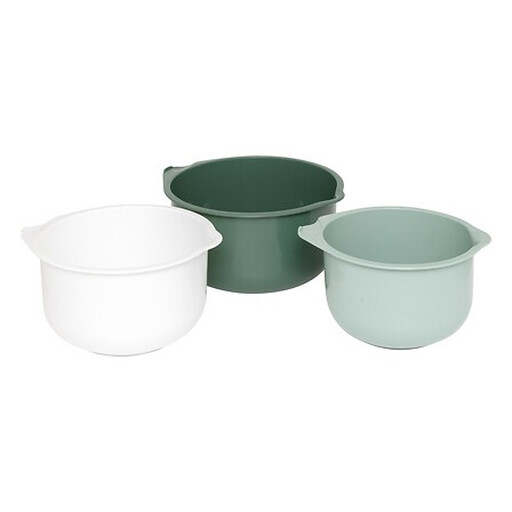
Why it suits this profile: The three PP bowls, with capacities of 1.5, 2 and 3 litres, cover typical cooking and baking tasks. Their nesting design also takes up little storage space.
The sizes and material are clearly specified, reducing the risk of choosing a set with bowls that are too similar or impractical in size.
Lightweight PP, three capacities and dishwasher-safe bowls. Not intended for microwave use or exposure to high heat.
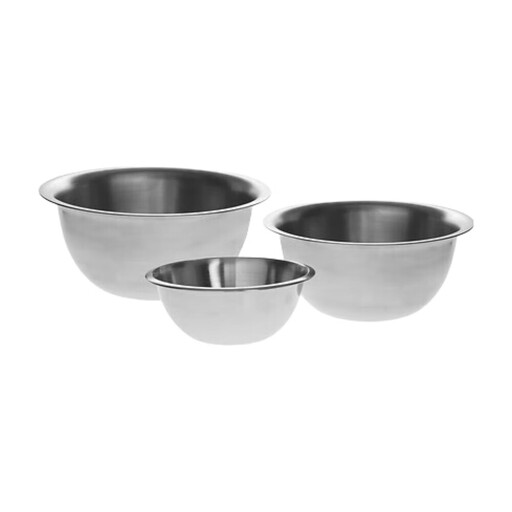
Why it suits this profile: This stainless steel set includes 1, 2 and 3.3-litre bowls, offering a choice of sizes while keeping storage compact.
A non-slip base addresses a common weakness: bowls that move around while you’re mixing or preparing ingredients.
Stainless steel construction, three nesting sizes and, according to the product details, dishwasher-safe bowls.
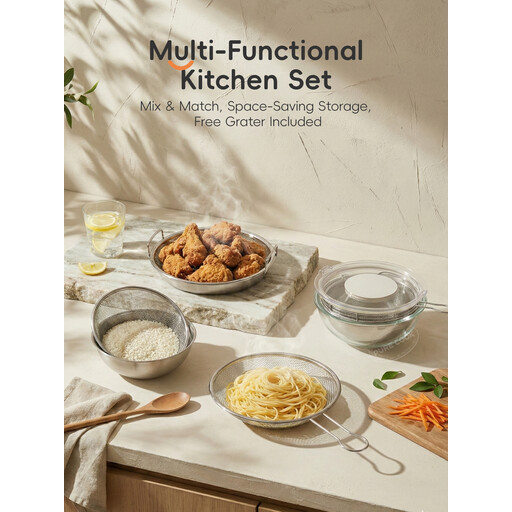
Why it suits this profile: Alongside several bowls, the set includes a sieve, grater and lids. It’s a good fit for households that wash, prepare, store and portion ingredients.
The contents are clearly listed, unlike with some basic multi-piece sets: accessories for draining, grating and storage are all specified.
304 stainless steel, stackable storage, lids and, according to the product details, dishwasher-safe components. The grater has sharp blades, so keep it out of children’s reach.
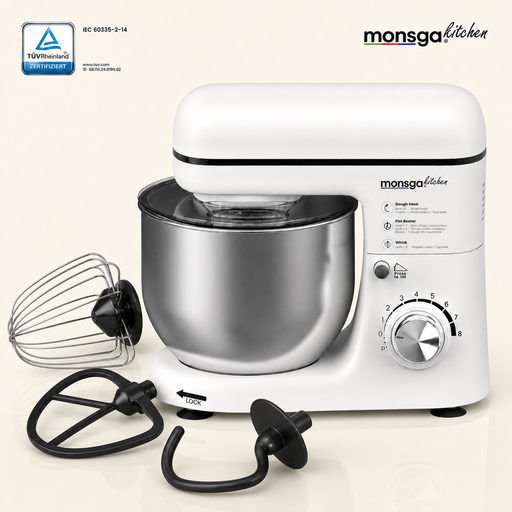
Why it suits this profile: If you regularly make bread dough, cake batter or larger quantities, this stand mixer offers a mixing bowl, eight speed settings and a maximum capacity of 6 litres.
The recommended usable capacity is 5 litres, according to the product description, helping you distinguish the working capacity from the maximum fill level.
6-litre stainless steel bowl, eight speed settings, splash guard and overload protection, according to the product details.
We’ve put together a complete, regularly updated list of products that meet these strict selection criteria and fully comply with the safety regulations in force in the EU.
A range of sizes is useful for a versatile household. Small bowls are ideal for ingredients and dressings, medium-sized ones for eggs or smaller quantities of dough, and large bowls for salads, bread dough or family-sized portions. Capacity isn’t the only thing to consider: depth matters too, as it helps prevent ingredients splashing over the rim while you mix.
It depends on what you need them for. Stainless steel is resistant to odours and suits many types of food preparation. Plastic is lighter and can be easier for children to handle or for quick kitchen tasks. With either material, check the care instructions, stability and suitability for hot food.
The bowls should nest securely without catching or jamming. Also check whether non-slip bases, lids or handles take up extra room. For meal prep, a set with lids and clearly labelled sizes may be more practical than a larger set with no storage options.