
Lieferung heute & morgen

Qualitätsgarantie

Willkommens-Angebote freischalten: KOSTENLOSE Lieferung | Bis zu 80 % RABATT | Kostenlose 30-Tage-JoyPlus-Testphase
App herunterladen
Mixing bowls are among those kitchen essentials you reach for every day – whether you’re baking, preparing salads, marinating, portioning or storing food. Yet unclear size specifications and marketing claims about materials often lead to the wrong purchase. So when you’re choosing a mixing bowl or a mixing bowl set, you shouldn’t just focus on the design; you need to consider capacity, stability, cleaning and the intended use.
A bowl with a 3-litre capacity cannot be filled to the brim when you’re whisking or mixing. Liquids and doughs need room so nothing spills over the edge during mixing. For everyday use, having several sizes is often more practical than one very large bowl.
With a stand mixer that includes a mixing bowl, there’s an additional point: the stated volume is not automatically the recommended working quantity. The Kenwood Titanium Chef Baker XL, for example, comes with a 7-litre stainless steel bowl. However, the permissible amount depends on the recipe and the instruction manual.
Terms like “rustproof”, “food-safe” or “heat-resistant” describe different characteristics. Stainless steel bowls are generally robust and don’t absorb odours, but they must not go in the microwave. Plastic bowls are lightweight and suitable for everyday use, but depending on the material, they may not be suitable for high temperatures.
With ceramic, temperature changes are critical. A cold bowl should not be placed directly into a preheated oven. Decorative aluminium bowls are not automatically suitable for the oven, hob, microwave or dishwasher either.
Stackable bowls save space when the size gradations are well thought out. What matters is whether the bowls fit inside one another and whether handles, pouring spouts or high rims get in the way of storage. In small kitchens, a bowl set with three or four nesting sizes can be more practical than several individual models.
When choosing baking bowls and bowls for baking and cooking, specific usage scenarios can help:
A single large bowl doesn’t replace a set. When mixing small amounts, a smaller vessel can be easier to handle.
304 stainless steel is commonly used for robust stainless steel bowls. Also look for a cleanly rolled rim, a stable base and a smooth interior surface. A non-slip base can make handling easier when whisking and kneading.
Polypropylene (PP) is lightweight and suitable for many kitchen tasks. With plastic bowls, check the specifications for dishwasher, microwave and high heat separately. The 5five PP set is described as dishwasher-safe, but is not intended for the microwave or high heat.
Ceramic is suitable for mixing as well as serving and baking, but it is heavier and more prone to chipping. The STAUB Ceramique Bowl is stated to be oven-safe, microwave-safe, freezer-safe and dishwasher-safe; direct heat on the hob or cooktop is expressly not recommended.
Before you buy, check the following:
With electrical appliances, the bowl and attachment must lock securely into place. Hands, hair, clothing and kitchen utensils should not come near the moving parts during operation. Before changing accessories, switch off the appliance and unplug it.
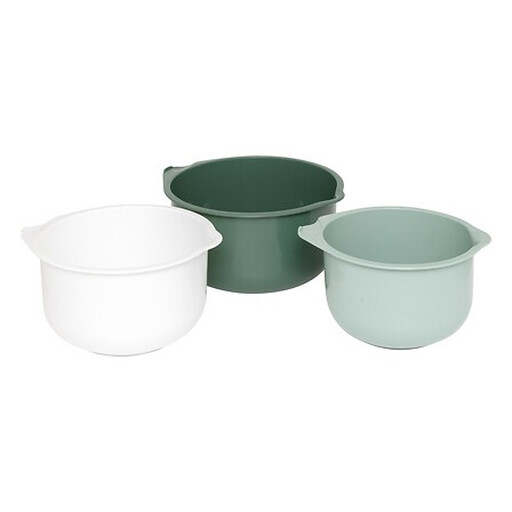
Why this product fits the profile: Three sizes – 1.5, 2 and 3 litres – cover typical cooking and baking tasks and nest together for storage.
The set avoids the limitation of a single size and is stated to be dishwasher-safe.
Lightweight PP material, three graduated volumes and space-saving nesting design.
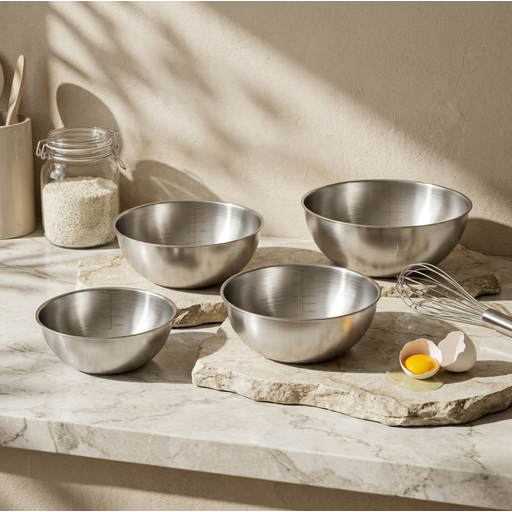
Why this product fits the profile: The four-piece set is made from food-grade 304 stainless steel according to the product description, and offers sizes from 19 to 28 cm.
The material specification is precise. It also explicitly states that the bowls are not suitable for the microwave.
Four nesting stainless steel bowls, dishwasher-safe and suitable for both hot and cold foods.
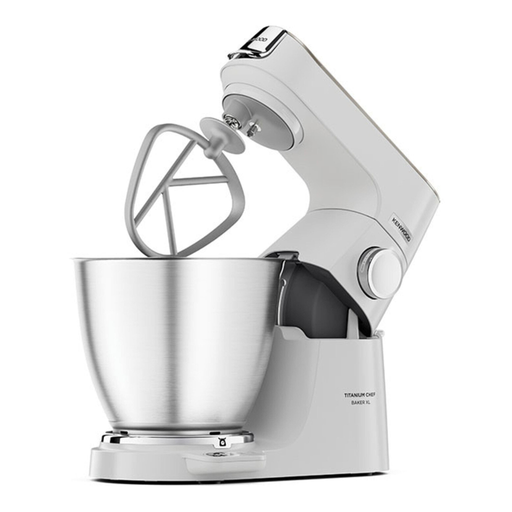
Why this product fits the profile: This stand mixer is aimed at households that regularly prepare dough, creams or larger quantities with motorised assistance.
The capacity of the stainless steel bowl is clearly stated as 7 litres. The integrated scales reduce the need for extra measuring vessels.
1,200-watt motor, variable speed control, EasyWeigh scales plus K-beater, whisk and dough hook.
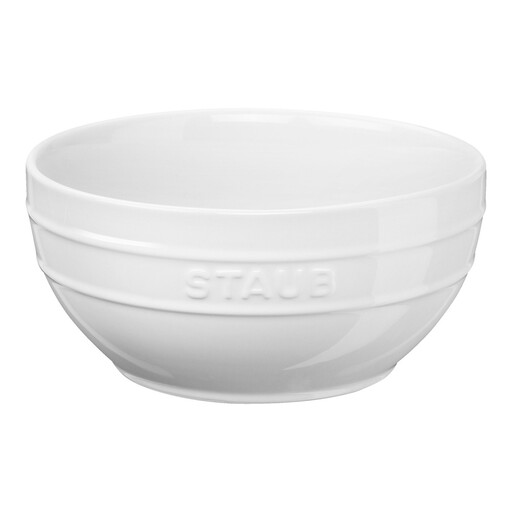
Why this product fits the profile: According to the product information, this glazed ceramic bowl can be used for mixing, serving, baking and reheating.
The limits of use are clearly stated: no direct heat and no abrupt temperature changes between the freezer and a hot oven.
1.4-litre capacity, glazed ceramic, oven-safe up to 300 °C according to the product information, and dishwasher-safe.
We’ve put together a full, regularly updated list of products that fully meet these strict selection criteria and the safety regulations in force in the EU.
For an average household, several sizes between roughly 1.5 and 3 litres offer the most versatility. If you frequently make bread, cake or yeast dough, you might consider a stand mixer with a mixing bowl of 5 litres or more. The usable volume should always be less than the nominal volume, so nothing spills over when you’re mixing.
That depends on the use. Stainless steel bowls are shape-stable, absorb few odours and are suitable for many hot and cold ingredients. Plastic bowls are lighter and often cheaper. With both types, check the specifications for dishwasher, microwave, heat and food contact.
The lifespan depends on the material, workmanship and care. Stainless steel can last a long time with normal use, while plastic may be more affected by high heat, sharp tools or staining. Ceramic should be checked regularly for cracks and chips. Damaged bowls should no longer be used.