
Lieferung heute & morgen

Qualitätsgarantie

Willkommens-Angebote freischalten: KOSTENLOSE Lieferung | Bis zu 80 % RABATT | Kostenlose 30-Tage-JoyPlus-Testphase
App herunterladen
A mobile car radio with wireless CarPlay and Android Auto can bring navigation, hands-free calling, music control and a reversing camera to older vehicles, without completely removing the factory-fitted radio. However, these devices differ significantly in terms of mounting, connection and operation.
Many poor purchases happen not because of missing features, but due to unclear specifications and an unsuitable design. Before buying, drivers should therefore check how the device is mounted, which smartphone connection is actually supported, and whether the reversing camera is compatible with their vehicle.
The term Wireless CarPlay or wireless Android Auto describes the smartphone connection. Depending on the device, Bluetooth and Wi-Fi must be enabled on your phone. It’s also crucial to check whether your smartphone and its operating system are compatible.
Power supply is still required. A portable CarPlay display is usually powered via the 12-volt socket or a USB port in the vehicle. A USB-C car radio can be handy, provided your car has a suitable port. So before you buy, you should check:
A 7-inch car display takes up less space on the dashboard and can often be positioned more easily within your line of sight. A 10.26-inch car display, on the other hand, offers more room for maps, menus and the reversing image. However, larger dimensions can restrict forward visibility if the mount is poorly placed.
That’s why it’s not just the inch measurement that matters, but also:
A touchscreen car radio should be mounted so that operating it distracts you as little as possible from the road. Voice control via your connected smartphone can reduce manual input, but it doesn’t replace safe vehicle operation.
A stated camera resolution, for example 720p, describes the image quality. On its own, it doesn’t tell you how reliable the picture will be in the dark, in rain or when the lens is dirty. Just as important are the cable length, connection type and correct linking to the reverse signal.
With a mobile system, you should clarify before buying:
The camera is an aid when manoeuvring and is not a substitute for direct visual checks or existing vehicle sensors.
A mobile display is usually mounted on the dashboard or windscreen. The factory-fitted radio stays in place. This solution is suitable for vehicles where there is no standard radio slot, or where you want to keep modifications to a minimum.
A 1 DIN car radio is installed into a standardised radio slot. Before ordering, you should check the installation dimensions, mounting depth and any existing vehicle adapters. Depending on your car, additional adapters may be needed for the power supply, speakers, steering wheel controls or aerial.
Bluetooth 5.0 can be relevant for phone calls, audio streaming or communication with accessories. However, the version number alone doesn’t guarantee that all your smartphone’s functions will be supported. For CarPlay and Android Auto, you should read the product description carefully.
MirrorLink is not the same as Apple CarPlay or Android Auto. It is a separate function for screen mirroring, and support depends on your smartphone. Buyers should therefore not assume full compatibility based solely on the term MirrorLink.
A device with USB Type-C can be practical with modern smartphones and power adapters. What matters is whether the port is used only for power supply or also for data transfer. For audio output, options may include FM, AUX or Bluetooth, depending on the model.
Specifications such as “1080p touchscreen” should also be considered in relation to the actual display size and usage. A higher screen resolution can show menus and camera images in more detail, but it doesn’t replace a suitable mounting position and sufficient brightness.
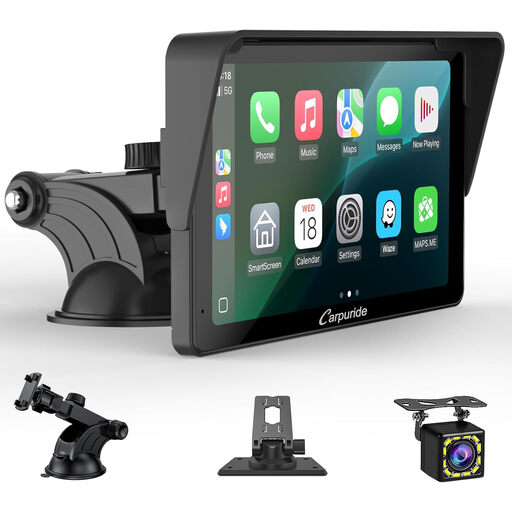
Why this product fits the profile: The compact 7-inch format is ideal for drivers who want to add smartphone functions without removing their existing car radio.
The portable design reduces the amount of modification needed in the vehicle. Before buying, you only need to check the power supply, mount and audio output.
7-inch touchscreen, wireless AirPlay and Android Auto support, 720p reversing camera and Bluetooth 5.0 according to product specifications.
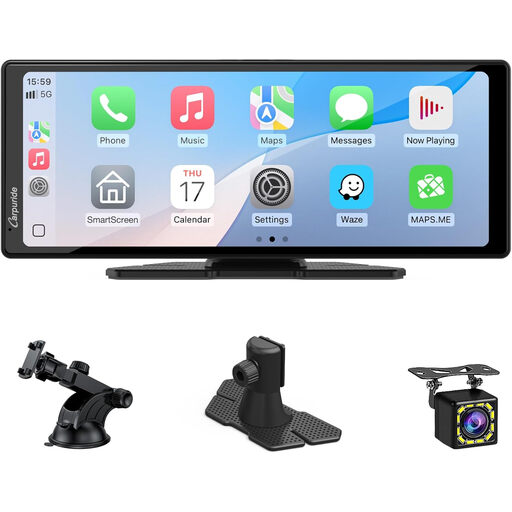
Why this product fits the profile: The larger display appeals to users who want to view maps and controls on a wider screen and have enough space on their dashboard.
The specifications list screen size, resolution, connection types and camera resolution separately. This makes it easy to compare the relevant buying criteria.
10.26-inch touchscreen, 1080p display, wireless CarPlay and Android Auto, plus 720p reversing camera according to product specifications.
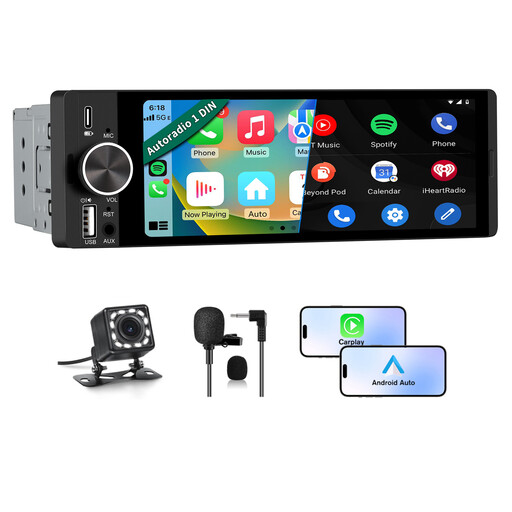
Why this product fits the profile: The 1 DIN format is aimed at users who prefer a fixed, built-in solution with a touchscreen, voice control and traditional FM reception.
The fixed design avoids a loose position on the dashboard. Before installation, you must check the slot size, adapters and the vehicle’s wiring connections.
6.36-inch HD touchscreen, wireless CarPlay and Android Auto, voice control, Bluetooth 5.0, FM, USB Type-C and reversing camera according to product specifications.
We’ve put together a full, regularly updated list of products that fully meet these strict selection criteria and the safety regulations in force in the EU.
Before mounting, test the planned installation position while the vehicle is stationary. The display must not obscure any important instruments and should remain readable even in direct sunlight. Cables should be routed so that they do not interfere with the steering wheel, pedals or gear shift area.
For a reversing camera, the connection to the reverse signal is particularly important. If you have no experience with vehicle wiring, you should have the installation checked by a qualified professional. After installation, it’s a good idea to test the following functions:
The actual lifespan depends on factors such as temperature, humidity, mechanical stress, power supply and care. No fixed expiry date can be determined from the screen size or Bluetooth version alone.
Not automatically. The vehicle needs a suitable power supply and a practical solution for audio output. In addition, your smartphone, operating system and the desired connection must be compatible. Before buying, you should also check the mounting space and field of view.
Both designs have different requirements. A 1 DIN car radio is installed permanently in the radio slot and can blend in more neatly with the vehicle’s interior. A portable CarPlay display can usually be fitted with less modification and can be taken with you more easily if you change cars. The right choice depends on the slot size, vehicle adapters and how much flexibility you want.
The functions themselves generally don’t incur a monthly device fee. However, costs for navigation, music streaming or online services may arise from your smartphone contract or the respective provider. The display also continues to draw power from the vehicle.