
Lieferung heute & morgen

Qualitätsgarantie

Willkommens-Angebote freischalten: KOSTENLOSE Lieferung | Bis zu 80 % RABATT | Kostenlose 30-Tage-JoyPlus-Testphase
App herunterladen
A mobile compressor cool box can do much more on the road than a simple passive cool box. It cools independently of ice or cool packs, can reach sub-zero temperatures depending on the model, and can be used in the car, motorhome, boat or at home. At the same time, the devices differ considerably in terms of noise level, power consumption, interior layout and operation.
Anyone who only looks at a large capacity or a particularly low temperature rating will miss important details. Three typical buying mistakes occur particularly often:
A compressor cooling system works similarly to a classic refrigerator. It removes heat from the interior and can therefore maintain a comparatively stable target temperature even in high outside temperatures. A car cool box with a freezing function is therefore more suitable for frozen food, ice or longer trips than a pure cooling and heating system.
Pay attention to the actual temperature range stated. A model with -20 °C to +20 °C offers different possibilities than a portable fridge that only promises a temperature reduction relative to the surroundings. With two separate zones, one side can also be used as a cooling area and the other as a freezer compartment. This is practical for families, boat owners and longer stays.
For the vehicle, a 12 V or 24 V supply is relevant. Lorries, motorhomes and some boats use 24 V, while many cars have 12 V. A mobile cool box 230V is additionally useful if it is to be operated on the campsite, in the garage or at home.
Check before buying:
A battery protection with several stages can help protect the vehicle battery from excessive discharge. However, it does not replace checking the vehicle battery and suitable on-board electrics.
The interior volume should suit the intended use. A mini fridge for the motorhome with 9 to 18 litres is space-saving and suitable for drinks, snacks or day trips. For several people and longer journeys, 45 to 65 litres can be more sensible. Also check the internal dimensions: bottles, lunch boxes and large food containers need sufficient height and width.
The manufacturer’s noise level is given in decibels (dB). Values around 38 to 42 dB can be relevant for operation in the vehicle or in the sleeping area. The actual perception depends on the placement, the surface and the compressor cycle. A level, stable and well-ventilated position is therefore important.
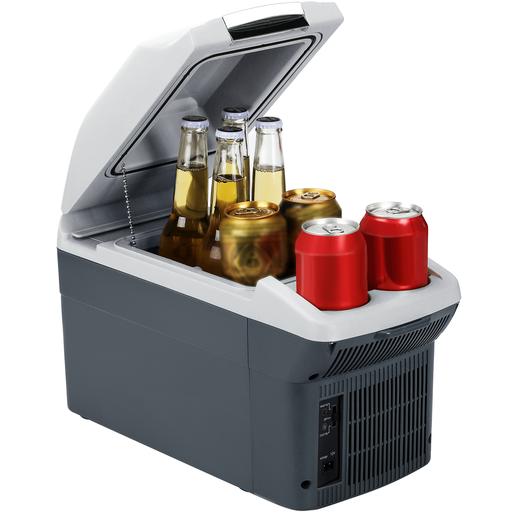
Why this product fits the profile: The 9-litre capacity and 12 V connection are suitable for short trips, commutes, picnics and smaller camping outings.
The product description explicitly mentions 12 V DC operation. An optional adapter for 220–240 V is planned and should be checked separately before use at home.
9 litres volume, cooling and warming function, carrying strap, two cup holders and, according to the manufacturer, an operating noise of around 40 dB.

Why this product fits the profile: This model is aimed at users who value multiple energy options and separate temperature zones when camping, van life, boat trips or long journeys.
The specifications distinguish between 45 litres of usable volume, two temperature zones and several power sources. This makes it easier to match your specific needs with the technical data before buying.
According to the manufacturer: -20 °C to +20 °C, AC, solar and 12/24 V operation, app support and a noise level below 38.5 dB.
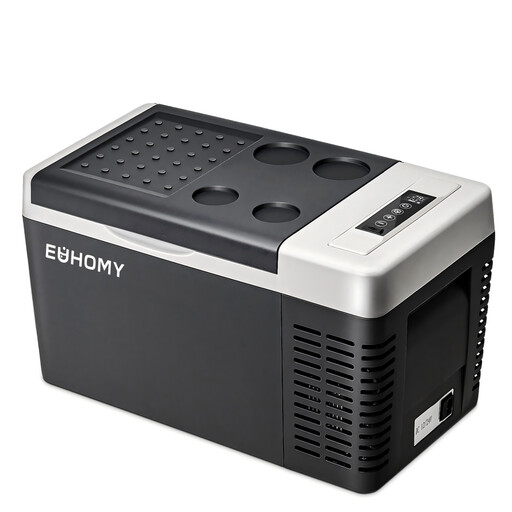
Why this product fits the profile: The 18-litre cool box is suitable for regular trips, camping, travel and boat trips when freezing, app control and flexible power supply are required.
The technical specifications mention 12/24 V DC as well as 100–240 V AC connections. In addition, a three-stage battery protection and a magnetic seal are described.
According to the manufacturer: -20 °C to +20 °C, WiFi app control, 45 W power consumption under the stated conditions and approximately 42 dB operating noise.
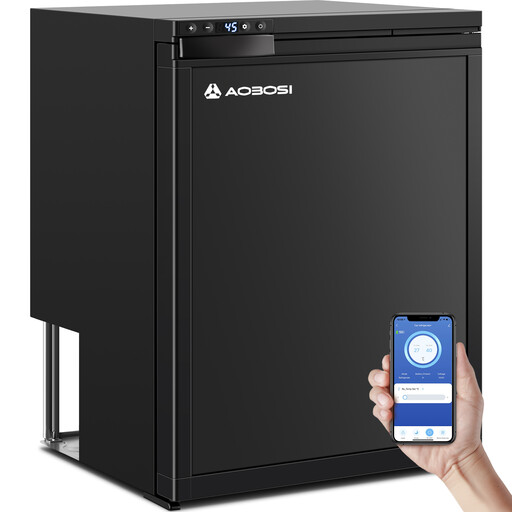
Why this product fits the profile: The large capacity is designed for motorhomes, campervans and longer stays with several people.
The product name explicitly indicates compressor technology and app control. Before buying, you should check the installation dimensions, power connections and the exact interior layout.
65 litres capacity, compressor cooling and app control according to the product specification; suitable for a larger supply of food and drinks.
We have put together a complete, regularly updated list of products that fully meet these strict selection criteria and the safety regulations in force in the EU.
Power consumption depends heavily on the ambient temperature and the target temperature. In cooling mode, a device normally requires less energy than in freezing mode. If the cool box is filled with pre-cooled items and opened as little as possible, this can reduce the running time. For longer periods without mains power, a solar connection, power station or additional battery should be considered.
For safe operation, you should also:
A compressor cool box is not a substitute for tested food storage under all conditions. Perishable goods should be appropriately packed and the temperature checked regularly.
Many models are operated via a 12 V connection. For lorries and certain motorhomes, a 24 V compatible device is required. Check in advance whether the socket has sufficient fuse protection and whether battery protection is present. When using it during longer stationary periods, a separate battery or power station can be useful.
The technical service life depends on use, ventilation, transport, cleaning and maintenance. A fixed period cannot be stated in general terms. Frequent opening, high outside temperatures and continuous freezing operation increase the strain. Therefore, pay attention to the warranty and support information from the respective manufacturer.
The ongoing costs result from the power consumption, operating time and electricity price. A cool box with a low nominal power rating is not automatically more economical, as insulation and compressor running time also play a role. For a realistic comparison, you should consider the specifications for cooling and freezing mode separately and base them on your planned use.