
Lieferung heute & morgen

Qualitätsgarantie

Willkommens-Angebote freischalten: KOSTENLOSE Lieferung | Bis zu 80 % RABATT | Kostenlose 30-Tage-JoyPlus-Testphase
App herunterladen
A mobile compressor cooler can do more than just chill drinks while you’re on the move: depending on the model, it can also freeze food. Unlike a thermoelectric cool box, it uses a compressor and offers an adjustable temperature range. This makes it ideal for campers, lorry drivers, boat owners, anglers and families who want to stay independent of ice or cool packs.
However, advertising claims such as “rapid cooling”, “app control” or “solar operation” reveal little about how practical a cooler really is in everyday use. Capacity, power supply, battery consumption, ventilation and the actual layout of the interior are what really matter.
A 40L compressor cooler or 45L compressor cooler offers enough space for several days of travel. However, the external dimensions, baskets, dividers and compressor unit reduce the usable interior space. When choosing, you should therefore pay attention to the stated usable volume and the internal dimensions.
Bottle height is also important: not every cooler can hold large 1.5- or 2-litre bottles upright. For families and longer trips, a 45-litre cooler may be more practical than a smaller model, while in a car, the available boot space often sets the limit.
An electric cool box with a freezer function can reach temperatures of around -20 °C. However, power consumption rises significantly if you want to keep items frozen continuously. Manufacturers’ consumption figures usually refer to specific conditions, such as an ambient temperature of 25 °C and energy-saving mode.
You should therefore look for:
A portable car cool box should have both a 12-volt and a 24-volt connection. An 12V 24V car fridge can therefore be used in both cars and lorries. For use at home or on a campsite, a 230V mobile cool box with a suitable mains adapter is also useful.
A solar-powered cooler does not necessarily need an integrated solar panel. It will often have a compatible solar input, while the panel, power station or additional battery must be purchased separately. You should therefore check the voltage, maximum current and what is included in the delivery.
For drinks and fresh food, a temperature above freezing is usually sufficient. If you want to store ice, frozen food or frozen fishing bait, you will need a cooler with a temperature range reaching at least -18 °C.
A dual-zone cooler separates the fridge and freezer compartments. With some models, the configuration can be changed flexibly. This is useful if you want to chill drinks and freeze food at the same time while travelling. Check whether both zones can actually be regulated separately and how much space remains once the divider has been inserted.
A 12V and 24V connection covers many vehicles. For stationary use, a 100- to 240-volt adapter is helpful. Some models also support solar or USB-C charging. For longer periods of use while parked, the cooler should have battery protection with L, M and H settings. The right setting depends on the vehicle and the condition of the battery.
An app can make temperature monitoring easier, but it does not replace checking the cables, ventilation and power source. Bluetooth range and smartphone compatibility should be checked before purchase.
Compressors produce operating noise. Levels of around 38 to 45 dB may be suitable for camping, vans and motorhomes, although how loud the cooler seems will depend on the pitch and surrounding environment. Depending on its size and battery, the weight can range from under 10 kg to over 20 kg.
Place the cooler on a level, stable surface and do not block any air inlets or outlets. For boats, festivals and outdoor areas, you should also check whether the model is protected against splashing water. A protection rating such as IPX4 does not mean that the cooler is completely waterproof.

Why this product suits this profile: This 40-litre model combines 12/24-volt and 100–240-volt operation with app control and a compact weight of 9.5 kg.
ECO and MAX modes, along with three-stage battery protection, make ongoing operation easier to plan.
Temperature range from -20 °C to 20 °C, LED interior light and removable carrying handle.

Why this product suits this profile: The 45-litre dual-zone cooler offers separate temperature zones and multiple power options for longer journeys.
The figures distinguish between cooling and freezing consumption; the 298-Wh additional battery is available separately.
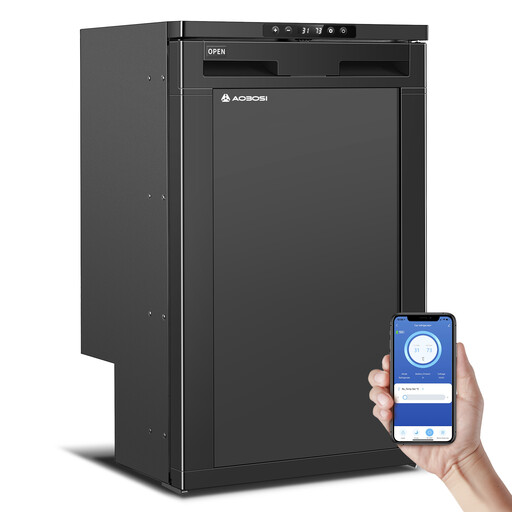
Why this product suits this profile: Its larger capacity is designed for motorhome travellers, boat owners and groups with high cooling requirements.
Before buying, you should consider the available space, weight and your vehicle’s electrical capacity.
83-litre capacity, app control, LED lighting and 12/24-volt DC power supply.
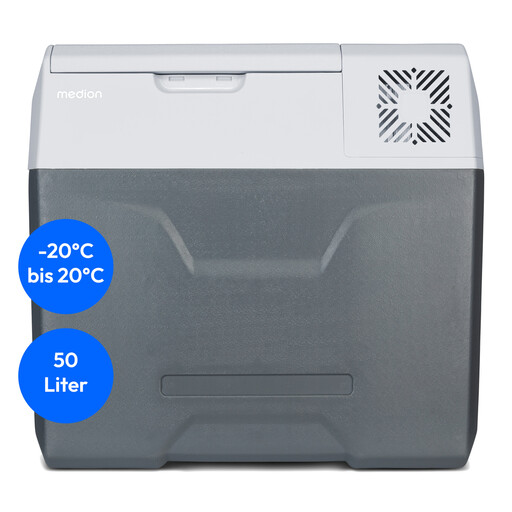
Why this product suits this profile: This model is suitable for cars, lorries, caravans, boats, gardens and festivals, and can also be operated from a standard mains socket.
The 230V, 12V and 24V connections reduce the need for additional adapters in different locations.
50 litres of total volume, 47 litres of usable volume, temperature range from -20 °C to 20 °C and a USB connection.
We have put together a complete, regularly updated list of products that fully meet these strict selection criteria and the safety regulations applicable in the EU.
Connect the appliance to the appropriate 12-volt or 24-volt connection and select the battery protection level suitable for the vehicle. The cooler should have sufficient ventilation while in operation. During longer stops with the engine switched off, a separate power station or additional battery is advisable to avoid placing unnecessary strain on the starter battery.
Consumption depends on the ambient temperature, target temperature, insulation, how often the cooler is opened and the operating mode. Cooling to around 4 °C requires significantly less energy than continuously freezing at -18 °C. Manufacturers’ figures should therefore be understood as comparative values measured under specific conditions, rather than guaranteed daily consumption.
Its lifespan depends on use, transport, cleaning and ventilation. Positioning the cooler on a level surface, keeping electrical connections dry, leaving ventilation openings clear and protecting it from strong impacts can support long-term use. Before buying, you should also check the warranty, availability of spare parts and the supplier’s customer service.