
Lieferung heute & morgen

Qualitätsgarantie

Willkommens-Angebote freischalten: KOSTENLOSE Lieferung | Bis zu 80 % RABATT | Kostenlose 30-Tage-JoyPlus-Testphase
App herunterladen
A mobile cool box for your car should keep drinks and food reliably chilled without blocking the boot or unnecessarily draining your vehicle's battery. In practice, however, some misleading product descriptions can lead to the wrong purchase. Cooling performance, capacity and power supply are particularly often misjudged.
With a thermoelectric cool box, the cooling performance depends on the ambient temperature. Claims like “up to 18–22 °C below ambient temperature” describe a difference, not a permanently adjustable temperature. If the box is sitting at 30 °C inside a hot car, the interior can end up considerably warmer than expected.
A compressor cool box, on the other hand, works with an adjustable temperature range, for example from -20 °C to +20 °C. It’s suitable if you need genuine cooling and freezing functions, but it’s usually heavier and more expensive to buy.
An advertised capacity of 35 litres doesn’t necessarily correspond to the usable interior space. With the MEDION MD370030, for example, 35 litres gross and 30 litres net are stated. Internal compartments, walls and technical components reduce the actual available space.
For individual drinks, snacks and lunchboxes, 5 to 9 litres is often enough. For several people, longer trips or a cool box for camping, 18 to 45 litres is usually more practical. Before buying, you should also compare the external dimensions with your seat, boot or built-in niche.
A 12V cool box can typically be operated via the vehicle’s cigarette lighter socket. For motorhomes, boats and some commercial vehicles, a cool box 12V 24V is also useful. If you want to use the device at home too, you’ll need a suitable 220–240 V or 100–240 V connection. With some compact models, the mains adapter is optional and not included in the box.
Also important are battery protection levels, adequate ventilation and whether the cool box should continue running when the engine is switched off. Without battery protection, prolonged use can drain the starter battery.
Pay attention to the details for 12V DC, 24V DC and AC mains operation. An ECO mode can reduce consumption, while a MAX mode cools faster and uses more energy. For longer stationary periods in a motorhome or when fishing, battery protection levels are particularly relevant.
Noise levels also matter: compressor units work with a compressor, while thermoelectric units usually cool with a fan. Manufacturer specifications of around 38 to 45 dB give a rough guide, but don’t replace checking the specific installation location.
The ventilation slots must not be covered. A gap of about 10 cm around the air openings may be required, depending on the instructions. In the car, the box should be secured against sliding, for example with a seat belt slot or a non-slip base.
When choosing, it’s not just the volume that counts, but also the weight: a 45-litre model with a compressor can weigh over 20 kg and is therefore more suitable for a fixed position in the vehicle than for frequent carrying.
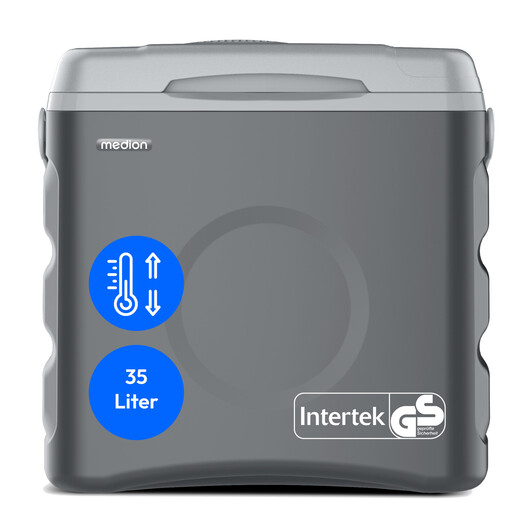
Why this product fits the profile: The box offers 30 litres of net volume and is suitable for day trips, family journeys and simple camping use.
Gross and net volume are stated separately. In addition, 12V, 230V and 5V USB are available as power sources.
Thermoelectric cooling, warming function, 30 litres net volume and flexible power supply.

Why this product fits the profile: Two temperature zones, app support and multiple power options suit longer trips and demanding vehicle use.
The temperature range of -20 °C to +20 °C is clearly stated. 12V/24V, AC and solar input allow for predictable energy supply.
45 litres usable volume, dual-zone function, stated noise level below 38.5 dB and optional battery operation.
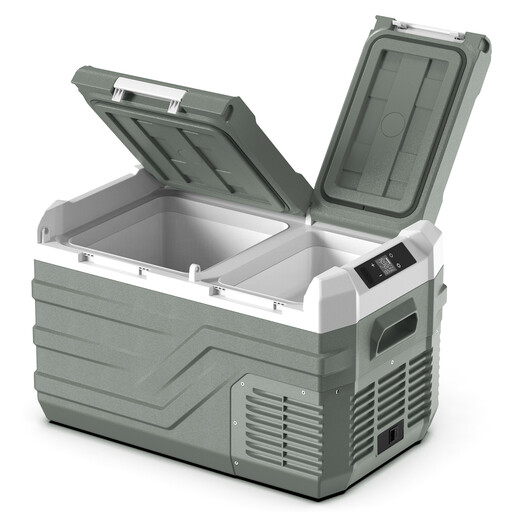
Why this product fits the profile: This model is aimed at campers, anglers and motorhome owners who want to store chilled and frozen items separately.
Two separately controllable compartments, three battery protection levels and a temperature range of -20 °C to +20 °C reduce typical planning mistakes.
23.3 litres total volume, 12/24V and 100–240V operation, 60 W power consumption according to the product specification and USB port.
We’ve put together a complete, regularly updated list of products that fully meet these strict selection criteria and the safety regulations in force in the EU.
Yes, this is possible with prolonged use without the engine running. Models with multi-level battery protection switch off earlier depending on the setting. Nevertheless, the cool box should be disconnected from the vehicle during longer breaks or operated via a suitable auxiliary battery or power station.
The lifespan depends on the cooling technology, operating time, ventilation, vibrations and care. A compressor cool box should stand on a stable surface and have sufficient airflow. With all devices, cables, seals and ventilation openings should be checked regularly and the interior cleaned dry.
The running costs depend on the power consumption, operating time, outside temperature and electricity tariff. An ECO mode can reduce consumption. With 12V operation in the vehicle, you also need to consider how the energy is supplied and whether the battery has sufficient capacity.