
Lieferung heute & morgen

Qualitätsgarantie

Willkommens-Angebote freischalten: KOSTENLOSE Lieferung | Bis zu 80 % RABATT | Kostenlose 30-Tage-JoyPlus-Testphase
App herunterladen
A mobile Type 2 EV charger with a 16 A Schuko plug allows you to charge from a standard 230-volt household socket. This is practical for owners of electric cars and plug-in hybrids who want to stay flexible at home, at work or while travelling. However, not every Schuko charger for electric cars is suitable for the same applications.
As Joybuy Product Recommendation Officer, I filter the most important information from product descriptions and explain what buyers in Germany should look out for. The advertised charging power and a long cable are not the only factors that matter. What is crucial is the combination of vehicle compatibility, current, socket and safety features.
A 230 V EV charger can theoretically reach up to 3.68 kW at 16 A. However, the actual charging power depends on several factors:
With older or insufficiently tested sockets, selecting a lower setting, such as 8 A or 10 A, may be advisable. A Schuko socket should not be used via multi-socket adapters, extension leads or power strips unless the manufacturer expressly permits this.
A Mode 2 charger with a Type 2 connection is suitable for many European BEV and PHEV models, including vehicles from Tesla, Volkswagen, Audi, BMW, Mercedes-Benz, Hyundai, Kia, Volvo and Škoda. Nevertheless, before buying, you should check whether your vehicle actually has a Type 2 charging connection in accordance with IEC 62196-2 and what AC charging power it supports.
A separate Type 2 charging cable for a wallbox or public AC charging point is not the same as a mobile charger with a Schuko plug. A cable without an integrated control box cannot simply be connected to a standard household socket.
A mobile electric car charger should have specific information in its product description about residual-current and temperature monitoring. Terms such as ‘safe’ or ‘suitable for all vehicles’ provide little useful information without technical details.
The following features are worth checking:
The information below consists of published product specifications from the respective providers. It does not replace an inspection of the electrical installation.
An adjustable charging current of 6–16 A offers greater flexibility than a fixed 16 A setting. For a modern socket with its own fuse protection, 16 A may be suitable. With an unknown electrical infrastructure, a lower current is often the more cautious choice.
Also bear in mind that a vehicle with limited AC charging power will not automatically draw the charger’s maximum available power. An EV charger with 3.68 kW simply represents the technical upper limit at 230 V and 16 A.
A 10 m charging cable can be useful in parking spaces where the vehicle and socket are awkwardly positioned in relation to one another. However, a longer cable also means greater weight and takes up more storage space. For a garage or carport, 5 m to 8 m may be sufficient, while 10 m or more can be beneficial when using different parking spaces.
The cable should be routed without sharp bends and should not be placed beneath the vehicle’s tyres during charging. After use, dry storage with minimal bending is recommended.
An EV charger with a timer can schedule when charging starts. This is useful if you prefer to charge during specific tariff periods. Check whether the device only supports a delay or allows you to set a specific start and end time.
An LCD or LED display should show at least the current, voltage and charging status. This makes it easier to identify error messages and unusual temperatures.
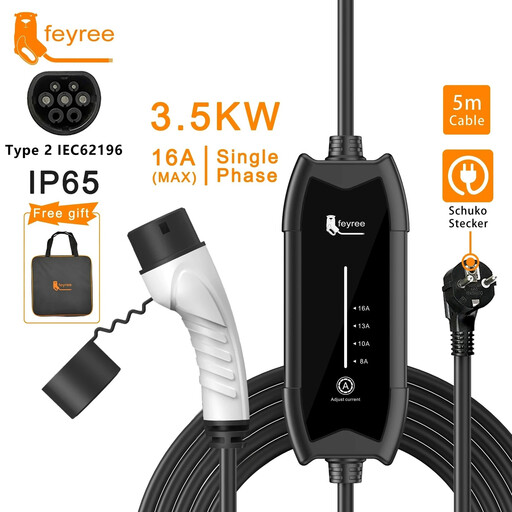
Why this product suits this profile: This portable electric car charger offers single-phase charging of up to 3.5 kW, a 5 m cable and an adjustable current of 8/10/13/16 A.
You can adjust the current to suit the available socket before charging. This reduces the risk of continuously putting a 16 A load on an unfamiliar domestic installation.
The listed safety features include protection against overcurrent, overvoltage, undervoltage, overheating and residual current, along with IP65 protection for the control box.
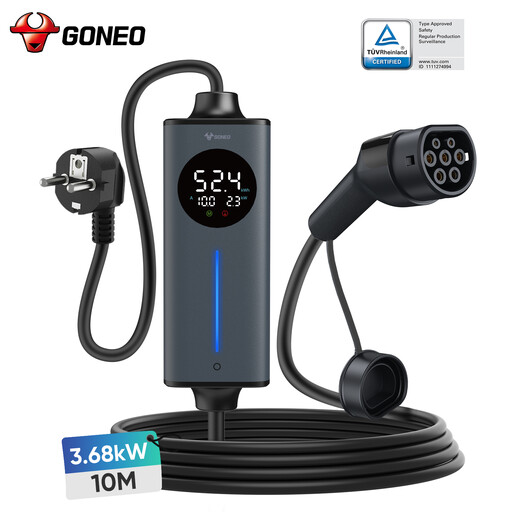
Why this product suits this profile: The combination of a 10 m cable, adjustable charging current of up to 16 A and display unit is designed for regular charging at home and on the go.
According to the product information, the safety features include earth detection, NTC temperature monitoring and RCD protection with 30 mA AC and 6 mA DC.
The provider lists a timer of 0–8 hours, maximum output of 3.68 kW and compatibility with IEC 62196-2.
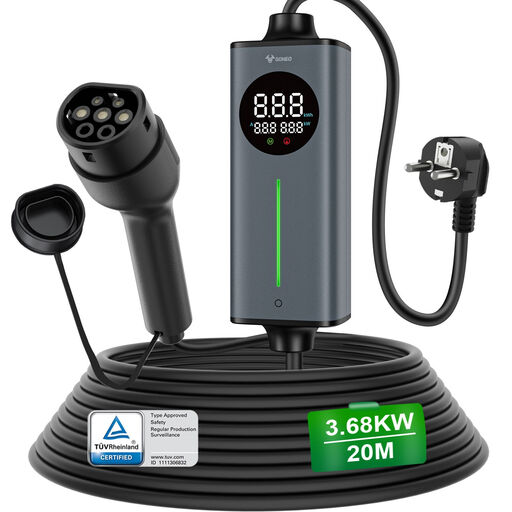
Why this product suits this profile: The 20 m version is aimed at users who have a greater distance between the socket and vehicle, such as on large properties or when using different parking spaces.
The current can be adjusted instead of permanently using the maximum setting. The cable length should nevertheless be chosen so that it does not create loops or trip hazards.
According to the provider, the features include a timer function, LED display, earth detection and RCD protection with 30 mA AC and 6 mA DC.
We have put together a complete, regularly updated list of products that fully meet these strict selection criteria and the safety regulations applicable in the EU.
Before using the charger for the first time, you should check the socket, charging cable and plugs for visible damage. The socket must be reliably earthed. During charging, the plugs and control box should be kept unobstructed so that heat can dissipate.
A wallbox is often the more suitable solution for regular charging at higher power levels. By contrast, a mobile Schuko charger is particularly useful as a flexible addition for rented accommodation, travelling or parking spaces without a permanently installed charging station. Installation or inspection of a separate circuit should be carried out by a qualified electrician.
With a suitable Mode 2 charger, this is possible with many BEV and PHEV models. The key factors are the vehicle’s Type 2 connection, the charger’s specifications and the electrical installation. A Type 2 connection alone does not guarantee that every current setting or charging power can be used.
The cost depends on your electricity tariff and the amount of energy charged. A simple calculation is: Kilowatt-hours × price per kilowatt-hour. Charging losses can increase the actual electricity drawn from the socket. A timer function can shift charging to cheaper tariff periods if your electricity tariff offers different prices.
Its lifespan depends on the number of connection cycles, storage conditions, moisture, tensile strain and thermal stress. Cables should not be kept sharply bent or driven over for extended periods. After each use, dry storage with the protective cap closed is recommended. If the cable, plug or control box shows visible damage, the device should no longer be used.