
Lieferung heute & morgen

Qualitätsgarantie

Willkommens-Angebote freischalten: KOSTENLOSE Lieferung | Bis zu 80 % RABATT | Kostenlose 30-Tage-JoyPlus-Testphase
App herunterladen
A mobile filing cabinet with castors and lock combines three practical requirements: documents should be organised, easy to move when needed and protected from unauthorised access. For home offices, small businesses, studios or workshops, this may sound straightforward at first. In practice, however, unclear dimensions, weak castors or unsuitable drawers can quickly lead to a disappointing purchase.
If you are looking for a mobile filing cabinet or a lockable filing cabinet, you should therefore look beyond the number of drawers. The key factors are usable dimensions, load capacity, the locking mechanism and whether the cabinet is genuinely suitable for A4 documents.
A cabinet may look compact from the outside, while files, suspension folders or larger documents may not fit inside. For a filing cabinet for A4 documents, check the internal width and drawer depth. A4 paper measures 21 × 29.7 cm; folders and easy access when filing require some additional room.
The location also matters. Next to a desk, you need to allow for skirting boards, table legs and the drawer extension. A narrow filing cabinet on castors saves space, but it must not be positioned so deeply that the drawers can only be opened partially.
Four small castors make the cabinet easier to move, but they do not automatically ensure a stable stand. For frequent repositioning, 360-degree castors, a sturdy castor frame and at least lockable front castors are advisable. When drawers are pulled out, the centre of gravity shifts forwards. The cabinet should therefore stand on a level floor and should not be loaded beyond the stated weight limit.
Many models have a central lock that secures several drawers at once. This is practical for confidential documents, but it is not a substitute for controlling access to the room. Before buying, check whether all the drawers can actually be locked and whether the key can be removed when the lock is in the open and closed positions.
A steel filing cabinet generally provides a robust construction and can be cleaned with a damp cloth. With engineered-wood models, greater attention should be paid to edge sealing, the surface finish and the design of the drawer runners.
Look for a load rating per drawer, rather than just the maximum total load. Paper, stationery and small office equipment require different capacities from workshop materials or heavy files. The manufacturer's stated limit must not be exceeded.
Full-extension runners allow you to see almost all the contents of a drawer. This makes filing easier and reduces the need to search at the back. Smooth-running runners, a sturdy drawer base and a stop to prevent accidental removal are also important.
A drawer unit on castors is more suitable for organising smaller items and keeping desk accessories close at hand. A taller mobile office cabinet with four or five drawers, on the other hand, offers more vertical storage space. Check whether the drawers are designed for loose documents, suspension folders or flat storage only.
A height of around 65 to 70 cm will fit beneath or next to many desks. Before ordering, measure the actual height of the alcove and the width of the passageway. With an office cabinet for the home office, the noise made by the castors is also relevant, particularly in living spaces.
If the cabinet is moved regularly, distribute the weight evenly: heavier contents should go in the bottom drawers and lighter materials at the top. This improves stability and reduces strain on the castors.
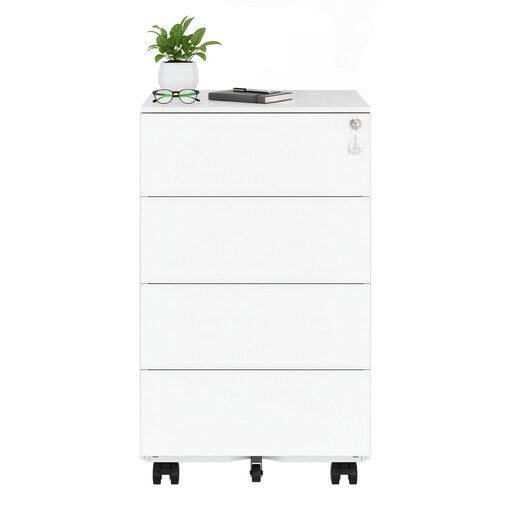
Why this product suits this profile: This white office drawer cabinet arrives pre-assembled and offers four drawers for documents and stationery. Measuring 39 × 45 × 69.3 cm, it is suitable for workspaces where space is limited.
The product details specify a steel construction, full-extension runners, a lock and included castors. This makes the key buying criteria clear before ordering.
Four drawers, pre-assembled delivery, steel construction and a stated load capacity of 15 kg per drawer.
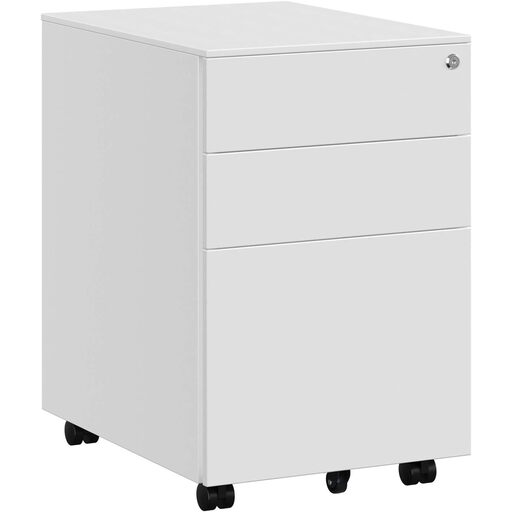
Why this product suits this profile: This model is an interesting option for users who work with different paper formats. According to the product details, it accommodates A4, Letter and Legal documents, as well as suspension folders.
The five castors, including one beneath the bottom drawer, and the stated load limits for each drawer make it easier to plan for regular use.
Three drawers, steel construction, full-extension runners, lock and pre-assembled delivery with the castors to be fitted.
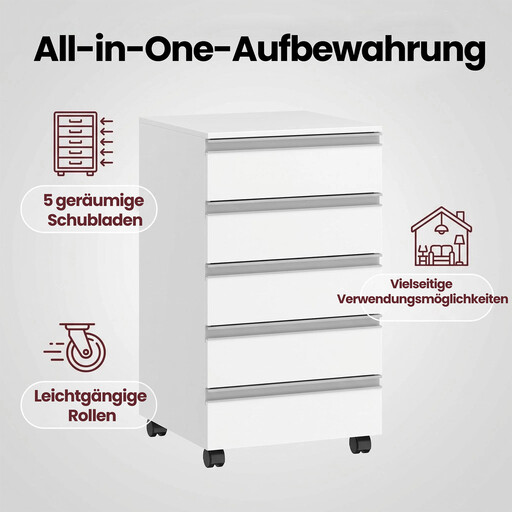
Why this product suits this profile: For studios, workshops and offices where materials change frequently, this model offers five drawers and a footprint of around 40 × 40 cm. As well as documents, it can hold accessories or work materials.
The product description specifies lockable front castors, reinforced drawer runners and a stated total load capacity of 50 kg.
Five drawers, 360-degree swivel castors, lockable front castors and a sturdy top suitable for smaller devices.
We have put together a complete, regularly updated list of products that fully meet these strict selection criteria and the safety regulations applicable in the EU.
With pre-assembled models, you usually only need to attach the castors. Before using the cabinet for the first time, check that all fastenings are secure and that it is standing on a level surface. For models requiring self-assembly, the runners and castors should be aligned precisely according to the instructions.
A lockable drawer unit on castors should not be used as a seat or step. Heavy files belong in the bottom drawers. The castors and runners should be checked regularly for dust, scraps of paper and loose screws. Suitable protective mats may be advisable for delicate flooring.
No. Measure the clear height, width and depth of the intended space. Also allow for the castors, table legs, skirting boards and the drawer extension required.
For a single home office, three to four drawers are often sufficient for files, stationery and technical accessories. If you have a large volume of paperwork or need the cabinet for business use, a five-drawer cabinet may be more suitable. The deciding factors are not just the number of drawers, but also their usable height and load capacity.
They generally do not incur running costs, as the cabinet operates without electricity. Potential additional costs include replacement keys, castors or damaged runner components. Loading the cabinet correctly and cleaning it regularly can help limit wear on the castors and drawer runners.