Travellers short on bag space
If you take a smartphone or tablet with you to study, you’ll want a keyboard that packs away small. But you’ll still need enough room to open it up at your seat.


Start by choosing a keyboard to suit your writing device and the space you can actually use. A folding keyboard saves space in your bag, but needs a stable surface when opened. A compact Bluetooth keyboard has no hinge to set up, while a keyboard case only fits the tablets it specifically lists as compatible. Then check the German layout, typing noise, power supply and documentation confirming that the specific variant complies with radio equipment requirements.
If you take a smartphone or tablet with you to study, you’ll want a keyboard that packs away small. But you’ll still need enough room to open it up at your seat.
If you switch between a mobile device and a computer to organise your notes, you could consider a keyboard that lets you switch between devices rather than using a different one for each.
If you already own a particular tablet, you could consider a keyboard designed to work with it that also offers protection or a stand. Just make sure you check the exact device model.
A good fit if: You have limited space in your bag and a sufficiently large, stable surface at your seat.
The trade-off: The ProtoArc XK01 measures 38,5 × 11,8 cm when open. ProtoArc recommends using it on a stable surface rather than your lap.
A good fit if: You mainly write at a table and want to switch between several devices. CHERRY and Logitech say the models mentioned can switch between up to three devices.
The trade-off: The casing stays rigid in transit. Logitech’s description of the Pebble Keys 2 K380s as quiet is not a measurement of its volume on a train.
A good fit if: You already own the specific supported tablet and want to combine a keyboard, stand and protection.
The trade-off: Apple’s Magic Keyboard Folio is listed for the iPad (A16) and requires iPadOS 18.3 or later; it is not a universal Bluetooth keyboard.
The figures below relate to consumers choosing a mobile keyboard to organise study notes on the train; each person is assigned to their most important buying consideration.
| Consideration | What to look for when buying | Who it matters most to |
|---|---|---|
| Pack size and space to set it up | Compare the folded and open dimensions with the table space available; don’t assume that a small packed size means it will work on your lap. | If I have limited room in my luggage, my keyboard needs to be small and still sit securely at my seat. Consumers who say pack size is their most important buying consideration make up around 36 %. |
| Compatibility and German layout | Check the operating system, connection, exact layout variant and, for a case, the precise tablet model. | If you organise notes across different devices, you need a suitable connection and a key layout that works for writing in German. Around 29 % of consumers prioritise device compatibility. |
| Quiet, stable typing | Check the key mechanism and the manufacturer’s noise claims; a product described as quiet has not necessarily been independently measured. | If I’m writing in a shared carriage, I want to disturb others as little as possible and make sure the keyboard is stable. Around 21 % of consumers are most concerned about quiet typing and a stable position. |
| Power on the go | Check the power source and whether the specific variant needs a charging cable or batteries. | If you want to catch up on your notes during the journey, you should know whether the keyboard needs charging or takes batteries. For around 14 % of consumers, power planning is their main concern. |
According to the manufacturer, the ProtoArc XK01 measures 38,5 cm across when open; ProtoArc recommends using it on a stable surface.
Measure the usable space at your usual seat and compare it with the keyboard’s open dimensions.
Apple’s Magic Keyboard Folio is listed for the iPad (A16) and requires iPadOS 18.3 or later.
Before buying, compare your tablet’s full model name with the stated system requirements.
If you change devices, an incompatible case may mean you have to buy another one.
The model range alone doesn’t confirm which key layout the listed variant has. For the ProtoArc XK01, the German layout is explicitly included in the variant name.
Check the layout for the specific listing using its full name and product details.
The Pebble Keys 2 K380s is a rigid, compact multi-device keyboard; the Keys-To-Go 2 is an especially slim keyboard with an integrated key cover.
The KW 7100 MINI BT is a rigid compact keyboard for use with several devices and in limited workspaces.
The XK01 is a folding keyboard with a German layout; the XK01 TP is a different variant with a touchpad.
The Magic Keyboard Folio is a device-specific option for owners of the expressly stated iPad (A16).
The Nomad Ergo KB603 is a folding alternative whose German product page specifies a QWERTZ layout.
This selection includes folding Bluetooth keyboards and a rigid compact Bluetooth keyboard for taking notes on the go. For each specific radio equipment variant, check the CE marking, the instructions for use and safety information in German, and the accompanying EU declaration of conformity or simplified declaration.
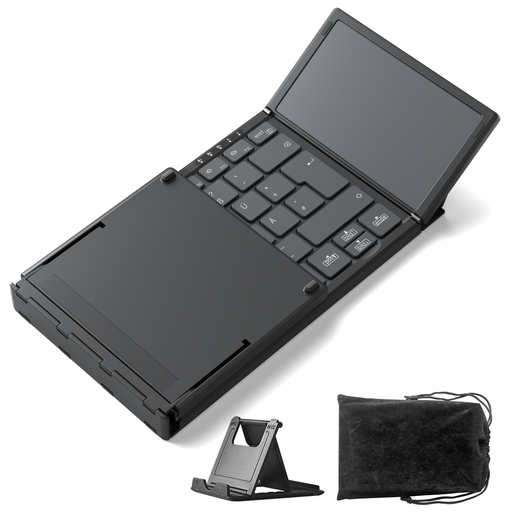 No image available
A folding option for travelling if you’d like a touchpad built into your keyboard.
This variant is listed with QWERTZ, three Bluetooth channels and compatibility with iPadOS, Android and Windows.
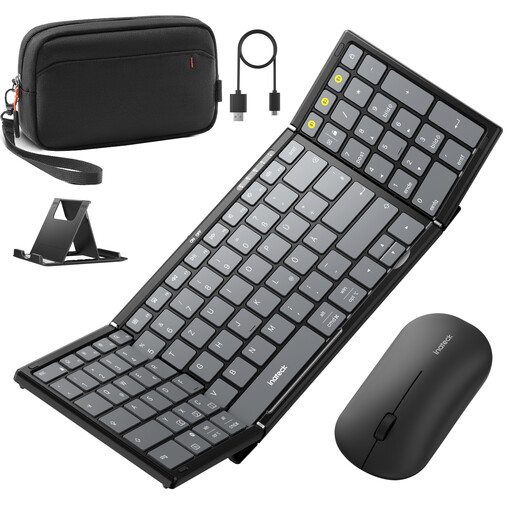 No image available
A folding option if you’d like to carry a keyboard and mouse together.
This variant is described as a QWERTZ keyboard with Bluetooth 5.3, a number pad, mouse, adjustable stand and carry case. It is listed as compatible with Windows, iOS or Android tablets, smartphones and laptops.
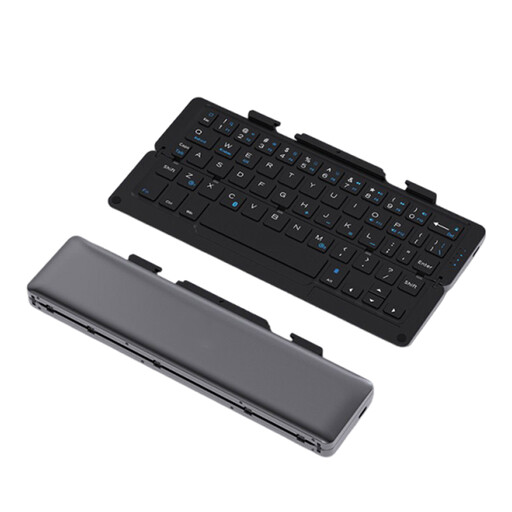 No image available
A folding keyboard for travelling if a magnetic stand is on your wish list.
This variant is described as rechargeable, with quiet keys and an aluminium casing; the listed colour is grey. It is specified for mobile phones and tablets.
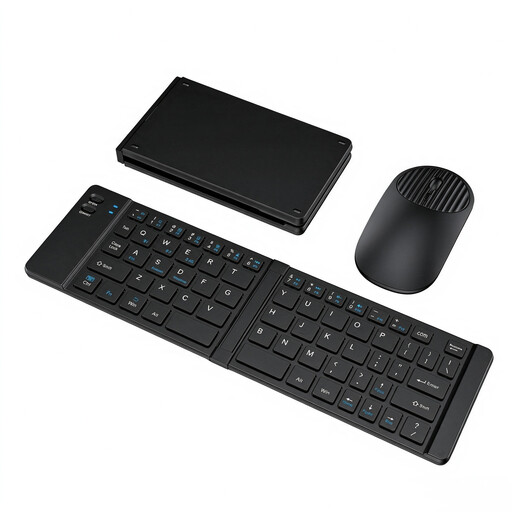 No image available
A folding set for travelling if you’d like a mouse to go with your keyboard.
This variant is described as having quiet scissor keys, three connection modes, USB-C charging and the ability to connect to up to three devices. Windows, Android and iOS are listed as compatible.
 No image available
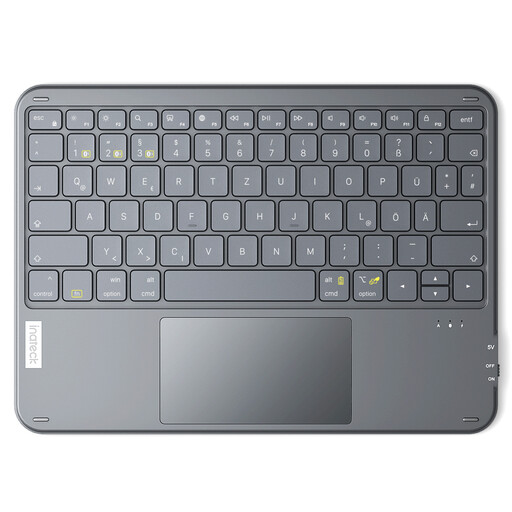
A rigid compact alternative if you want a touchpad and an explicitly German key layout.
This variant is listed as wireless, ultra-thin and Bluetooth-enabled. iPad, Android tablets, Windows, laptops and PCs are listed as compatible.
Not necessarily. ProtoArc recommends using the XK01 on a stable surface rather than your lap. Deutsche Bahn says many ICE seats have fixed or folding tables, but not every seat or train does.
No. Check the exact tablet generation and system requirements. Apple’s Magic Keyboard Folio is listed for the iPad (A16) and requires iPadOS 18.3 or later.
Pair the keyboard with the device you plan to write on during the journey, then test the layout and switching between devices. For the XK01, ProtoArc describes separate Bluetooth keys for pairing and switching between up to three devices.
No, a constant connection isn’t guaranteed. Deutsche Bahn warns that ICE Wi-Fi speeds can vary, and says Wi-Fi is available on selected local services only. Check whether your notes app makes the content you need available offline.
Under § 20 FuAG, radio equipment intended for non-professional users must come with instructions for use and safety information in German, as well as an EU declaration of conformity or simplified declaration. The Federal Network Agency also monitors CE marking. Check that the specific variant on offer meets these requirements.