
Lieferung heute & morgen

Qualitätsgarantie

Willkommens-Angebote freischalten: KOSTENLOSE Lieferung | Bis zu 80 % RABATT | Kostenlose 30-Tage-JoyPlus-Testphase
App herunterladen
A well-organized workspace is the foundation for focused and efficient work. A mobile pedestal is often the central solution for keeping documents, office supplies, and personal items organized and within easy reach. However, the selection is vast, and not every model lives up to its promise. Before making a decision, it's important to understand the common weaknesses that can quickly turn a practical assistant into a source of frustration.
Many buyers focus on aesthetics and the number of drawers, but overlook crucial construction details. The most common purchasing mistakes are caused by three typical problems:
To avoid these pitfalls, it's worth taking a closer look at the core features that define a functional and durable mobile pedestal.
A well-considered purchase is based on objective parameters, not marketing promises. Pay attention to the following three aspects to make an informed decision.
The longevity of a mobile pedestal depends directly on the material used. Models made from E1-grade engineered wood are a solid choice. This standard ensures low formaldehyde emissions, contributing to a healthier indoor environment. A melamine resin coating also makes the surfaces scratch-resistant, water-repellent, and easy to clean.
For more demanding requirements, especially if the cabinet will be used as a mobile file cabinet or needs to be locked, models with a steel frame or a full steel construction are preferable. They offer significantly greater stability and security. Always check the manufacturer's specified maximum load capacity, particularly for the top surface. A value of 50 kg, for example, ensures that even heavy multifunction printers can be placed safely.
The quality of the casters is crucial for functionality. A good office rolling cabinet has at least four smooth-rolling casters, two of which should be equipped with locking brakes. These brakes prevent the cabinet from rolling away unintentionally when you open a drawer or operate a device.
For models with deep or heavily loaded drawers, a fifth anti-tip caster on the front of the bottom drawer is an important safety feature. It prevents the cabinet from tipping forward when the drawer is fully extended. High-quality casters made of hard rubber or polyurethane are also gentler on floors than simple hard plastic ones.
An under-desk cabinet is meant to create order. Therefore, check carefully whether the internal layout meets your needs. Full-extension slides allow for convenient access to the entire contents of a drawer. If you plan to archive documents, make sure the bottom drawer is designed for A4 hanging files.
For confidential documents, a lockable rolling cabinet is essential. There are differences here: some models secure only one drawer, while others feature a central locking system that locks all drawers simultaneously. As a flexible under-desk cabinet, it should offer the exact combination of compartments you need for your workflow.
To make your selection easier, we have identified several models that meet specific user requirements and avoid the common pitfalls mentioned earlier.
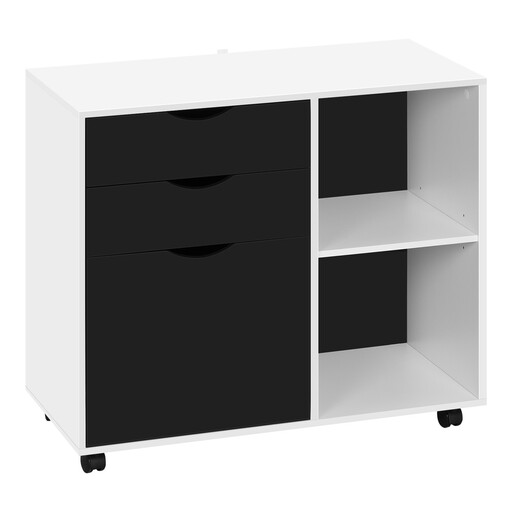
Why it's a great fit: Ideal for home office users who need a mix of quick access and secure storage. The hybrid design with open shelves and closed drawers adapts to dynamic workflows.
The bottom drawer includes a rail for A4 hanging files, solving the problem of incompatible formats. The 5-caster system with an anti-tip caster ensures the necessary stability.
Multifunctional design with open and closed storage; dedicated A4 hanging file rail for optimal document organization.
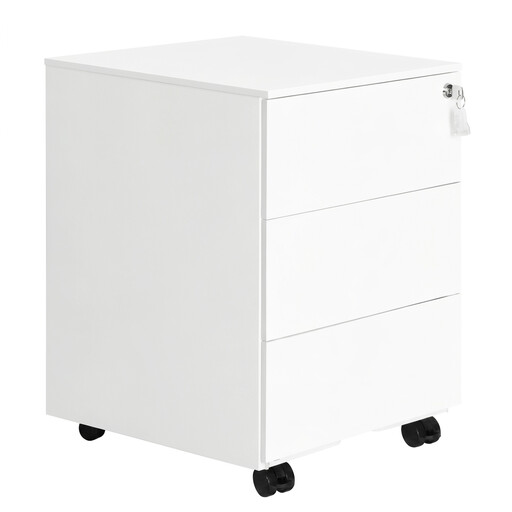
Why it's a great fit: For users who need to store confidential documents securely. The steel construction and lock provide the necessary security and robustness for professional environments.
The sturdy steel frame and a load capacity of 15 kg per drawer prevent sagging or jamming of overloaded drawers. The lock meets data security requirements.
Lockable for confidential documents; robust steel construction and pre-assembled delivery (only casters need to be attached).
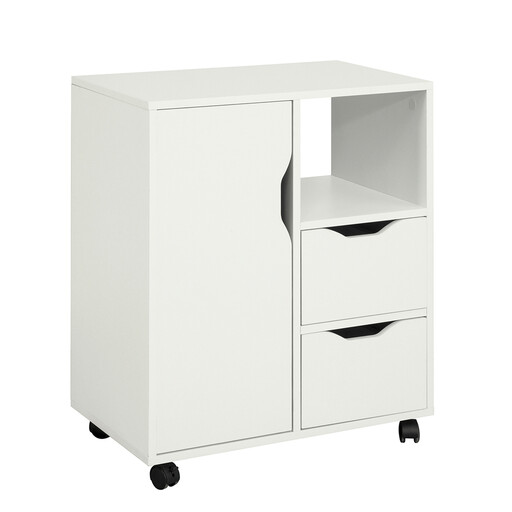
Why it's a great fit: Designed as a stable cabinet for heavy office equipment. With a load capacity of 50 kg, it provides a secure platform for large printers, scanners, or even 3D printers.
The reinforced panels and a net weight of approx. 19.5 kg ensure maximum stability and prevent the surface from sagging, a common weakness when used as a printer stand.
High load capacity of up to 50 kg; explicitly designed as a stable rolling printer stand that minimizes vibrations.
If you're redesigning your workspace and looking for matching furniture, we've curated a selection that meets strict criteria for design and functionality.
Ensure that at least two of the four casters have locking brakes. This provides a secure footing when the cabinet should not be moved. For heavily loaded models or those with deep drawers, a fifth anti-tip caster on the front of the bottom drawer is recommended to prevent tipping. The caster material should be suitable for your flooring; softer materials are gentler on sensitive floors like parquet or laminate.
The load capacity varies greatly depending on the model and construction. Simple engineered wood cabinets often only support 10–15 kg on the top surface. In contrast, a model designed as a rolling printer stand or a cabinet with a steel frame can have a maximum load capacity of 50 kg or more. Always check the manufacturer's specifications to ensure the cabinet is suitable for its intended purpose.
Not necessarily. The standard height for office desks is typically between 72 cm and 76 cm. Before buying, measure the exact height under your desktop and compare it with the total height of the mobile pedestal, including its casters. Plan for a few centimetres of clearance to ensure you can manoeuvre the under-desk cabinet comfortably.