
Lieferung heute & morgen

Qualitätsgarantie

Willkommens-Angebote freischalten: KOSTENLOSE Lieferung | Bis zu 80 % RABATT | Kostenlose 30-Tage-JoyPlus-Testphase
App herunterladen
A mobile storage cabinet on wheels can store documents, kitchen utensils and everyday essentials without taking up much space, and can be moved whenever needed. In practice, however, unclear dimensions, insufficient load capacity or unsuitable castors can quickly lead to a poor purchase. This guide explains which details really matter when buying a mobile storage cabinet.
A narrow cabinet on wheels may fit into an alcove, but offer very little space inside. So check more than just the width, depth and height:
For an office cabinet under a desk, the overall depth, including castors and handles, is particularly important.
A storage cabinet with four castors is easy to move. But without brakes, it may move unintentionally on smooth floors. Taller cabinets and fully loaded drawers also carry a greater risk of tipping. Look for:
Avoid pulling out several drawers at once when they’re heavily loaded. This is particularly important with narrow models.
‘Sturdy’ isn’t a technical specification. Specific details about the material, product weight and load capacity are more useful. A drawer cabinet made from MDF or chipboard may be suitable for office supplies, while tools or heavy equipment may need a different construction. The load capacity of the top panel may also differ from the cabinet’s overall load capacity.
Measure the available space at several points. If you’re choosing a printer cabinet on wheels, also allow for nearby sockets, cable trunking and the desk. A model with a depth of 35 cm may fit under a table, but you’ll still need room for cables and air circulation.
For the kitchen and bathroom, wipe-clean surfaces and enough distance from water sources are important. A bathroom cabinet on wheels shouldn’t be left standing in damp conditions. For a kitchen trolley, consider the working height, available space to move around and a stable surface for placing items.
A storage cabinet with drawers isn’t automatically suitable for files. Check whether A4 folders fit upright and how far the drawers can be pulled out.
360-degree swivel castors make it easier to move a cabinet around. If you have parquet, laminate or tiled floors, look for castors designed to protect the surface. For frequent moving, such as in a workshop or studio, easy-gliding castors and sturdy fixings are essential. Two castors with brakes may be enough to keep a kitchen trolley or filing cabinet in place, provided it’s on a level floor.
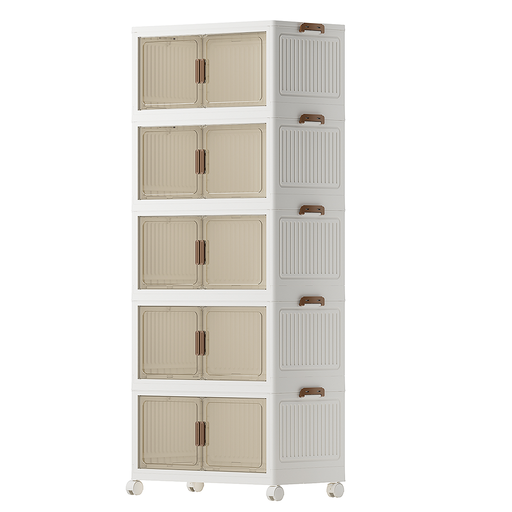
Why this product suits this profile: This 55 cm-wide, five-compartment folding cabinet is designed for living rooms, bedrooms or home offices, and can be set up without tools.
The product details specify the material, number of compartments and intended indoor use. Check the stated load limit before filling the cabinet.
PP plastic, magnetic fasteners, five compartments and nylon castors; folds away when not in use.
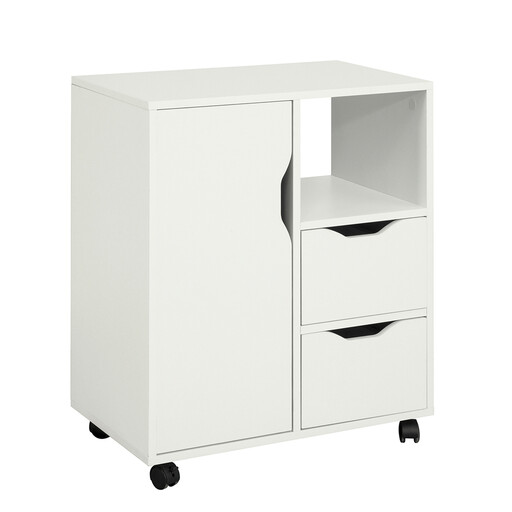
Why this product suits this profile: This model combines two drawers, a door and open shelves in a compact design for a home office, living room or kitchen.
The listed dimensions are 60 × 35 × 70 cm, with a maximum load of 50 kg. This makes it easier to check whether it’s suitable for a printer or office supplies.
Two drawers, a hinged door, two shelves and castors; materials listed as PB(E1), MDF and wood-based materials.
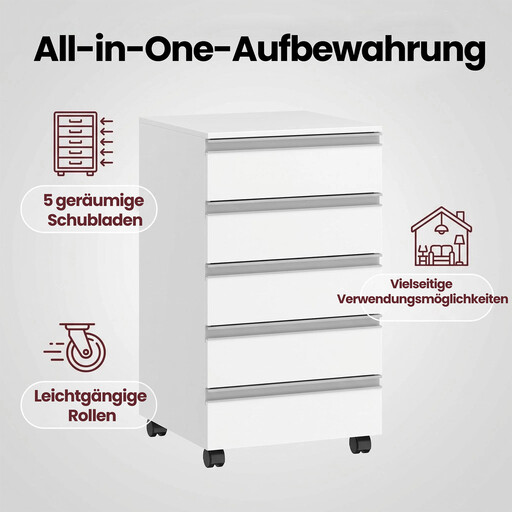
Why this product suits this profile: Five drawers and dimensions of around 40 × 40 × 66 cm make this cabinet a good fit for offices, studios and workshops where items need to be sorted and moved frequently.
The product description lists a total load capacity of up to 50 kg and two lockable front castors. Even so, distribute the load evenly.
Five drawers, 360-degree castors, lockable front castors and a coated chipboard and steel construction.
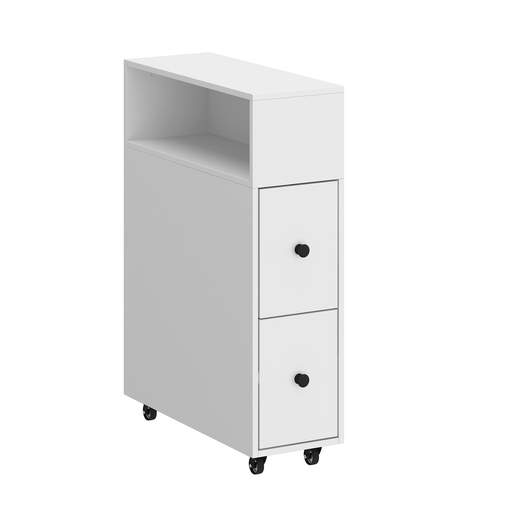
Why this product suits this profile: This slim cabinet combines an open compartment with two drawers and is designed for the kitchen, bathroom or utility room.
The description specifically recommends using a level surface, distributing the load evenly and taking care when opening heavily loaded drawers at the same time.
Four castors, one open compartment, two drawers and a white MDF finish; the listed dimensions are 72 × 48,6 × 4,8 cm.
We’ve put together a complete, regularly updated list of products that meet these strict selection criteria and the safety regulations in force in the EU.
Before using the cabinet for the first time, secure all screws, castors and fixings as instructed. After a few days, check that none of the screws have worked loose. For many coated surfaces, a soft, slightly damp cloth is all you need for cleaning. Harsh cleaners and abrasive products may damage the finish.
Place heavier items as low down as possible. Don’t use a cabinet on wheels as a seat or step. Children shouldn’t climb on trolleys or drawers. For electrical appliances such as printers, also make sure the cable isn’t pulled tight, allow for ventilation and check the stated load capacity.
Choose a model with a wide base and, ideally, lockable castors. Put heavier items in the lower compartments. Don’t pull out several fully loaded drawers at once, and place the cabinet on a level floor.
Its lifespan depends on the material, load, flooring and care. Frequent moving puts more strain on the castors and fixings than leaving it in one place. Regular checks, an even load and staying within the stated load capacity can help reduce wear.
A standard cabinet on wheels has no ongoing energy costs. Potential additional costs include assembly, replacement castors or repairs to damaged surfaces. If you use it as a printer cabinet, you’ll also have the running costs of the printer, not the cabinet itself.