
Lieferung heute & morgen

Qualitätsgarantie

Willkommens-Angebote freischalten: KOSTENLOSE Lieferung | Bis zu 80 % RABATT | Kostenlose 30-Tage-JoyPlus-Testphase
App herunterladen
A mobile transfer chair for seniors can make moving between bed, chair, wheelchair and bathroom much easier. For family members and carers, however, it is not just the price that matters. Load capacity, width, brakes and how easy it is to operate in practice all determine whether a walking and transfer aid is suitable for daily use.
When choosing a product, three common pitfalls can be avoided:
A transfer chair up to 180 kg should have a clearly stated weight limit. The model mentioned here specifies 180 kg and a steel frame. The weight limit should not be taken as a recommendation to push the chair to its maximum on a regular basis. Clothing, footwear and any movement during the transfer should all be factored into your individual assessment.
It is also important to check whether the rating applies to the whole chair or just individual components. For care homes and nursing services, this information should be included in the internal risk assessment and in user training.
A transfer chair with wheels must be able to move in a controlled way and lock securely in place. According to the product details, the model listed features 3-inch castors at the front and 4-inch castors at the rear. Two of the rear castors are described as lockable.
Before you buy, you should check:
The dimensions given for this model are 802 mm length, 645 mm front width and 440 mm rear width. You should compare the actual space available with your bed, toilet and door frames.
A transfer aid for those needing care should suit the specific transfer routine. The model described features a seat that rotates 180 degrees, a two-point construction and a fold-down seat opening. These features can make access easier, but they do not replace proper training or an assessment of the individual situation.
If you are looking for a commode chair with transfer function, pay particular attention to the seat opening, hygiene and cleaning options. Not every transfer chair with a fold-down seat is automatically suitable as a commode chair. What matters are the manufacturer's instructions on the intended use.
A standing aid for seniors is also not the same as a full lifting aid. If the person has severely limited ability to stand, balance problems or a high level of support needs, a professional assessment should be carried out before use.
The following selection matches the available model to different usage scenarios. The two laptop stands in the range are not suitable for this purpose and are therefore not recommended as transfer aids.
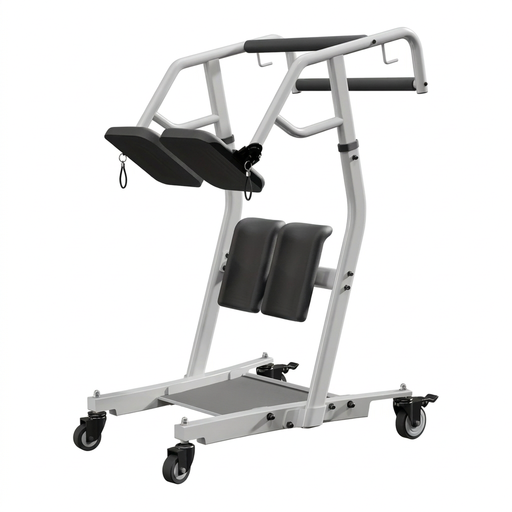
Why this product fits the profile: For households that need a mobile transfer aid for clearly defined transfers between seating and can check the dimensions beforehand.
The product details state the load capacity, dimensions, castor sizes and lockable rear castors. This means you can compare the key buying criteria before ordering.
Steel frame, stated load capacity of 180 kg and fold-down seat opening.
Why this product fits the profile: For buyers who want to consider concrete technical data and operating instructions before making a decision.
The manual refers to proper use and following safety instructions. Staff should practically check the functions before using the chair.
180-degree seat rotation, 30 kg net weight and a stated one-year manufacturer's warranty under the specified conditions.
Why this product fits the profile: For care households or facilities where a transfer chair with wheels is used regularly on different, pre-checked routes.
The different castor sizes and base dimensions are stated. This means routes, door widths and parking spaces can be checked before regular use.
Front and rear castors, two lockable rear castors and a stated package size of 850 × 295 × 430 mm.
We have put together a full, regularly updated list of products that fully meet these strict selection criteria and the safety regulations in force in the EU.
That depends on the design and the person's remaining mobility. A transfer chair can help when moving between seating surfaces, but it is not automatically a full lifting aid. The carer should practise the process without time pressure and follow the instructions.
It is not possible to give a reliable overall lifespan. It depends on how often it is used, the user's weight, the floor surface, cleaning and maintenance. Castors, brakes, seat fixings and moving parts should be checked regularly. The model mentioned comes with a one-year warranty; wear parts, lifting mechanisms and damage from improper use are excluded according to the product details.
In addition to the purchase price, you may have costs for cleaning, maintenance and replacing worn parts. For care facilities, you should also budget for training, inspection intervals and usage documentation. With an ergonomic transfer chair, it is not just the initial purchase that matters, but also how practical it is to use in your specific setting over the long term.