
Lieferung heute & morgen

Qualitätsgarantie

Willkommens-Angebote freischalten: KOSTENLOSE Lieferung | Bis zu 80 % RABATT | Kostenlose 30-Tage-JoyPlus-Testphase
App herunterladen
A mobile Type 2 EV charger can be a flexible addition to a public charging station or wallbox. It's suitable for many electric cars and plug-in hybrids with a Type 2 charging port, such as the Tesla Model 3 and Model Y, VW ID models or the Škoda Enyaq. However, portable electric car chargers differ significantly in terms of connection, charging power, safety features and operation.
If you only focus on a high kilowatt rating or app control, you'll miss important details. Three typical buying mistakes are particularly relevant:
A Schuko electric car charger uses a standard 230-volt household socket. Depending on the setting, 8, 10, 13 or 16 A are usually possible. At 16 A, this gives a theoretical power of around 3.7 kW. For regular home electric car charging, the socket must be suitable for this purpose. If you're unsure, it's wise to have it checked by a qualified electrician. Unapproved extension cables or adapters increase the risk of overheating.
A CEE electric car charger is operated at a dedicated industrial socket. A single-phase 3.7 kW charger, for example, uses CEE 16 A, while an 11 kW charger typically requires a three-phase connection. A 22 kW charger usually requires a suitable three-phase 32 A circuit. Your vehicle must also support the respective AC charging power.
The vehicle connector should comply with the IEC 62196-2, Type 2 standard. This primarily describes the mechanical and electrical interface, not the maximum charging speed of each vehicle. A plug-in hybrid often charges at a lower AC power, even if the mobile electric car charger can deliver 11 kW or 22 kW.
Check before you buy:
A mobile EVSE charger handles communication between the vehicle and the power supply. Clearly described functions such as overcurrent, overvoltage, undervoltage, overheat and short-circuit protection are useful. A 30 mA AC and 6 mA DC residual current detection may be part of the charger, depending on the model. The requirements of your specific electrical installation remain unaffected.
Also practical are an adjustable charging current, a charger with a timer, a display for voltage and current, and – where network coverage allows – an EV charger with an app. App functions should not be seen as a mandatory safety certificate. What matters are the technical specifications, the instruction manual and the correct installation.

Why this product fits the profile: For occasional charging at home, on trips or as a backup, this model offers a Schuko connection, a maximum power of 3.68 kW and an 8 m cable.
The charging current can be adjusted up to 16 A. Earth detection, temperature monitoring and AC and DC residual current protection are also specified.
Timer from 0 to 8 hours, LED display and optionally available cable lengths. Suitable for Type 2 vehicles and plug-in hybrids.
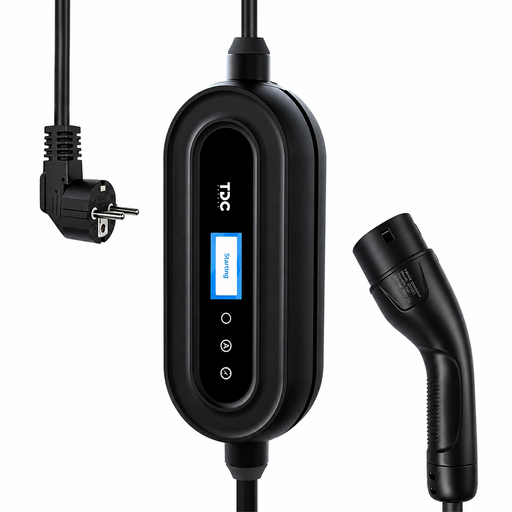
Why this product fits the profile: This device combines four selectable current levels with app and Bluetooth support, plus a compact design for home and on the go.
The 8, 10, 13 and 16 A settings allow you to adapt to the appropriate socket and fuse protection. The manual advises against using unsuitable adapters and extensions.
IP66, LCD display, 5 m cable and protection functions including earth monitoring and AC and 6 mA DC residual current protection.
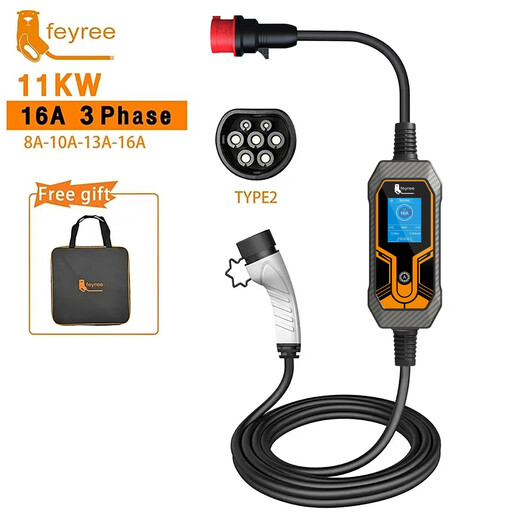
Why this product fits the profile: For users with a suitable CEE infrastructure who need a mobile 11 kW charger for travel, visits or different parking spaces.
The CEE connection makes the required infrastructure clear. The LCD display and adjustable charging current make it easy to monitor the charging process.
Type 2 according to IEC 62196-2, IP65 and protection against overcurrent, overvoltage, undervoltage, residual current and overheating.
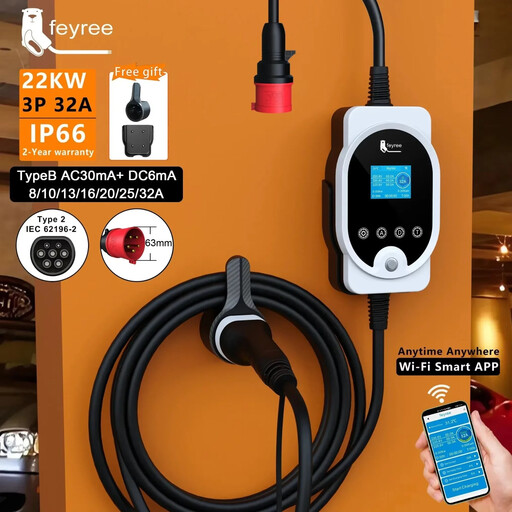
Why this product fits the profile: This model is aimed at users with a suitable three-phase 32 A infrastructure who want to combine mobile and wall-mounted charging.
The current can be adjusted in several steps up to 32 A. Before use, you must check whether the vehicle, household connection and installation support three-phase charging at this power.
Wi-Fi and Bluetooth connectivity, scheduling, charging log, IP66 and Type B residual current protection with AC and DC detection according to product specifications.
We've put together a complete, regularly updated list of products that fully meet these strict selection criteria and the safety regulations in force in the EU.
Not without checking. The socket must be suitable for the selected continuous load and correctly fused. For longer charging sessions, a reduced current setting is often more sensible than the maximum setting. Damaged, loose or unusually warm sockets must not be used.
The lifespan depends on usage, storage, temperature, mechanical stress and the quality of the electrical installation. Dry storage, clean contacts and a kink-free cable can help maintain everyday usability. If you notice cracks, deformation, error messages or unusual heating, the device should be taken out of service.
The electricity costs depend on the vehicle's energy consumption and your individual electricity tariff. Timer or app functions can control the start time, for example during cheaper tariff periods. However, they do not automatically change the vehicle's energy consumption. The actual power delivered also depends on the vehicle, state of charge and mains connection.