
Lieferung heute & morgen

Qualitätsgarantie

Willkommens-Angebote freischalten: KOSTENLOSE Lieferung | Bis zu 80 % RABATT | Kostenlose 30-Tage-JoyPlus-Testphase
App herunterladen
A mobile Type 2 EV charger with a Schuko plug is a flexible alternative to a permanently installed wallbox for many electric car and plug-in hybrid owners. It can be used at home, while travelling or at relatives’ homes with a suitable 230-V socket. However, mobile EV chargers vary considerably in terms of current, safety features, cable length and operation.
The following points can help you avoid common buying mistakes and choose an electric car charger for home and on the go that suits your vehicle and power connection.
A 16A charger can theoretically deliver up to around 3.7 kW at 230 V. However, this requires a suitable, technically sound Schuko socket and a domestic electrical installation with sufficient capacity. With older installations or unknown wiring, a lower setting, such as 10 A, may be advisable.
If you want to charge continuously at high power, have the installation checked by a qualified electrician. An ordinary household socket is not automatically designed for several hours of continuous load.
A 10 or 15-m Type 2 charging cable provides extra reach between the socket and the vehicle, but it is more difficult to store and requires more space. For a parking space directly next to the house, 5 to 8 m is often sufficient. For a remote garage or changing parking positions, 10 m or more may be more practical.
It is also important that the cable remains flexible, can be rolled up neatly and that the charge controller is positioned safely. A cable that is too short, on the other hand, can quickly place strain on the plug.
An EVSE charger monitors the charging process and controls, among other things, current authorisation and safety shut-offs. Statements about overcurrent, overheating or residual-current protection should not merely be mentioned as marketing claims. Look for specific values and functions, such as:
In Germany and Europe, many BEVs and PHEVs use a Type 2 connection in accordance with IEC 62196-2. These include many Tesla Model 3 and Model Y vehicles, Volkswagen ID models, Škoda Enyaq, as well as Audi, Volvo, Hyundai and Kia vehicles. Nevertheless, you should check the specific vehicle connection before buying.
The actual charging power depends on three factors: the socket, the mobile EV charger and the car’s onboard charger. A 3.7-kW EV charger will therefore not automatically deliver 3.7 kW with every vehicle.
A 16A charger with several settings is more versatile in everyday use than a model with one fixed current setting. Typical settings are 6 A, 8 A, 10 A, 13 A and 16 A. Reducing the current may be advisable with older wiring, shared circuits or longer overnight charging sessions.
When connecting the charger, do not use multi-socket adapters, cable reels or unsuitable extension leads. The Schuko plug must be fully inserted into the socket without any mechanical strain.
A timer charging function allows you to charge at a later time, for example when electricity rates are lower. It is important to check whether the time is set in hours or as a start delay, and whether the charger saves the last current setting.
An LCD or LED display can show voltage, current, temperature, charging time and power. This information makes monitoring easier, but it does not replace an inspection of the domestic electrical installation. Energy-saving claims generally refer to being able to schedule charging outside expensive tariff periods; the device itself does not automatically reduce the vehicle’s electricity consumption.
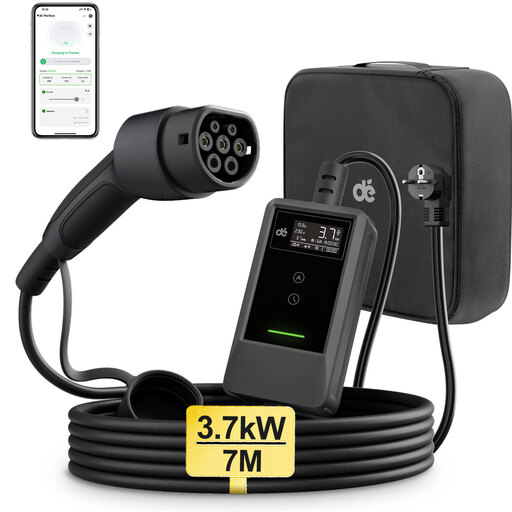
Why this product suits the profile: The combination of a Schuko plug, 7-m cable, 6–16 A range and app control covers typical charging situations at home and on the go.
The current can be adjusted, so you do not have to charge continuously at 16 A. The 7 m length also reduces the risk of the cable being too short.
App functions, LCD display and an adjustable range of 6–16 A according to the product specifications.
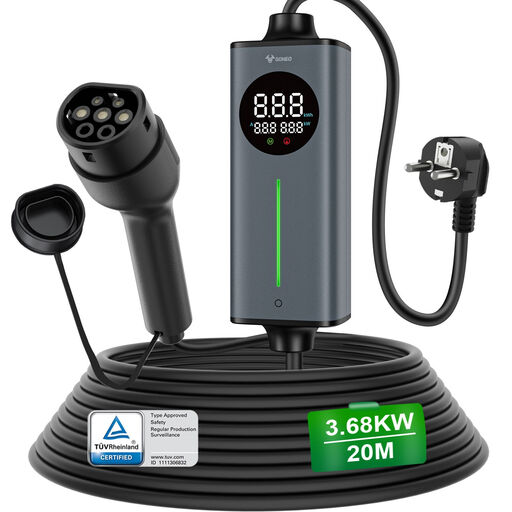
Why this product suits the profile: The 20-m version is suitable for users with a remote parking space, a large driveway or changing charging locations.
The product specifications state 30 mA AC and 6 mA DC RCD protection, earth connection detection and temperature monitoring. This gives a clearer description of the safety features than general safety claims.
Up to 16 A, 0–8-hour timer, LCD display and 20 m cable length according to the product description.
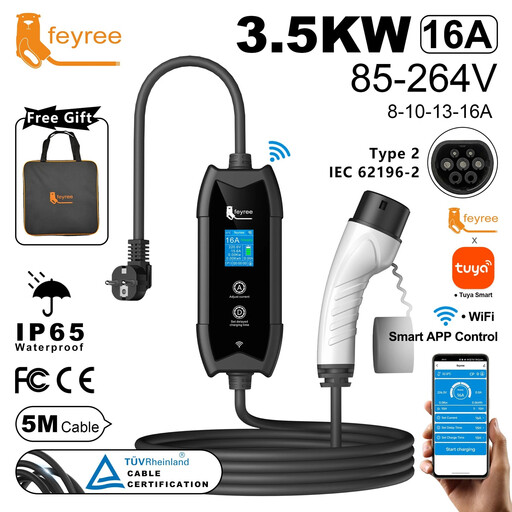
Why this product suits the profile: For regular electric car charging from different Schuko sockets, this model offers app control, a delay function and a compact 5-m solution.
The current can be adjusted between 8 A and 16 A. The integrated specifications for overcurrent, overheating, earth connection and residual-current protection make it easier to assess the technical features.
1.8-inch LCD display, app control, 8–16 A adjustment and delayed charging for 1–15 hours.
We have put together a complete, regularly updated list of products that fully meet these strict selection criteria and the safety regulations applicable in the EU.
At 230 V and 16 A, around 3.68 kW is theoretically possible. At 10 A, the power is approximately 2.3 kW. The actual charging speed also depends on the vehicle, state of charge, battery management system and onboard charger. Due to their smaller batteries, plug-in hybrids often require less charging time than fully electric vehicles.
This depends on the socket, electrical installation, current setting and charging frequency. A mobile charger is practical for occasional charging and travelling. If you use it daily for several hours, a qualified electrician should check whether the socket, circuit protection and residual-current protection are suitable for the load. An adjustable current setting allows for more cautious adjustment.
The cost is calculated from the vehicle’s electricity consumption and the applicable unit rate of your electricity tariff. Timer and scheduling functions can shift charging to cheaper tariff periods. Charging losses between the socket and the battery are possible and should be taken into account when planning costs realistically.