
Lieferung heute & morgen

Qualitätsgarantie

Willkommens-Angebote freischalten: KOSTENLOSE Lieferung | Bis zu 80 % RABATT | Kostenlose 30-Tage-JoyPlus-Testphase
App herunterladen
As a driver of an electric car or plug-in hybrid, you're faced with the question of how to charge your vehicle most efficiently. A permanently installed wallbox is one option, but it comes with installation costs and is often impractical for renters or frequent travellers. A mobile wallbox offers a flexible and high-performance alternative.
This article serves as a guide. It explains the key technical features of a portable EV charger and presents various models to provide you with a solid basis for making a decision that suits your individual needs.
To find the right mobile charging station for your EV, several technical aspects are crucial. Understanding these parameters will help you select a device that matches your vehicle, your available power connections, and your daily routine.
The charging power, measured in kilowatts (kW), determines how quickly your vehicle's battery charges. It depends on the charger itself, the power connection used, and your EV's onboard charger.
Safety is paramount when charging electric vehicles. High-quality mobile chargers, often referred to as ICCB charging cables (In-Cable Control Box), have a range of integrated protection mechanisms. Look for the following features:
Modern devices often offer more than just basic charging. A Smart EV Charger with App can significantly enhance convenience and efficiency.
Based on the criteria mentioned, we have compiled a selection of mobile chargers that cover various use cases.

Why it stands out: This charger is designed for simplicity and safety when charging from a common Schuko household socket. It combines basic charging functions with comprehensive protection mechanisms.
Advantages:
Who is it for? For EV drivers looking for a straightforward and safe solution for charging at home, at a friend's house, or as a replacement for a basic emergency EV charging cable, who primarily charge using standard household sockets.
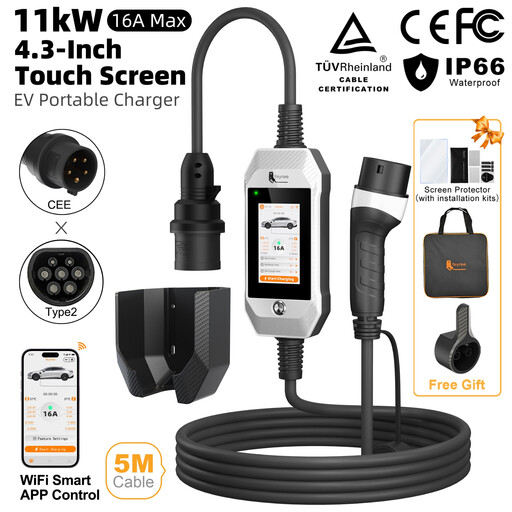
Why it stands out: This model combines the higher charging power of 11 kW with modern control concepts like a touchscreen and full app integration.
Advantages:
Who is it for? For users with access to a CEE 16A high-power socket who want significantly faster charging than a Schuko outlet and value smart features, data control, and a modern user interface.
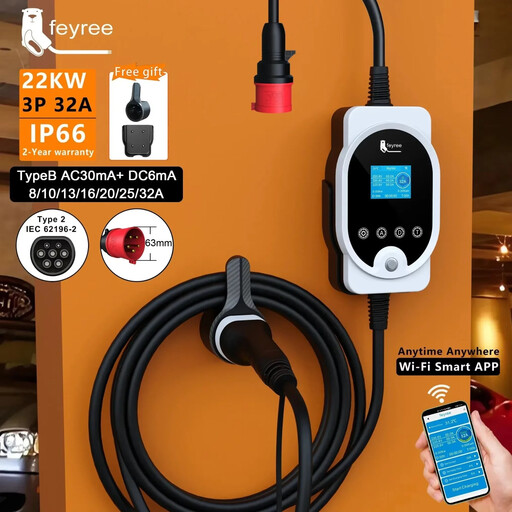
Why it stands out: This charger offers the maximum available mobile charging power at 22 kW, aimed at users who want to reduce charging time to a minimum.
Advantages:
Who is it for? For drivers of electric vehicles with a 22 kW onboard charger who have regular access to a CEE 32A industrial socket and want the fastest possible mobile charging option without installing a permanent wallbox.
The models presented cover common use cases. However, if you have different requirements, such as specific cable lengths, adapters, or other features, you may find a suitable alternative in our broader selection.
Discover more models in our Type 3 Electric Vehicle Charger category.
An emergency EV charging cable, often called an ICCB cable, is typically designed for slow charging from a low-power Schuko socket. A mobile wallbox is more versatile: it often provides higher charging power (e.g., 11 kW or 22 kW via CEE adapters), advanced safety features like a Type B RCD, and smart control options via an app.
In principle, charging an EV from a socket is possible, but the type of socket determines the speed and safety. A Schuko socket is not always designed for continuous high loads and should only be used at a reduced current and after being checked by a qualified professional. CEE sockets (high-power current) are designed for high continuous loads and enable much faster and safer charging with a compatible portable EV charger.
A Mobile Wallbox 11kW delivers 11 kilowatt-hours (kWh) of energy to the vehicle's battery per hour. An electric car with a 55 kWh battery capacity would theoretically take about 5 hours to charge completely from 0 to 100%. In practice, the charging time can vary due to factors like battery temperature and the vehicle's battery management system.