
Lieferung heute & morgen

Qualitätsgarantie

Willkommens-Angebote freischalten: KOSTENLOSE Lieferung | Bis zu 80 % RABATT | Kostenlose 30-Tage-JoyPlus-Testphase
App herunterladen
Buying an electric car is a big step, but choosing the right charging solution presents a challenge for many owners. A permanently installed wallbox often seems out of reach, especially for renters or those without a dedicated parking spot where installation is possible. A Mobile Wallbox promises a solution: flexibility, lower costs, and the ability to charge at various locations. But the market is crowded and full of products whose promises don't hold up in practice.
As your Joybuy Product Recommendation Officer, I'll help you separate the wheat from the chaff. We'll highlight the most common pitfalls and show you which technical features truly matter, so you can make an informed and safe decision.
Many offers sound tempting, but they often hide technical flaws or exaggerated marketing claims. You should absolutely avoid these three mistakes:
To find a safe and efficient charging solution, you should carefully examine three core aspects. These determine the speed, safety, and practical everyday usability.
Charging power is the decisive factor for charging speed. Mobile charging stations are mainly offered in three power classes:
A high-quality mobile wallbox is more than just a cable with a plug. It is an intelligent protective device between the power grid and your vehicle. Be sure to look for the following features listed in the product data sheets:
Well-designed app functionality offers tangible benefits that go beyond being a mere gimmick:
Based on the criteria mentioned, we have identified some products that are suitable for different requirements.
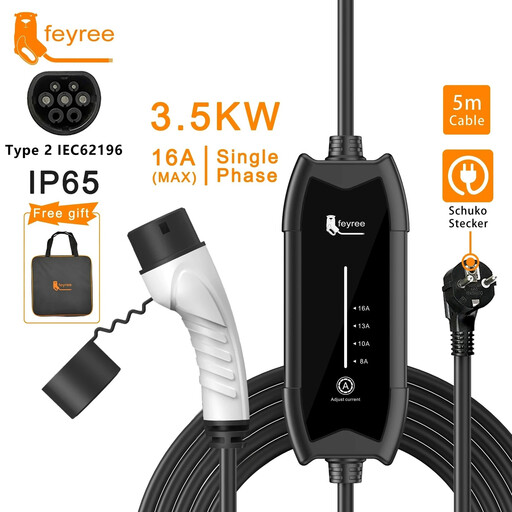
Why This Fits Their Persona: Ideal for plug-in hybrid owners or drivers who are primarily looking for a safe and flexible alternative to a simple emergency charging cable for a Schuko socket, without having to invest in an expensive high-power installation.
Unlike a simple emergency cable, this device offers adjustable amperage (8A-16A) to adapt to the home's electrical system and includes essential safety mechanisms like overheating and overvoltage protection.
High flexibility thanks to operation on any standard Schuko socket. The adjustable amperage ensures safe operation even on older electrical circuits.
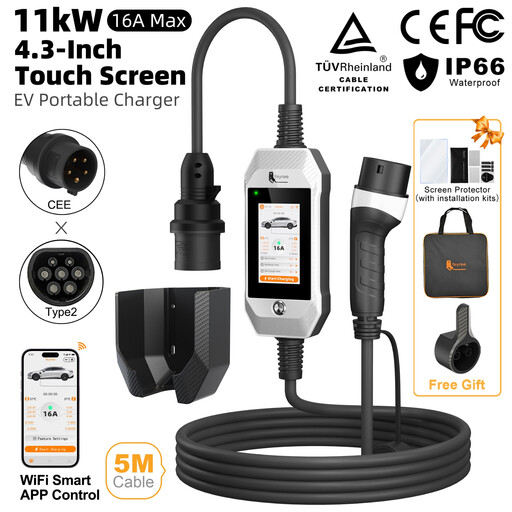
Why This Fits Their Persona: Perfect for BEV drivers who want a powerful 11 kW charging solution for home (with a CEE connection) but also want to remain flexible when travelling or visiting friends. The combination of an app and a touchscreen offers maximum convenience.
This device integrates a full-fledged RCD (Type B: AC 30mA + DC 6mA) and dual temperature monitoring. The Tuya Smart App is well-established and offers useful features like charge scheduling and remote control.
Delivers a high charging speed of 11 kW for daily use. Control via the app and touchscreen allows for intuitive operation and full control over the charging process, including a detailed charging history.
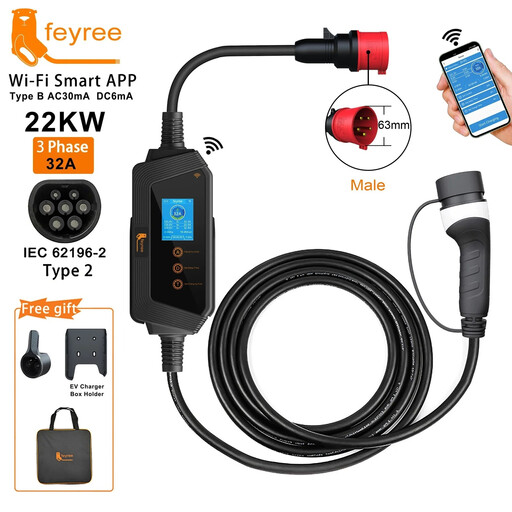
Why This Fits Their Persona: For drivers of EVs with large batteries and a 22 kW onboard charger who want to maximise charging speed. This requires access to a 32A CEE socket and approval from the grid operator.
Despite its high power, all relevant safety features are on board, including a Type B RCD (AC 30mA + DC 6mA) and overheating protection. The app control allows for safe and scheduled use of the high charging power.
Maximum mobile charging power of 22 kW, which significantly reduces the vehicle's downtime. The ability to use the device both portably and stationary with a wall mount offers additional flexibility.
We have compiled a complete, up-to-date list of products that fully meet these strict selection criteria and German safety regulations.
1. Do I need a permit from the grid operator for a mobile wallbox? For mobile charging stations with a power of up to and including 11 kW, only a registration with the responsible grid operator is required in Germany. This is usually a simple, informal process. For all chargers with a power of more than 11 kW (e.g., 22 kW), approval from the grid operator is mandatory before commissioning.
2. Can I operate a mobile wallbox on a normal Schuko domestic socket? Yes, many portable chargers are either designed directly for Schuko sockets or can be operated with an adapter. However, the charging power is limited to a maximum of 3.7 kW. For safety reasons, it is recommended to manually reduce the amperage to 10A (equivalent to 2.3 kW) to avoid continuous load on the household wiring. This option offers maximum flexibility but is not the primary solution for fast charging of large batteries.
3. How safe is a portable EV charger compared to a fixed wallbox? A high-quality, certified portable EV charger with all the mentioned safety mechanisms (especially Type B RCD and temperature monitoring) offers a level of safety comparable to a permanently installed wallbox. The biggest potential weak point is not the charger itself, but the socket it is connected to. Using a professionally installed CEE industrial socket is the safest method for regular operation at high power.