
Lieferung heute & morgen

Qualitätsgarantie

Willkommens-Angebote freischalten: KOSTENLOSE Lieferung | Bis zu 80 % RABATT | Kostenlose 30-Tage-JoyPlus-Testphase
App herunterladen
Choosing the right mobility aids for seniors starts not with design, but with the specific daily situation. Do you need help with short distances around the home, a seat for resting, support during transfers, or assistance for longer outdoor journeys? Depending on your needs, a folding walking aid, a rollator with seat, a manual or electric wheelchair, a transfer chair or a mobility scooter could be the right choice.
As a Joybuy Product Recommendation Officer, I filter relevant product data and highlight points that are easily overlooked in marketing descriptions. This helps you better assess which mobility aid for older people suits your living environment, physical capabilities and transport needs.
A stated maximum load usually refers to the person, and sometimes additionally to luggage or accessories. If you regularly carry a bag, shopping or medical equipment, you should allow sufficient margin below the stated maximum weight. It is also crucial to know whether the weight capacity applies to the seat, the frame or the entire vehicle.
A folding wheelchair can save space in the boot, but weight, folded dimensions and handling determine its practical usefulness. A model weighing 26 kg is loaded very differently from a travel wheelchair weighing 8.5 kg. Before buying, you should compare the folded dimensions with your boot opening, lift and storage space.
An electric wheelchair, an electric walking aid and a 3-wheel mobility scooter are not automatically subject to the same rules. A mobility scooter with a top speed of 25 km/h may be classified as a motor vehicle. For use on public roads, third-party liability insurance, insurance number plate, driving licence and helmet may be required. The information in the individual CoC document and German law are decisive.
In addition to the maximum load, seat width, seat depth and seat height are important. With a manual wheelchair offering 42 cm seat width and 41 cm seat depth, you should check whether the seating position provides sufficient freedom of movement. For a transfer chair, it is also relevant whether the seat is swivel or folding, and how close the device can get to the bed, armchair or toilet.
For travel and transport in the car, packed size and weight are crucial. An electric wheelchair with a net weight of 26 kg may still be manageable for some households, while an 8.5 kg lightweight wheelchair opens up other possibilities. For motorised models, the turning circle should suit your home. A turning circle of 750 mm is more practical for narrow hallways and lifts than a significantly larger radius.
For indoor use, compact wheels and a small turning circle are useful. Outdoors, wheel size, ground clearance and obstacle height affect usability. A model with an electromagnetic brake requires clear operating instructions and safe training. For a rollator with seat, lockable brakes, a stable seat surface and an appropriate handle height are particularly important.
With a mobility scooter for seniors, you should also consider motor power, battery type, range under realistic conditions and charging location. The advertised range can vary due to weight, inclines, temperature and terrain.
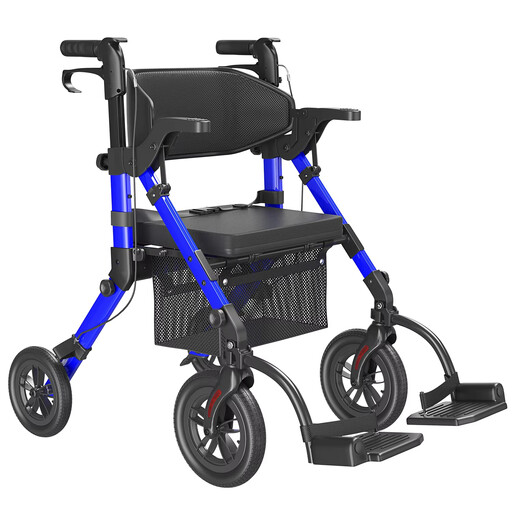
Why this product suits the profile: The folding walking aid combines a walking support function with a seating option, and is suitable for people who want to combine short distances with regular rest breaks.
The stated folded dimensions of 365 × 605 × 990 mm and weight capacity of 136 kg make transport planning and weight checking straightforward.
10-inch front wheels, 8-inch rear wheels and a stated product weight of 10.4 kg.
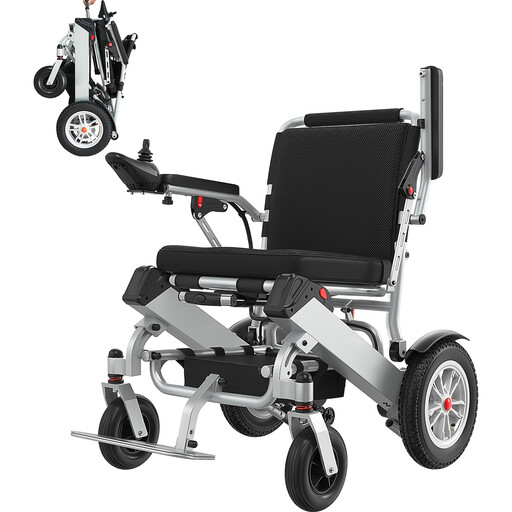
Why this product suits the profile: This model is aimed at users who want to combine electric assistance, foldability and clearly stated technical specifications for both indoor and outdoor use.
Motor power, battery, turning circle and obstacle height are all clearly stated, making it easy to compare with your intended use location.
Aluminium frame, two 250 W motors, electromagnetic brake, 120 kg maximum load and 26 kg net weight including battery.
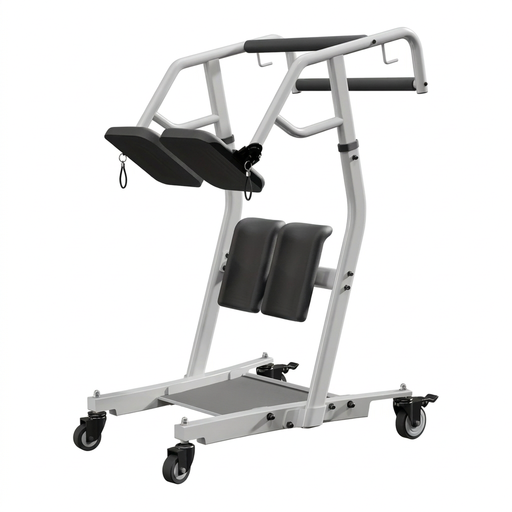
Why this product suits the profile: The transfer chair is designed for moving between seating surfaces and could be a suitable option for households with regular transfer needs.
The dual-lockable rear wheels, 180-degree seat rotation and folding seat opening can all be checked concretely before purchase.
Steel frame, stated weight capacity of 180 kg and 802 mm base length.
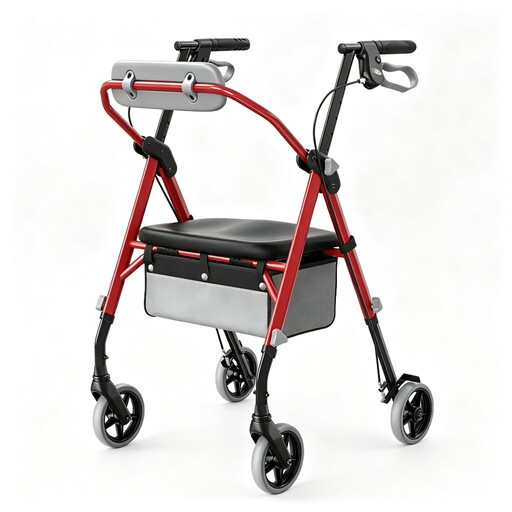
Why this product suits the profile: The low net weight of 8.5 kg may be of interest to carers who need to regularly store or carry a travel wheelchair in the car.
Weight, seat dimensions, handle height range and bag capacity are all listed separately, preventing a blanket assessment of transport suitability.
Folding design, 5-step adjustable handle range from 80 to 93 cm and bag with a stated capacity of 5 kg.
For a motorised vehicle such as the Chunlai CL-06Z-60, additional checks apply: the product information states EU type approval as an L2e-P three-wheeler, a top speed of 25 km/h and a 1,000 W motor. In Germany, according to the vehicle information provided, you must observe CoC, third-party liability insurance, insurance number plate, driving licence class AM and a suitable protective helmet. Before using it on public roads, you should check the individual documents and current authority information.
We have compiled a complete, regularly updated list of products that fully meet these strict selection criteria and the safety regulations in force in the EU.
A rollator with seat or a folding walking aid may be suitable if the person can still walk independently and only needs a seat occasionally. Important factors are correctly adjusted handles, working brakes and a safe, level surface.
In addition to the purchase price, there are costs for charging, possible replacement batteries, tyres, brake parts and maintenance. With lithium batteries, you should follow the manufacturer's instructions for storage, charger and ambient temperature. The actual range depends on factors including load, incline and driving style.
The service life depends on frame material, load, storage, terrain and maintenance. Moving parts, brakes, wheels and batteries may wear out sooner than the frame. Before buying, you should check the availability of spare parts, warranty coverage and exclusions for consumable items.