Close-up filming at the workbench
You film track, wiring or small components up close and want to check focus and exposure as you work.


For close-ups at your model railway workbench, a compact HDMI monitor with focus and exposure tools is a good choice, provided the camera output is compatible with the monitor. For a fixed overhead view from a little further away, a larger display may be more practical. You only need a recorder if you also want to record externally. Check the HDMI format, native display resolution, mounting and power supply separately: a 4K HDMI input does not mean the display is 4K or that it can record.
You film track, wiring or small components up close and want to check focus and exposure as you work.
You want a clear view of the layout and your hands from a fixed camera position. Display size, positioning and a suitable power supply all matter for your set-up.
You want to monitor longer or repeated tasks and check whether the camera records footage itself or needs an external recorder.
A good fit if: You check focus and exposure while working up close, and your camera records the footage itself. Atomos lists a 5-inch display with monitoring tools for the Shinobi II.
The trade-off: A smaller screen is less convenient to view from further away. In Atomos’ range overview, an HDMI loop-through output is listed for the 7-inch models mentioned.
A good fit if: You want to see the layout from a little further away or send the signal to another display. NEEWER lists the F700 as a 7-inch model with HDMI input and output.
The trade-off: A larger display takes up more room around your layout. The stated panel resolution of the NEEWER F700 is 1920 × 1080 pixels.
A good fit if: You specifically want to record externally or need a recording format supported by your camera. Blackmagic Design offers Video Assist models with built-in recording.
The trade-off: Recording formats, camera and storage media must all be compatible with the specific model. According to the manufacturer, Blackmagic RAW requires a supported camera.
| What you need | What to check before buying | Who it matters to most |
|---|---|---|
| See small details clearly | Check that the specific model offers focus peaking, image magnification and exposure tools. | If I want to focus on small components, I need to be able to check focus and exposure while recording. Around 36% of consumers would prioritise seeing details clearly when choosing a monitor. |
| See the layout from further away | Check the display size and mounting against the space available at your workbench. Only plan for an HDMI output if you need a second display. | For a fixed overhead view, I want to see the whole work area from my workstation. Around 29% of consumers would prioritise a clear view from a little further away. |
| Connections and power supply | Check that the camera’s HDMI format and frame rate match the monitor input. Also check the cables, mounting and recommended power source. | For my set-up to work, the camera connection and power supply need to suit my filming location. Around 21% of consumers would focus mainly on connections and power supply. |
| Record externally | Check whether recording in-camera is enough. If not, check the recorder’s recording format, camera compatibility and storage media. | If I want to record files externally as well as monitor the image, I need a compatible recorder and camera. Around 14% of consumers would consider external recording first. |
An input that accepts a 4K signal does not determine the display’s native resolution. Atomos lists a 4K HDMI input and a display resolution of 1920 × 1080 pixels for the Shinobi II.
Check the input formats and native panel resolution separately.
A camera monitor displays the image; recording files externally is an additional function. Before comparing models, check whether your camera records footage itself or needs a recorder.
A recorder may also require compatible storage media.
What’s included can vary depending on the product variant on offer. FEELWORLD notes that the F6 PLUS is available in different configurations.
Check the specific offer to see which power supply and accessories are included, and what you’ll need for your planned recording time.
Depending on what’s included, you may need to buy a compatible battery, mains adapter or cable separately.
The Shinobi range is aimed at buyers looking for a display to monitor their footage.
Models such as the F6 PLUS and F5 PROX are designed for compact HDMI monitor set-ups.
The F700 is an option if you’re looking for a 7-inch monitor with HDMI loop-through.
The LH5P II combines a compact HDMI display with monitoring tools.
Video Assist is aimed at buyers who want to record externally as well as monitor their footage.
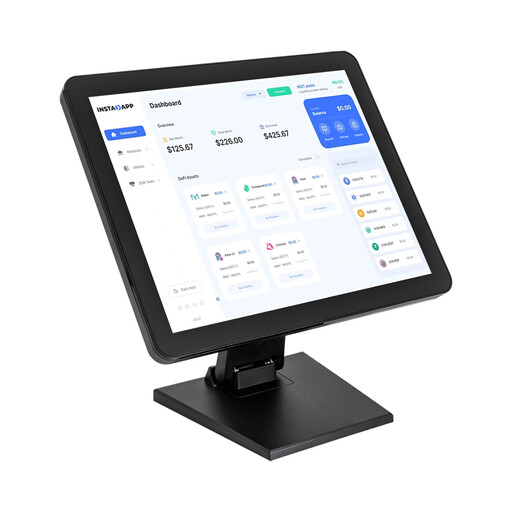
This selection features an HDMI monitor for a fixed studio view at your workbench. Before buying, check that the camera output, set-up and connections suit your needs.
 No image available
Could be suitable for a fixed studio view if the camera’s HDMI signal is compatible and you can position the monitor where you need it. The product title lists uses in POS systems, industry and self-service.
Resolution: 1280 × 1024; adjustable angle: 0–90°.
Connections listed in the product title: VGA, HDMI and USB; touch: 10-point.
Not necessarily. Atomos lists a 4K HDMI input for the Shinobi II, but its display resolution is 1920 × 1080 pixels. Check the input format and native display resolution separately.
Position it so you can see the frame and focus while you’re working. Check which HDMI signal your camera outputs, where the monitor and cables will be mounted, and which power supply the specific device variant supports.
Only if you want to record externally as well as monitor the image. Blackmagic Design lists built-in recorders for Video Assist; recording formats and compatible storage media must suit the camera and specific model.
Check the specific offer to see which power supply and accessories are included with your chosen variant. FEELWORLD notes that the F6 PLUS comes in different configurations; make sure the power supply will last for your planned recording time.