
Lieferung heute & morgen

Qualitätsgarantie

Willkommens-Angebote freischalten: KOSTENLOSE Lieferung | Bis zu 80 % RABATT | Kostenlose 30-Tage-JoyPlus-Testphase
App herunterladen
A modern indoor wall light can completely transform a room's atmosphere. It not only provides targeted accent lighting but also serves as a stylish design element. However, the selection is vast, and not every product lives up to its advertising. As your Joybuy Product Recommendation Officer, I'll help you spot common purchasing traps and make an informed decision that suits your interior style and requirements.
Before you invest, you should be aware of the most common issues that can lead to disappointment and unnecessary costs.
To avoid these mistakes, focus on three core technical features. These determine the light's function, longevity, and the atmosphere it creates.
The lighting mood is primarily determined by the colour temperature, measured in Kelvin (K).
The luminous flux (lumens) indicates the actual brightness of a light, whereas watts only describe its energy consumption. A modern indoor LED wall lamp should offer a high lumen output for a low wattage—a sign of high energy efficiency.
The material affects not only the look but also the lifespan. Solid aluminium or steel is robust, dissipates heat efficiently, and has a premium feel. A black wall light with a matte powder-coated finish is currently in high demand and is resistant to fingerprints and scratches. For lights in bathrooms or outdoor areas, the IP rating is also crucial. IP44 signifies protection against splashing water and is the minimum requirement here. For dry indoor spaces like living rooms or as a hallway wall light, IP20 is sufficient.
Consider what function the light should serve. An up-and-down wall light creates indirect light and interesting effects on the wall, while a dimmable wall lamp allows for flexible brightness adjustment to suit different situations. Note that dimmable LED lights often require a compatible LED dimmer.
Here are some recommendations tailored to specific use cases that meet the quality criteria mentioned above.
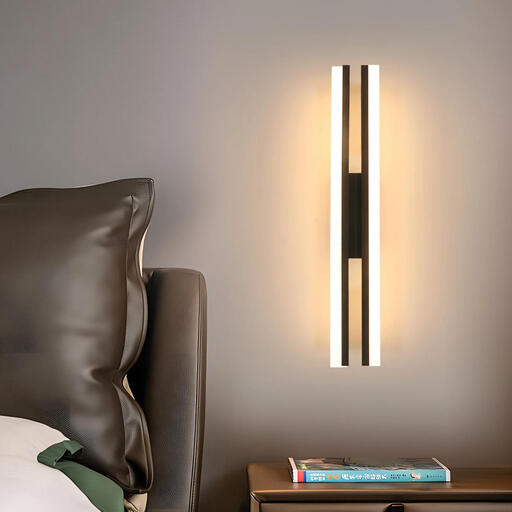
Why it's a match: Ideal for anyone seeking an understated yet stylish light source. The clean, rectangular design and black finish blend seamlessly into modern interiors without being overpowering.
The colour temperature is clearly specified as 3000K Warm White, ensuring a cosy atmosphere. The frame is made of iron with a baked-enamel finish, which promises a more premium feel and greater durability than simple plastic.
The light can be mounted both vertically and horizontally, offering maximum flexibility in your interior design.
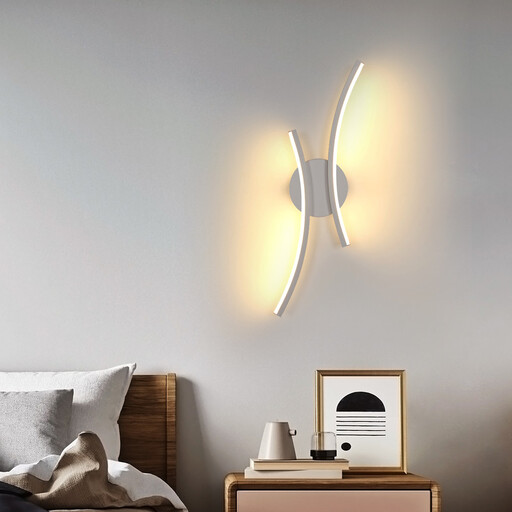
Why it's a match: Perfect for areas that need good ambient lighting without being obtrusive. The curved design has a modern feel, and the up-and-down illumination provides pleasant, indirect brightness.
The housing is made of aluminium, which ensures good heat dissipation and longevity. The flicker-free LED chips with a high colour rendering index provide illumination that is easy on the eyes and true to colour.
With a depth of only 5 cm, it has a very slim profile and barely protrudes into the room, which is a particular advantage in narrow hallways or stairwells.
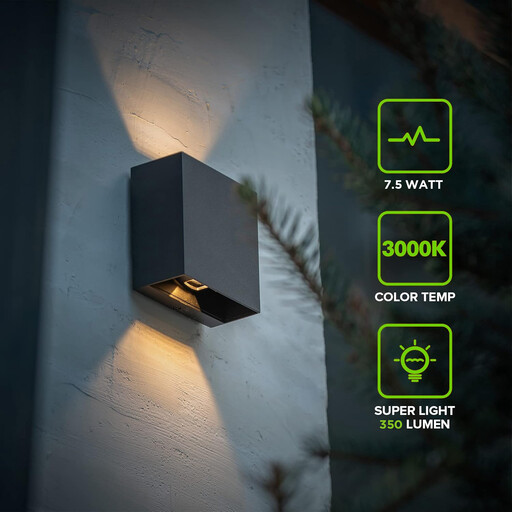
Why it's a match: For those who want more than just a light source. This fixture allows you to cast custom light beams onto the wall, making it possible to specifically highlight architectural details or artwork.
Instead of a fixed light effect, this model offers full control. The adjustable beam angle (0 to 106 degrees) prevents the disappointment of an unsuitable light cone. The powder-coated aluminium housing is also rustproof and weather-resistant.
The light is water-resistant and can be used both indoors and outdoors, making it extremely versatile.
We have compiled a complete, up-to-date list of products that fully meet these strict selection criteria and European safety regulations.
A common recommendation is to mount it at eye level, which typically corresponds to a height of 1.60 m to 1.70 m (approx. 5'3" to 5'7") from the floor. For up-and-down lights, a slightly higher or lower position can be effective, depending on the desired light effect on the wall. The key is to ensure the light source does not cause direct glare.
For basic orientation lighting in a hallway, around 100 to 150 lumens per square metre is sufficient. If the hallway light is the main light source, you should plan for 200 to 300 lumens per square metre. Using several smaller wall lights can create more uniform illumination than a single, very bright fixture.
No. An LED light is only dimmable if it is explicitly marked as "dimmable". This applies to both lights with integrated LEDs and those with replaceable bulbs. Additionally, you will need a dimmer switch suitable for LED technology (usually a trailing-edge or leading-edge dimmer), as conventional dimmers are often incompatible and can cause flickering or damage.