
Lieferung heute & morgen

Qualitätsgarantie

Willkommens-Angebote freischalten: KOSTENLOSE Lieferung | Bis zu 80 % RABATT | Kostenlose 30-Tage-JoyPlus-Testphase
App herunterladen
By Joybuy Product Recommendation Officer, August 29, 2026
Choosing a new ceiling light seems straightforward at first glance. But the market for modern LED lighting is filled with technical jargon and design promises that don't always deliver. The wrong fixture can negatively impact a room's atmosphere or lead to unexpected follow-up costs. Before you make a decision, it's helpful to know the most common pitfalls to avoid a poor investment.
This guide focuses on the objective criteria that define a quality modern LED ceiling light and helps you make the right choice for your home.
Many buyers focus primarily on design, overlooking functional aspects that are crucial in daily life. These three mistakes are particularly common:
dimmable ceiling light models are not compatible with all standard wall dimmers (e.g., leading-edge or trailing-edge dimmers). This often results in annoying flickering, buzzing noises, or a dimming function that only partially works.designer ceiling light models can turn into dust traps that are difficult to clean. Furthermore, some designs require a complex installation that is nearly impossible without an electrician, unexpectedly driving up the total cost.To avoid these mistakes, you should focus on three core technical values. These define the quality and suitability of an LED ceiling lamp for your needs.
Light colour isn't a subjective feeling but a measurable value. The choice depends on the purpose of the room:
LED living room ceiling light or a bedroom ceiling light.kitchen ceiling light, bathroom, or workspace.Forget watts—the brightness of an LED fixture is measured in lumens (lm). As a rule of thumb for ambient lighting, you can use the following values:
For a 20 m? living room, a fixture with a luminous flux of 2,000 to 3,000 lumens would be a good starting point.
The Colour Rendering Index (CRI) indicates how true-to-life the colours of objects appear under the lamp's light. The value is given on a scale up to 100, where 100 corresponds to sunlight. For living spaces, a CRI value of over 80 (Ra > 80) is recommended. A high CRI value ensures that skin tones, food, and the colours of your decor look natural and not distorted.
Based on these objective criteria, we have identified several models suitable for different user profiles and use cases.
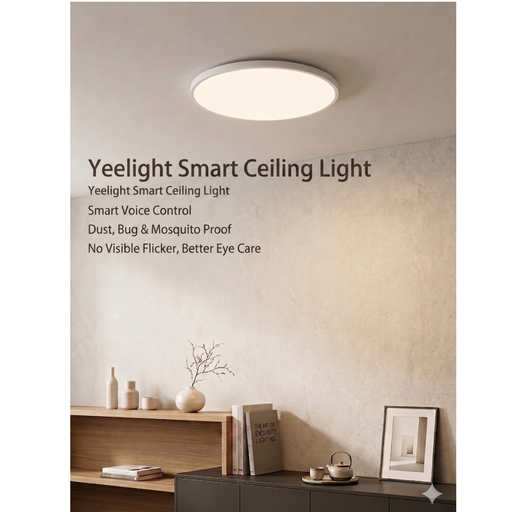
Why This Fits Their Persona: Ideal for users who want full control and automation. This smart home ceiling light seamlessly integrates with systems like Alexa or Google Home and can be controlled via app or voice. Brightness and colour temperature are infinitely adjustable.
Solves the "Kelvin Trap" and "Dimming Dilemma" through software-based control. Adjustments are made digitally, bypassing compatibility issues with physical dimmers.
Compatible with common AIoT platforms; fully enclosed design protects against dust and insects, minimising maintenance.

Why This Fits Their Persona: With its spiral silhouette, this modern black ceiling light is a clear statement piece for lovers of minimalist yet expressive aesthetics. It fits perfectly into modern living concepts.
The clean form avoids the "Design Deception" of an overly complex dust trap. With a fixed, pleasant light colour of 3000K (Warm White), it bypasses the "Kelvin Trap" for anyone who prefers a consistent, welcoming atmosphere.
Striking, sculptural design; delivers high brightness with 4000 lumens, suitable for rooms of 10-15 m?.
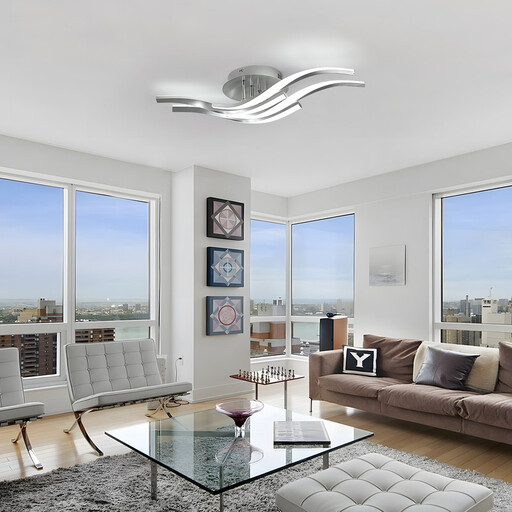
Why This Fits Their Persona: This fixture is designed for users who need bright, functional lighting for a kitchen, hallway, or office. The cool, white light of 6500K is ideal for task-oriented areas where concentration and good visibility are required.
A straightforward solution without complex features. It makes no promises of dimmability, thus avoiding the "Dimming Dilemma." Its purpose is clearly defined: maximum brightness for functional spaces.
High energy efficiency; according to the manufacturer, it saves up to 85% on electricity costs compared to incandescent bulbs. The integrated LED technology makes bulb replacement unnecessary.
We've compiled a complete, up-to-date list of products that fully meet these strict selection criteria and safety regulations.
As a guideline for pleasant ambient lighting in living spaces, 100 to 150 lumens per square metre is recommended. For a 20 m? living room, you should plan for a fixture or a combination of fixtures with a total luminous flux of 2,000 to 3,000 lumens. Also, consider the room layout, wall colours, and your personal preferences.
No, this is a common source of error. It is crucial that the light fixture and the dimmer are technically compatible. Check the product specifications for the fixture to see which type of dimmer (e.g., leading-edge or trailing-edge) is required. An alternative is smart home lights, where dimming is controlled via an app or remote, thus eliminating compatibility problems with the wall switch.
The lifespan of integrated LEDs is specified in operating hours and is typically between 20,000 and 50,000 hours. With an average use of four hours per day, a lifespan of 25,000 hours equates to more than 17 years. The advantage is that no bulb changes are necessary during this time. However, at the end of its life, the entire fixture must be replaced.