
Lieferung heute & morgen

Qualitätsgarantie

Willkommens-Angebote freischalten: KOSTENLOSE Lieferung | Bis zu 80 % RABATT | Kostenlose 30-Tage-JoyPlus-Testphase
App herunterladen
A modern LED ceiling light should do more than simply look good. It needs to suit the size of the room, provide enough light and be practical to operate every day. However, there are clear differences between decorative wood-effect designs, warm-white lighting, dimmers and sensor controls.
Common buying decisions can therefore lead to disappointment:
The luminous flux in lumens (lm) describes how much visible light a light fitting produces. Watts, on the other hand, describe energy consumption. When choosing a living room or bedroom light, the lumen value is therefore the more practical comparison.
As a general guide:
The actual effect also depends on wall colour, ceiling height, the light fitting’s cover and the furnishings. The word “bright” in a product description is therefore no substitute for technical specifications.
A dimmable ceiling light can adjust its brightness to suit different situations. Check whether it is controlled via:
“Three brightness levels” is not the same as continuously variable dimming. With a light fitting that uses an external dimmer, you must also ensure that the light and dimmer are compatible.
A sensor ceiling light can be practical in hallways, entrance areas or infrequently used rooms. Before buying, check the range, run-on time, detection angle and any potential false activations. If these details are not clearly stated, check the product page again before placing your order.
Before buying, measure the room and check the existing connection. A diameter of 35 to 38.5 cm may be suitable for small to medium-sized rooms, but this alone says nothing about how the light will be distributed.
The material also affects the appearance and maintenance requirements:
Electrical connections and work on the building’s electrical installation must only be carried out by an appropriately qualified person. Also check the intended area of use, such as IP20 for dry indoor areas, where this is specified for the relevant model.
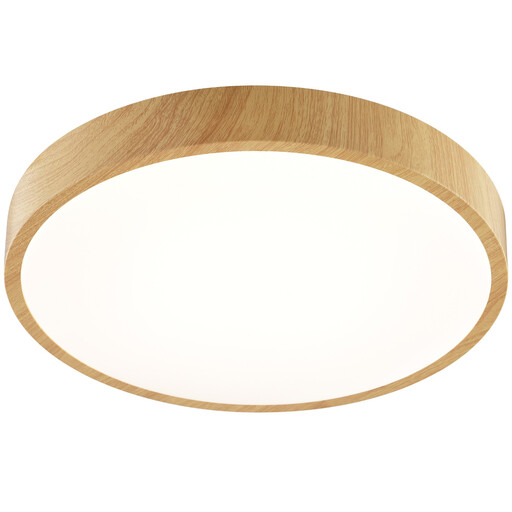
Why this product suits the profile: According to the product details, the 24 W light provides 2,300 lm at 3,000 K and is suitable for living rooms, bedrooms, hallways or dining areas. It is mounted directly onto the ceiling.
The product details provide specific figures for power, luminous flux and colour temperature. They also clearly state that the light is not dimmable.
Plastic wood-effect finish, 2,300 lm, 3,000 K and a diameter of 38.5 cm.
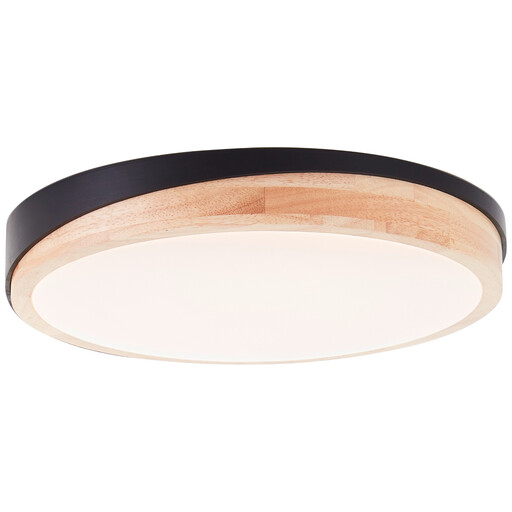
Why this product suits the profile: According to the product details, this model combines real wood with 2,400 lm, 3,000 K and an integrated three-stage dimmer with memory function.
The dimming method is described as three fixed levels. This makes it clear that continuously variable adjustment is not promised.
Real wood, 35 cm diameter, memory function, 2,400 lm and FSC information in the product details.
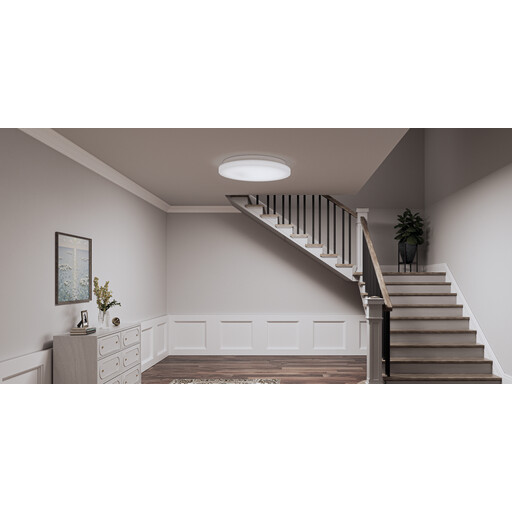
Why this product suits the profile: The model name indicates presence detection or a sensor function. This could be useful in hallways or areas where automatic control is preferred.
The sensor function is apparent from the model name. Before buying, check the range, controls and settings on the full product page.
Presence detection according to the product name, with the option to use it as automatic ceiling lighting.
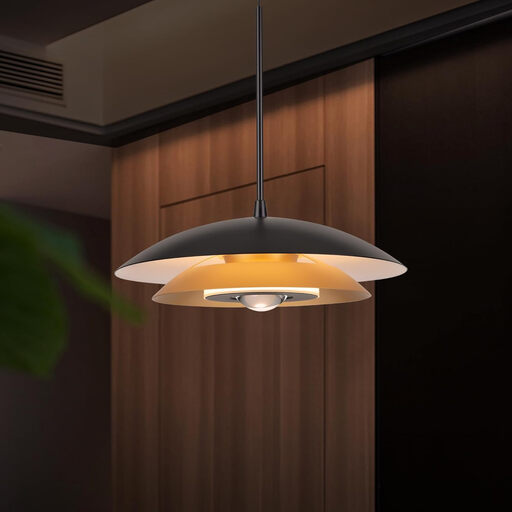
Why this product suits the profile: According to the product description, this LED pendant light is designed for kitchen islands, dining areas and bedrooms. It offers 12 W, 3,000 K and an adjustable-height suspension.
The product details explicitly state that it is dimmable with a compatible dimmer. The existing installation must therefore be checked before fitting.
Double-layer metal shade, warm-white light at 3,000 K and adjustable cable length.
We have put together a complete, regularly updated list of products that fully meet these strict selection criteria and the safety regulations applicable in the EU.
For energy-efficient LED lighting, you should consider power consumption and operating time together. A 24 W light uses 24 kWh over 1,000 hours of operation. The actual cost depends on your electricity tariff and daily usage.
The energy efficiency class is shown on the EU energy label from A to G. Class F is a specific rating for the lights mentioned and should not be equated with a blanket claim such as “particularly economical”. Compare the wattage, lumens and expected operating hours instead. With permanently installed LEDs, the stated lifespan is also relevant, provided the manufacturer gives specific figures.
This depends on the room size, how it is used and the desired lighting effect. Higher lumen values are generally more practical for living and working areas than for hallways or small ancillary rooms. Even coverage is just as important as the total luminous flux.
A colour temperature of around 2,700 to 3,000 Kelvin is often described as warm white. It can be a good choice for a welcoming bedroom or living room light. Whether the lighting feels comfortable also depends on the shade and the room’s interior design.
Check the dimensions, weight, connection type and intended indoor area. Work on electrical wiring should only be carried out by a qualified electrician. In rented accommodation, it may also be advisable to consult your landlord if the existing connection needs to be altered.