
Lieferung heute & morgen

Qualitätsgarantie

Willkommens-Angebote freischalten: KOSTENLOSE Lieferung | Bis zu 80 % RABATT | Kostenlose 30-Tage-JoyPlus-Testphase
App herunterladen
A modern LED ceiling light can illuminate a room evenly and blend seamlessly into a variety of interior styles. Yet with so many options available, finding the right one isn’t always straightforward. All too often, lights are bought on first impressions or based on a high wattage, while crucial details such as lumens, colour temperature, mounting type and dimming functionality are overlooked.
This buying guide explains what you should look for when choosing modern ceiling lighting for your bedroom, living room, hallway, kitchen or home office.
With integrated LEDs, the wattage primarily indicates power consumption. For actual brightness, the lumen value is what matters. A 22-watt light can vary significantly in brightness depending on the LED technology used. If you’re looking for an LED ceiling light for a study or kitchen, always check the lumen rating and the recommended room size.
A colour temperature of around 2,700 to 3,000 Kelvin gives a warm glow and is ideal for bedrooms or cosy living areas. 4,000 to 4,500 Kelvin is generally perceived as neutral white and works well in hallways, kitchens or workspaces. Light at 6,500 Kelvin appears much cooler and may be suitable for functional areas, but it isn’t right for every home atmosphere.
An LED ceiling light with 3 colour temperatures offers greater flexibility, provided you can actually switch between the light colours using the designated switch or remote control.
A flat, round LED ceiling light often fits well in rooms with low ceilings. However, before buying, you should check the diameter, installation height and connection position against your existing ceiling space. With integrated LEDs, remember that you cannot replace a conventional bulb. If a fault develops later, the entire light or LED module will usually need replacing.
As a guide, consider the combination of room size, usage and lumens. A bedroom typically needs a different lighting effect to a kitchen or office. For a ceiling light for the bedroom, a softer, warmer light may be more appropriate. A hallway LED light, on the other hand, should provide enough light for orientation without casting annoying shadows.
The recommendation “for 10–20 m²” should be treated as a rough guide. Dark walls, high ceilings, lots of furniture or plans to use the light as task lighting may all increase your light requirements.
Alongside Kelvin, the colour rendering index (CRI) is important. A CRI of at least 80 is considered a decent benchmark for most living areas. When choosing a ceiling light with neutral white light, check whether the CRI value is stated and whether the light suits your intended use.
“Dimmable” doesn’t always mean the light is compatible with every wall dimmer. The manufacturer’s instructions on control are what matter. Some lights switch between colour temperatures without being continuously dimmable. Others require a remote control or a specific type of switch.
Installation also needs consideration: for a fixed ceiling connection, check the connection type, wall plugs, screws and the nature of your ceiling. Any work on the electrical installation should always be carried out by a qualified professional.
The following selection groups specific lights by their intended use and the product information available. Not every feature is documented for every model; any missing details should be checked on the product page before purchase.
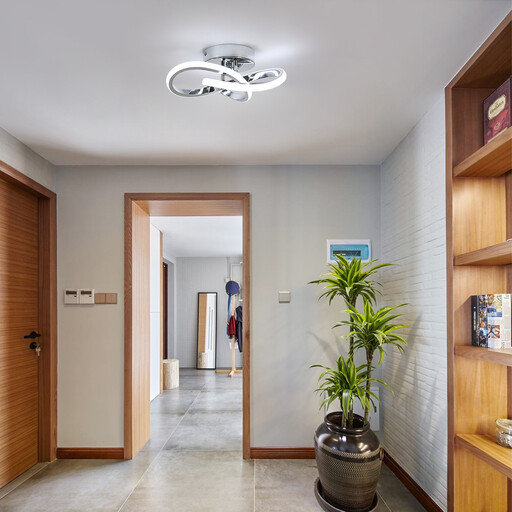
Why this product suits the profile: The compact light, measuring 25 × 25 × 10 cm, is designed for smaller bedrooms, hallways and other rooms with limited ceiling space.
The product details include dimensions, light colour, power and brightness, so you don’t have to choose based on design alone.
22 W, 2,500 lumens, CRI ≥ 83 and chrome-plated aluminium according to the product description.
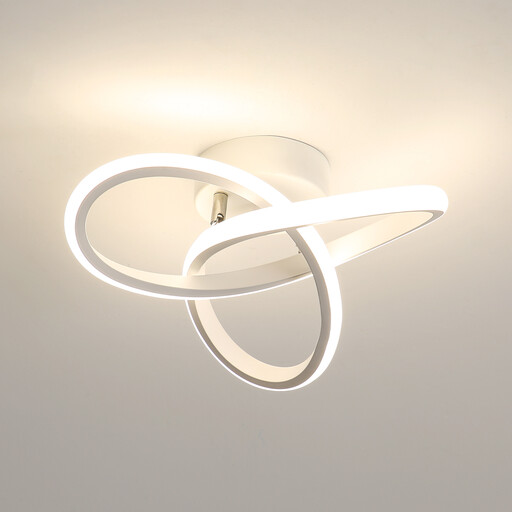
Why this product suits the profile: The decorative flower shape combines an eye-catching design with neutral white light, suitable for living rooms, bedrooms, kitchens or hallways.
The description lists materials such as metal, aluminium, silicone and acrylic. You can check in advance whether the installation height and style suit your ceiling.
30 W and 4,500 K; the product description mentions a silicone cover for even light distribution.
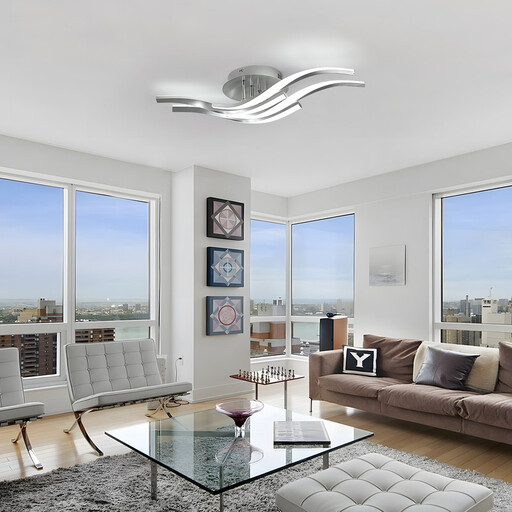
Why this product suits the profile: The geometric shape and cool light are described as suitable for general lighting in living and working areas.
The recommended area of around 10–20 m² helps with size planning. The 6,500 K light colour should be chosen deliberately before installation.
32 W, integrated LED technology and, according to the product information, no need for regular bulb replacement.
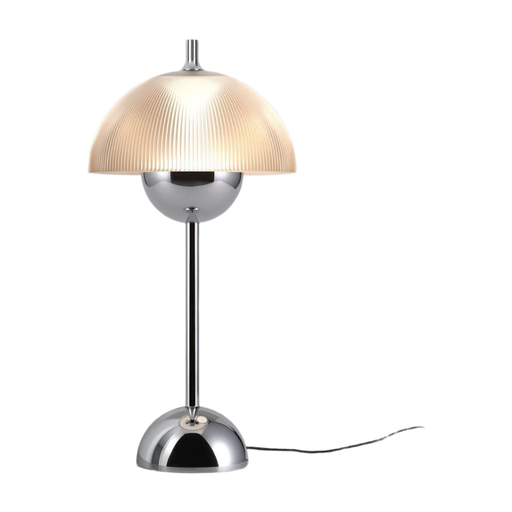
Why this product suits the profile: This compact table lamp complements a ceiling light in the bedroom, living room or office, and requires no ceiling installation.
The fixed light colour of 3,000 K and the four-level touch dimming are clearly stated. This reduces uncertainty when using it.
LED light source, warm white light, four dimming levels and a memory function according to the product description.
We’ve put together a full, regularly updated list of products that meet these strict selection criteria and comply with EU safety regulations.
A chrome ceiling light can be paired with matching accent lights. For a bedside table, for example, you might choose models with a fabric shade and an E14 or E27 fitting. Just check whether the bulb is included. According to the product information, the Premier Housewares Chrome Table Lamp does not come with a bulb; it requires an E14 bulb up to 40 W and comes with an EU plug.
For an additional light source next to a sofa or armchair, a floor lamp with a chrome stand and fabric shade can work well. Check the stated height and the floor space needed before buying. Such lamps don’t replace even ceiling lighting, but they can enhance specific zones.
It depends on the room size, wall colours and how you use the space. As a rough guide, compare the lumen rating with the recommended floor area. A kitchen or office usually needs more functional light than a bedroom.
No. The light must be explicitly suitable for use with a dimmer, and the instructions should confirm compatibility with your existing wall dimmer. With multi-colour models, also check whether only the colour temperature can be changed or the brightness too.
It’s impossible to give a reliable lifespan without specific manufacturer data. What matters is the documented operating life, heat dissipation, operating environment and the quality of the power supply. So look for information on LED lifespan and pay attention to the warranty and guarantee terms.