
Lieferung heute & morgen

Qualitätsgarantie

Willkommens-Angebote freischalten: KOSTENLOSE Lieferung | Bis zu 80 % RABATT | Kostenlose 30-Tage-JoyPlus-Testphase
App herunterladen
A modern LED ceiling light should illuminate a room well, suit your décor and fit seamlessly into everyday life without unnecessary ongoing costs. However, many product specifications can seem more straightforward than they really are. A higher wattage, for example, does not automatically mean a brighter light. Decorative details and flexible settings can also prove less practical than expected once you take a closer look.
Power consumption in watts mainly tells you how much energy a light uses. The luminous flux, measured in lumens, is what determines its actual brightness. Depending on its design, a 20 W LED ceiling light can produce very different amounts of light. So if you’re lighting a living room, hallway or dining room, compare the lumen rating rather than just the wattage.
A 4000 K LED ceiling light gives off neutral white light. It’s often a good choice for hallways, work areas and rooms that need clear, bright lighting. In a bedroom or a cosy living room, a warmer light may feel more comfortable. Models with several colour temperature settings give you more flexibility, as long as the controls are easy to use day to day.
A strikingly shaped light can look bigger on the ceiling than you expect. Before buying, check the width, depth and height against the available mounting area. A square 41 x 41 cm LED ceiling light, for example, needs enough clear space and shouldn’t clash with doors, cupboards or other lights.
Luminous flux is measured in lumens (lm). A 2700-lumen LED ceiling light provides plenty of light for many medium-sized indoor spaces. How evenly the light spreads also depends on the diffuser’s shape, the position of the LEDs and the size of the room.
Power consumption is measured in watts. To get a more realistic idea of running costs, it can also help to check the energy consumption in kWh per 1,000 hours. With a light that has an integrated LED, check whether the light source is built in and what information the manufacturer provides about its energy efficiency rating.
Colour temperature is measured in kelvins (K):
A round LED ceiling light with 3 colour temperatures can therefore be a flexible option if you don’t want to commit to just one shade of light.
A black LED ceiling light creates a striking contrast against light-coloured ceilings and can complement modern or industrial-style interiors. If you’re considering a decorative model with crystal elements, check that the crystal effect suits the rest of your décor and that the surface is easy to clean.
For dry indoor spaces, the usual rating is IP20. This means the light has no special protection against water. It should not be installed in damp outdoor areas or anywhere exposed to direct splashes. The electrical connection must only be carried out by a suitably qualified professional.
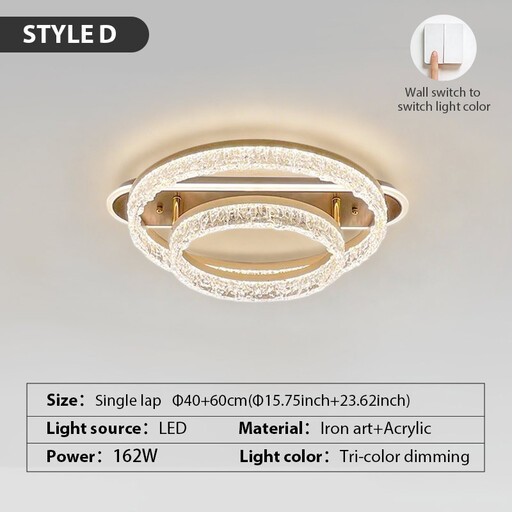
Why this product suits this type of shopper: Its round design and choice of three colour temperatures make it an easy option for a range of indoor spaces.
The three colour temperature settings reduce the risk of choosing a fixed light colour that isn’t right for the room.
Round metal design and three selectable colour temperatures, according to the product name.
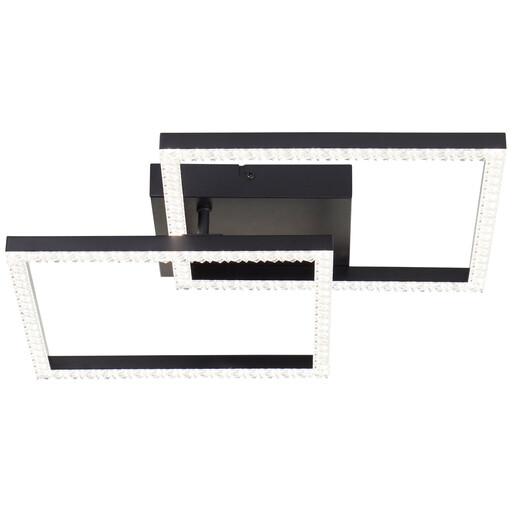
Why this product suits this type of shopper: The combination of a matt black finish, a crystal effect and two rectangular elements is a good fit for buyers who want to weigh up design alongside clearly stated performance figures.
The wattage, luminous flux, colour temperature and dimensions are all clearly stated. This makes it easier to check whether the light suits your room size and available ceiling space.
20 W, 2700 lm, 4000 K, 41 x 41 cm, integrated LED and a swivelling element, according to the product specifications.
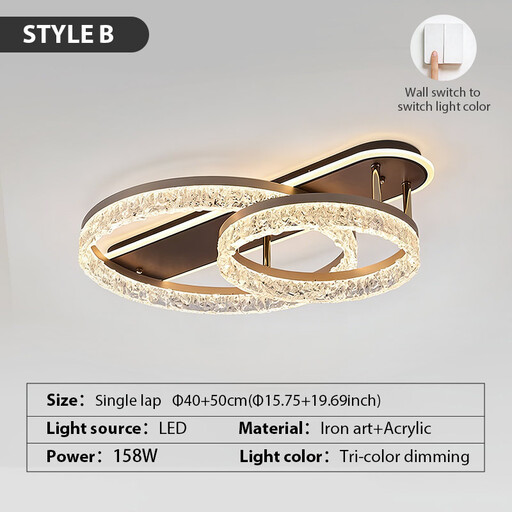
Why this product suits this type of shopper: The flexible choice of light colour is useful in households where a room is used at different times of day or for different activities.
Being able to choose between three colour temperatures means you’re not tied to a single lighting mood.
Round metal design and three colour temperatures, according to the product name.
Before ordering, check the position of the existing electrical connection. If you’re choosing a ceiling light with an integrated LED, also find out whether it requires an external dimmer or a particular wall switch. Ceiling installation and electrical connection must be carried out by a qualified professional.
A higher light output can be useful in a living room, while a warmer light is often preferred in a bedroom. In a hallway, even illumination, a suitable height and easy cleaning are more important. If you’re considering a swivelling ceiling light, check the actual angle at which its movable element can be positioned.
If you’re looking for a simple shape without a pronounced crystal effect, browse the simple ceiling light category. You can compare designs, sizes and features to find the right fit for your room.
We’ve put together a complete, regularly updated list of products that meet these strict selection criteria and fully comply with the safety regulations in force in the EU.
It depends on the size of the room, ceiling height, wall colour and the type of light distribution you want. A 2700-lumen LED ceiling light can provide a useful amount of light for many medium-sized rooms. What matters is whether the light is distributed evenly and whether you also have floor or table lamps.
Its actual lifespan depends on factors including operating hours, heat dissipation, ambient temperature and component quality. Check the manufacturer’s information on lifespan and warranty. With integrated LEDs, the light source cannot always be replaced in the same way as a bulb in a standard fitting.
LED lights are designed to use relatively little energy. For a specific comparison, however, look at the power consumption in watts and the stated consumption per 1,000 hours. A 20 W light uses less electricity than a model with a higher power consumption over the same period of use. You should also take the brightness you need, measured in lumens, into account.