
Lieferung heute & morgen

Qualitätsgarantie

Willkommens-Angebote freischalten: KOSTENLOSE Lieferung | Bis zu 80 % RABATT | Kostenlose 30-Tage-JoyPlus-Testphase
App herunterladen
A modern wall light can add a decorative touch to your living room, bedroom or hallway while providing targeted lighting. But choosing the right model involves more than just picking a shape and colour. Light colour, connection type, dimensions and suitability for the room are all important considerations.
Three common buying mistakes are particularly likely to lead to the wrong choice:
Warm light between around 2700 and 3000 Kelvin is often used in living rooms and bedrooms. A 3000K wall light gives off a warm white glow, making it suitable for cosy ambient or accent lighting. Neutral or cool white options can be useful in hallways, studies or areas where better visibility is needed.
Alongside colour temperature, luminous flux in lumens is also important. A 27 W light can produce different amounts of light depending on the LED technology used. If the lumen output is not listed, take extra care when deciding whether it will be bright enough.
An up-and-down wall light directs light both upwards and downwards. This can add definition to a wall and create areas of indirect light. For reading or as a guide light, a more focused beam may be a better choice.
An aluminium wall light is lightweight and often comes with a painted or powder-coated finish. For visible parts of the light, look for an even finish, neat edges and a suitably robust cover. Acrylic or PVC shades can diffuse the light, although the effect will depend on the shape, cover and LED arrangement.
Measure the following in advance:
A slim indoor wall light may be more practical than a larger model, especially in a bedroom or narrow hallway.
An LED wall light with a built-in light source usually does not need an additional bulb. However, if it develops a fault, you will generally need to replace the whole light or the LED module. With an E27 wall light, you can choose and replace the bulb separately. Check the permitted wattage, the light colour you want and the bulb’s shape.
Fixed-wired lights should be installed by a suitably qualified electrician. A visible CE mark does not replace the need to check that the connection, installation location and electrical setup are suitable for your home.
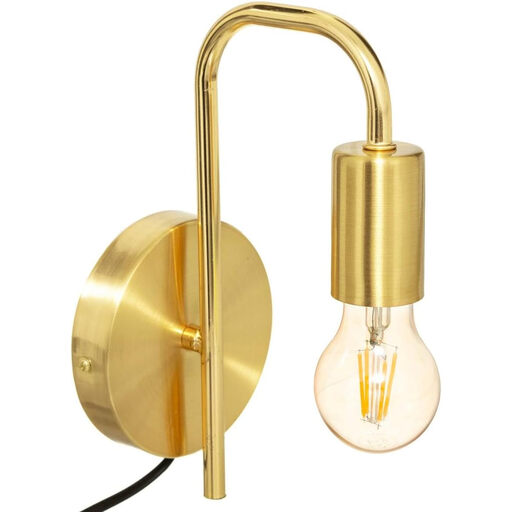
Why it suits this profile: This light has an E27 fitting, a compact design and a 1.80 m cable. This makes it easy to choose a bulb and replace it later.
The E27 fitting lets you choose a bulb with the light colour and wattage you want. Make sure you stay within the maximum 40 W rating.
E27 fitting, 12 cm long and wall-mounted with screws; suitable for the kitchen, bedroom and living room.
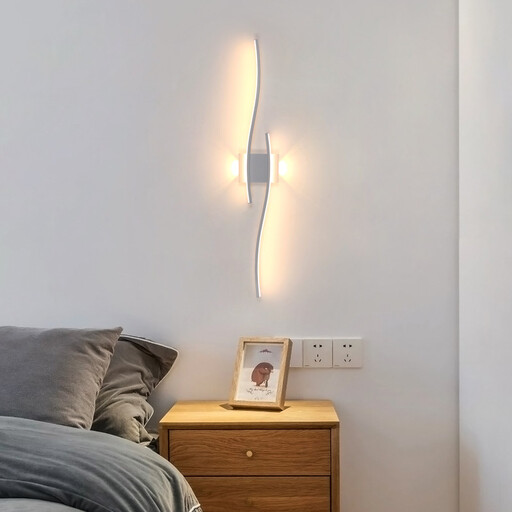
Why it suits this profile: The aluminium alloy, brushed and powder-coated finish, and light-diffusing acrylic-PVC cover make this a good choice for living spaces where decorative appeal matters.
The product description clearly specifies the material, finish and cover. This makes it easier to check important details about the build before you buy.
27 W, warm white 3000 K lighting and an aluminium construction with a diffusing cover.
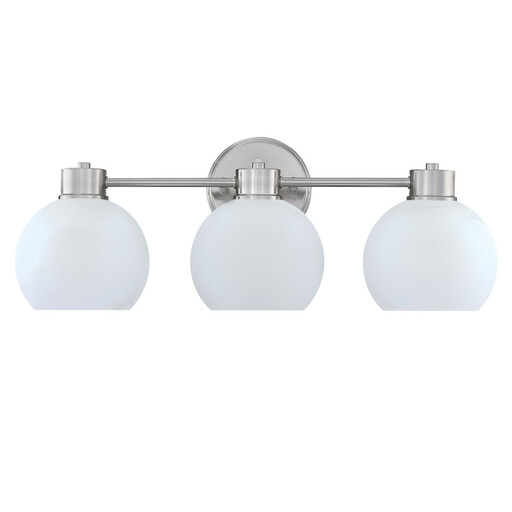
Why it suits this profile: Three E27 bulbs, the option to mount it facing upwards or downwards, and a width of 61 cm make this model a good fit for larger wall spaces.
The three separate E27 fittings mean you are not tied to a fixed light colour. Bulbs are not included, however, and must be chosen to suit the maximum rating of 60 W per fitting.
Three light points, a matt nickel-plated body, hand-blown frosted glass and flexible upward or downward orientation.
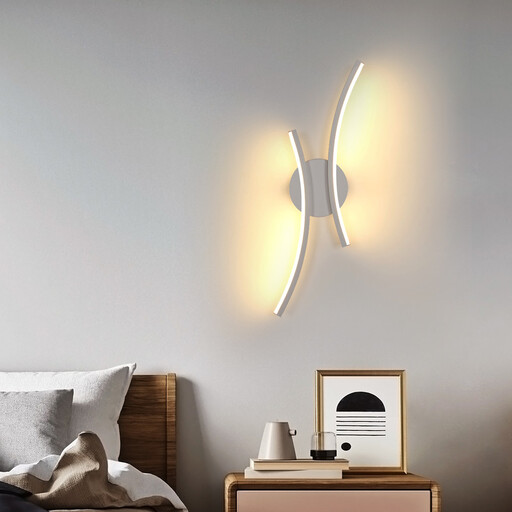
Why it suits this profile: Its curved shape, shallow depth of 5 cm and option to mount it off-centre make it a good fit for bedrooms, hallways and smaller living spaces.
The stated depth makes it easier to check whether the light will fit in a narrow space. Its 3000 K light colour is clearly specified, so you do not have to judge it from marketing images.
20 W, warm white lighting, up-and-down light and vertical or horizontal installation.
We’ve put together a complete, regularly updated list of products that meet these strict selection criteria and comply with the safety regulations in force in the EU.
Running costs depend on the wattage, how many hours a day the light is used and your electricity tariff. A simple calculation is: wattage ÷ 1000 × hours of use × electricity price. For an accurate estimate, use the actual wattage and your current tariff.
For integrated LEDs, lifespan depends on the module, heat dissipation and how the light is used. Unless the manufacturer provides a specific figure, you should not assume a fixed lifespan. With an E27 light, you can replace the bulb without changing the fitting.
If there is already a power outlet in place, the physical installation may be straightforward, depending on the model. Any work involving mains electricity or changes to an existing installation should be carried out by a qualified electrician. Before buying, check the connection type, mounting surface and whether fixings are included.