
Lieferung heute & morgen

Qualitätsgarantie

Willkommens-Angebote freischalten: KOSTENLOSE Lieferung | Bis zu 80 % RABATT | Kostenlose 30-Tage-JoyPlus-Testphase
App herunterladen
A modern wall light can brighten a room in a targeted way, highlight a wall or provide an additional light source beside a sofa or bed. However, many models look similar in product images while differing considerably in lighting technology, installation, materials and everyday practicality.
Three typical buying problems occur particularly often:
A warm white wall light with a colour temperature of 3000 Kelvin creates a warmer lighting effect than neutral white or daylight white alternatives. It is often suitable for:
Brightness is measured in lumens. For example, a 1500-lumen model may provide more direct light for a hallway or stairwell than a compact 6-watt light. For a decorative wall light, on the other hand, lower light output is often sufficient if it is only intended to highlight a wall or piece of furniture.
Also check whether the light is emitted upwards, downwards or sideways, or diffused through a shade. Even light distribution reduces harsh shadows, while adjustable spotlights can illuminate specific areas precisely.
Aluminium, steel, glass, acrylic and bamboo serve different design and functional purposes. A black wall light made of metal often suits modern, industrial or minimalist interiors. Glass can distribute light in a visible and decorative way, while acrylic shades are often used to create more even light diffusion.
Before ordering, you should measure:
The IP rating is also relevant. IP20 may be suitable for dry indoor areas. In bathrooms or areas exposed to splashing water, the IP rating must explicitly be suitable for the installation zone. A product without a stated IP rating should not simply be used in damp areas.
An integrated LED wall light generally does not require an additional bulb. This means there is no need to buy a compatible bulb separately. However, in the event of a fault, the entire light may be affected, depending on its construction.
Models with an E27 socket offer more choice when it comes to colour temperature, brightness and dimming. The bulb must then be purchased separately. Check the following in advance:
A dimmable wall light can only be controlled effectively if all the components involved are compatible with one another. The product description should therefore include specific information about the dimming function.
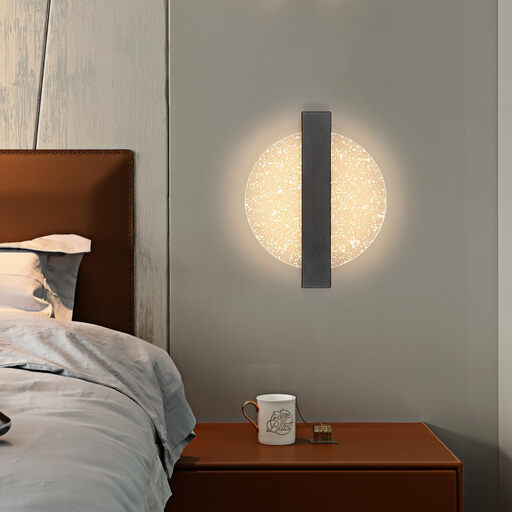
Why this product suits this profile: The round shape, black finish and integrated 12-watt LED are ideal for shoppers looking for a cleanly designed indoor wall light for a hallway, bedroom or living room.
The colour temperature and power consumption are clearly stated as 3000 Kelvin and 12 watts. A luminous flux of 1500 lumens is also specified, making it easier to assess the brightness.
Integrated LED, warm white light and a round acrylic design. With its 12-watt output, the light is suitable for several indoor areas.
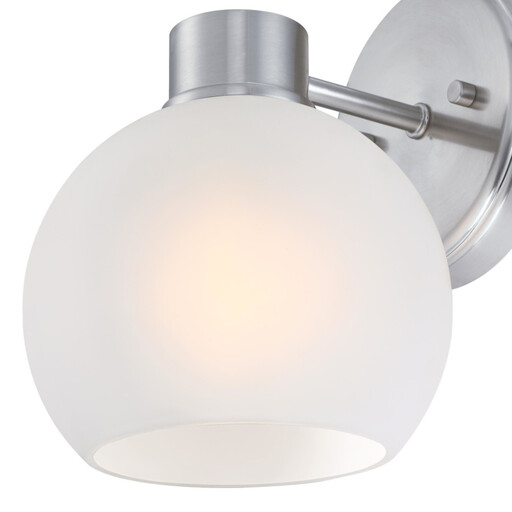
Why this product suits this profile: The combination of brushed nickel and hand-blown opal glass appeals to shoppers who place greater emphasis on material specifications and a customisable light source than on an integrated LED.
The light uses a replaceable E27 socket. The bulb is not included, but this allows you to choose one that matches your preferred brightness and colour temperature.
Opal glass, brushed nickel, 220–240 volts and a maximum output of 60 watts. The light is described as suitable for installation with the shade facing upwards or downwards.
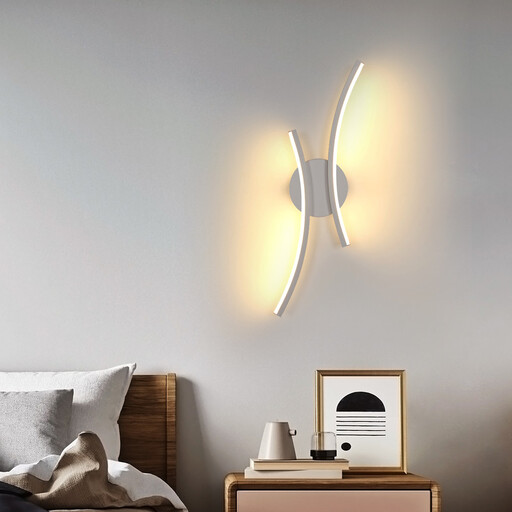
Why this product suits this profile: The curved shape and described up-and-down lighting make it suitable for feature walls, living rooms, bedrooms, hallways and stairwells.
The product description states the colour temperature as 3000 Kelvin, power consumption as 20 watts and the shallow depth as 5 centimetres. This makes it easier to assess the lighting effect and space required.
Aluminium housing, a slim profile and light emitted upwards and downwards. According to the product description, it can be installed horizontally or vertically.
We have put together a complete, regularly updated list of products that fully meet these strict selection criteria and the safety regulations applicable in the EU.
For a hard-wired wall light, check the connection type, installation clearance and the wall’s load-bearing capacity in advance. A black wall light or decorative light can be a good visual match, provided it does not project too far into the room and the direction of the light suits how the space is used.
Power consumption is the key factor when it comes to running costs. A 6-watt LED uses less energy over the same operating period than a 60-watt bulb. However, the actual cost depends on your electricity tariff and how long the light is used. With integrated LEDs, you should also check whether the light source can be replaced. With E27 models, the light itself remains usable even when the bulb is changed.
For a calm, homely lighting effect, warm white at around 2700 to 3000 Kelvin is often chosen. Other colour temperatures may be more suitable for a workspace or very functional lighting. The key factors are the room’s purpose, existing ceiling lighting and personal preference.
There is no fixed standard height. In a hallway, the light should not obstruct the passageway. Beside a bed or sofa, take the sitting or lying position into account. The light should not shine directly into your eyes at eye level. When installing several lights, arranging them evenly along the wall is recommended.
Not every model is dimmable. With integrated LEDs, the dimming function must be explicitly stated. For a light with an E27 socket, dimmability depends on the bulb used and the dimmer installed. Therefore, check the specifications of both components before installation.