
Lieferung heute & morgen

Qualitätsgarantie

Willkommens-Angebote freischalten: KOSTENLOSE Lieferung | Bis zu 80 % RABATT | Kostenlose 30-Tage-JoyPlus-Testphase
App herunterladen
A modular shoe cabinet can create far more order in the hallway, bedroom or wardrobe than a rigid shelving unit. Even so, some common buying claims can quickly lead to poor decisions: a high number of compartments does not automatically mean there is enough room for boots, the stated pair capacity does not always take different shoe sizes into account, and simple DIY assembly still requires careful work.
This guide explains which dimensions, materials and features matter before you buy. We then present a selection of suitable models for different households and usage scenarios.
Claims such as ‘for 20 or 40 pairs of shoes’ are only meaningful under certain conditions. Trainers, men’s shoes with a wider shape and lined winter boots require more space than flat summer shoes. So do not just check the total number of compartments; also consider the width, depth and height of each compartment.
Removable dividers are useful in practice. They allow a shoe rack with compartments to be adapted for larger shoes or other items.
A shoe rack with doors protects the contents from dust and gives the hallway a tidier appearance. However, shoes should be allowed to dry completely after wearing before being placed in enclosed compartments. Eyelets or small openings in the doors can make the rack easier to use and allow some air circulation. An enclosed compartment is no substitute for drying shoes or cleaning them regularly.
A DIY plastic shoe rack is often assembled using just a few components. What matters is not only the number of tools required, but whether the push-fit connections, metal frame and securing elements fit together correctly. Tall or wide structures should also be fitted with an anti-tip device if one is supplied.
Measure the intended space, including skirting boards, doors and walkways. For narrow hallways, a vertically arranged hallway shoe cabinet can be a practical choice. In a low wardrobe or beneath a staircase, a horizontal arrangement may be more suitable.
A modular design is particularly useful if your living space changes later on. Check whether the model can be used as a single cabinet, several cubes or a stackable shoe rack. Tall versions should not be left freely accessible for climbing.
The models featured here are made primarily from polypropylene panels (PP), ABS plastic connectors and a metal frame. PP is lightweight and can be cleaned with a damp cloth. However, ‘water-repellent’ or ‘water-resistant’ does not mean that the cabinet should be exposed to moisture, puddles or direct water for extended periods.
Check the load capacity per compartment and distribute heavy items evenly. The manufacturer’s specifications apply to the particular design and should not be exceeded.
A shoe organiser with doors is suitable for households that want to keep their shoes as dust-free as possible. Side hooks can hold keys, bags or umbrellas, helping to keep the entrance area clear. Removable dividers are helpful when the cabinet is used for different purposes, as individual compartments can be enlarged for boots, toys or textiles.
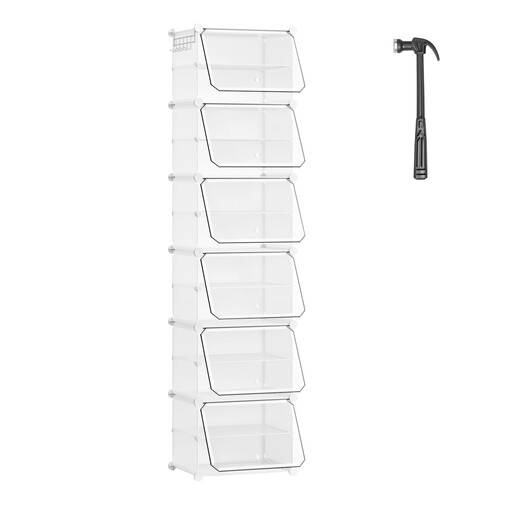
Why this product suits the profile: The compact design, measuring 40 × 150 × 30 cm, is suitable for a narrow hallway or wardrobe. Ten compartments, five side hooks and flexible assembly cover basic storage needs.
The compartments and dividers can be adjusted. An anti-tip device and cable ties are also included according to the product description.
PP panels, metal frame, ABS connectors and five hooks; maximum load per compartment according to the specifications: 5 kg.
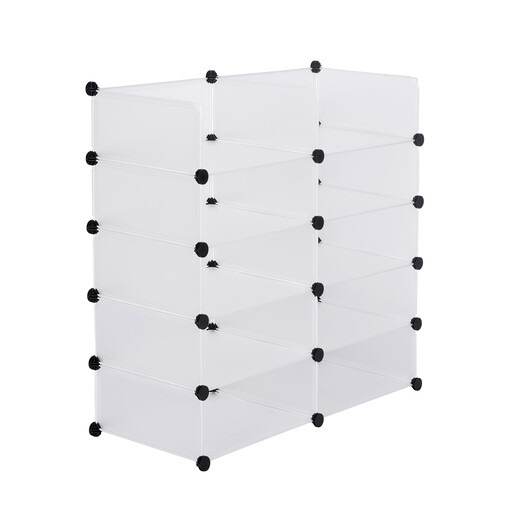
Why this product suits the profile: The transparent doors, dimensions of approximately 48 × 173 × 36 cm and modular arrangement are ideal for households that prefer consistent, enclosed shoe storage.
The compartments are enclosed, and the assembly instructions emphasise fully inserting the connectors and distributing the load evenly.
Water-repellent PP panels, steel frame and ABS connectors; load capacity according to the product specifications: up to 10 kg per compartment.
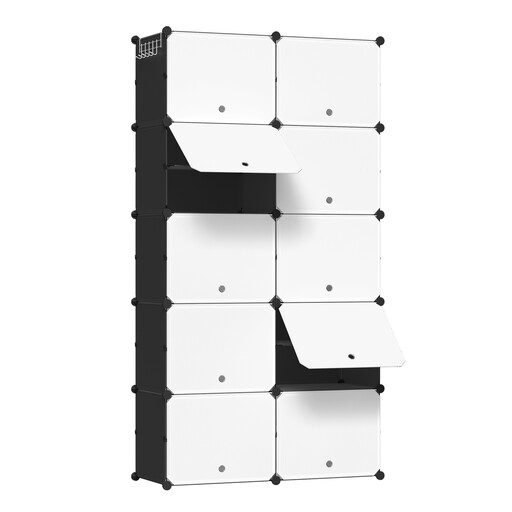
Why this product suits the profile: Ten compartments with two tiers each and an overall size of 94 × 180 × 36,5 cm are designed for families or households with extensive shoe collections.
The dividers can be removed when larger compartments are needed for boots or other items. The unit should be assembled securely and not overloaded.
Capacity of up to 40 pairs according to the product description, PP panels, metal frame, ABS connectors and side hooks.
Before assembly, sort through the shoes you actually want to store in the cabinet. Then check every push-fit component and insert the panels into the connectors without any visible gaps. For tall versions, attach the supplied anti-tip device according to the instructions.
For everyday care, a soft, damp cloth is usually all you need. Abrasive cleaners can damage plastic surfaces. Wet or heavily soiled shoes should be dried and cleaned before being stored. Hooks are intended for lightweight items such as keys, bags or umbrellas unless the product description specifies a different load capacity.
We have put together a complete, regularly updated list of products that fully meet these strict selection criteria and the safety regulations applicable in the EU.
Stability depends on the combination of materials, connector quality, assembly and load. Models with a metal frame and ABS connectors may be structurally more robust than simple push-fit systems made from thin plastic panels. The stated maximum load per compartment remains the key factor. An anti-tip device is advisable for tall configurations.
This depends on shoe size, shoe shape and the compartment layout. The manufacturer’s stated pair capacity generally refers to a specific arrangement with the dividers in place. Removable shelves create space for boots, but reduce the number of shoe compartments that can be used at the same time.
Yes, provided that the available space, compartment dimensions and ventilation options suit your household. Doors keep out dust and hide visible shoe clutter. However, the cabinet should only be used for wet shoes once they have dried sufficiently. In small homes, a narrow, tall model can make more efficient use of the available floor space.