Compare spreadsheets and reports side by side
If you want to keep borrowing figures, filters and a report in view at the same time, usable screen space and a suitable window layout matter more than gaming or professional colour features.


If you want to read borrowing figures and reports side by side, choose a monitor based on usable screen space, resolution and a scaling setting that’s comfortable for you to read. A 27-inch QHD model is one option, but it’s not essential. If you often connect a laptop, also check that the monitor’s features match your laptop’s video output and charging requirements. Very wide displays also need plenty of desk space.
If you want to keep borrowing figures, filters and a report in view at the same time, usable screen space and a suitable window layout matter more than gaming or professional colour features.
If you often connect your laptop at home, check that the monitor and computer are compatible for video output, peripherals and, if needed, power delivery.
If you spend long periods working at a screen or have limited space, readability, an adjustable position and the monitor’s dimensions all need to suit your workspace.
Start by working out how many views you need open at once. Then check the connections, positioning and available desk space against your workspace.
The proportions refer to consumers choosing a monitor for analysing borrowing data at home. Each person is grouped according to their main buying priority.
| Buying priority | What to check | Who it matters most to |
|---|---|---|
| Read spreadsheets and reports side by side | Check the resolution, screen size, preferred text scaling and window layout together. | If I want to compare borrowing figures and a report side by side, having the right amount of workspace matters to me. Consumers whose main priority is analysing data side by side are likely to account for around 36% in this use case. |
| Connect a laptop that meets my needs | Check the laptop’s video output and charging requirements against the monitor’s Power Delivery and hub connections. | If I regularly connect my laptop to a monitor, I want to know whether the intended connection will carry the video signal and provide power. Consumers whose main priority is connecting a laptop are likely to account for around 29%. |
| Adjust readability and positioning | Check the height and tilt adjustments, reflections and text size at your own workspace. | If I work at a screen for long periods, I want to position the display to suit my seat and preferred text size. Around 21% of consumers are likely to put ergonomic readability first. |
| Compare space requirements and energy use | Measure the width and depth, including the stand; for comparable models, check the EU energy label. | If my desk has little free space or I want to compare energy use, the monitor needs to fit my workspace. Consumers whose main priority is desk space and ongoing energy use are likely to account for around 14%. |
USB-C features and Power Delivery output vary by model. Your laptop also needs to support the video connection you require.
Depending on the combination, you may also need a separate power adapter or another connection.
Check your laptop’s video output and charging requirements against the specifications for the specific monitor.
An ultrawide model also takes up space with its stand. According to LG, the LG 49WQ95X-W measures 1215,1 mm wide and 281,0 mm deep, including the stand.
Measure the available desk space, including the room you need to sit comfortably.
A review or recommendation doesn’t automatically mean that a specific model is currently available. LG marks the 49WQ95X-W as no longer available on its German product page.
Before buying, check the exact model name and its availability with the retailer.
The P2725DE offers 27-inch QHD with a USB-C hub, while the S2725DSM is a separate QHD model without an integrated USB hub.
The FlexScan EV2490 combines a 23,8-inch Full HD display with USB-C docking in a more compact format.
According to Lenovo, the ThinkVision T27h-30 has a 27-inch QHD display, USB-C docking, a USB hub and Ethernet.
The ProArt PA279CRV is a 27-inch 4K model with documented colour modes, USB-C and an adjustable stand.
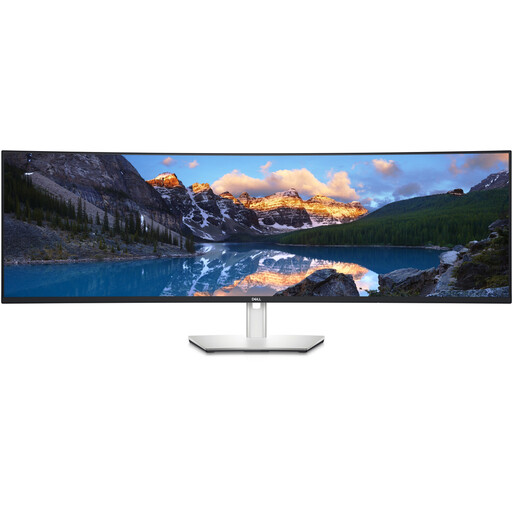
The 49WQ95X-W is an example of a 49-inch display in a 32:9 format, designed to provide an extra-wide workspace.
This selection includes monitors for viewing spreadsheets side by side, working with detailed documents and connecting laptops, from 27-inch QHD and 4K models to wide ultrawide formats. In particular, check the space available on your desk, your preferred text size and compatibility with your laptop.
 No image available
For viewing several spreadsheets and reports side by side. Check beforehand that the wide footprint will fit your desk.
40 inches, 21:9 and 5120 × 2160 pixels; USB-C with 65 W Power Delivery, a USB hub and PIP/PBP. The listed width, including the stand, is 944,1 mm.
 No image available
For detailed documents and side-by-side views. Check that your computer supports the resolution you want and that the text size works for you.
3840 × 2160 pixels, USB-C with 90 W Power Delivery and PIP/PBP. The listed height adjustment is 150 mm.
 No image available
For several windows arranged side by side, provided your desk has enough space.
32:9 format and 5120 × 1440 pixels; USB-C with 90 W Power Delivery, a USB hub and RJ45. The listed width is 1214,9 mm.
 No image available
For working with spreadsheets and reports on a QHD display, and for a laptop workspace with compatible docking requirements.
2560 × 1440 pixels; USB-C docking with 98 W Power Delivery, KVM, a USB hub and RJ45. The listed height adjustment is 130 mm.
 No image available
For viewing borrowing figures and reports side by side, if a 27-inch QHD display suits your desk and preferred text size.
2560 × 1440 pixels; USB-C with 90 W Power Delivery and four USB ports. The stand offers tilt, pivot and height adjustment.
Not necessarily. Consider screen size and resolution together, and check the text size and window layout on your computer. For example, 27-inch models are available in both QHD and 4K.
No, it depends on both devices. Check whether your laptop outputs video through its port and whether the specific monitor’s Power Delivery output meets its charging requirements. BenQ lists USB-C with DisplayPort Alt Mode, data transfer and 90 W Power Delivery for the RD320UA.
Adjust the height, tilt and text size to suit your seating position, and watch out for reflections. The Federal Institute for Occupational Safety and Health treats screen positioning, workspace design and, where appropriate, suitable glasses as related considerations. This doesn’t amount to a one-size-fits-all monitor recommendation for every home office.
Use the EU energy label and the specifications for the specific model as a basis for comparison. Without knowing your usage hours and electricity tariff, it’s not possible to work out a relevant cost in pounds for your household.
If an organisation processes data that can identify individuals, it must comply with the GDPR. Buying a monitor doesn’t determine which organisational data protection measures are needed when handling borrowing records.