Calendar designers working with multiple windows
If you need to see your calendar design, appointments and text templates at the same time, a readable workspace and a suitable setup are essential.


When designing an event calendar alongside a second screen, you need a workspace that’s easy to read and a setup that suits your needs. A 27-inch QHD model could be a good starting point. 4K is worth considering if you want to view detailed designs, but check that the text is the right size for your viewing distance. USB-C docking is only useful if it’s compatible with your laptop, charging needs and the connection to your second display.
If you need to see your calendar design, appointments and text templates at the same time, a readable workspace and a suitable setup are essential.
Reliable colour specifications are helpful when working with calendar colours or graphics intended for a particular output. However, manufacturers’ figures are no substitute for checking how colours look in your own workflow.
If you want to connect video, data and ideally power with as few cables as possible, check the ports on the specific monitor and whether your laptop supports a second display.
First, check that the resolution and text size suit your viewing distance. Then make sure the colour requirements, laptop connections and space available for both screens work for your setup.
| What matters | What to check before buying | Who it matters most to |
|---|---|---|
| Readable workspace | Check that your calendar view and tools fit on screen at your preferred text size. | I want to be able to read my calendar and references at the same time without setting the text size unsuitably for my viewing distance. Around 33% of consumers prioritise a readable workspace. |
| Assessing colours | Compare the colour specifications of the specific model with your target colour space, and check how it displays colours in your workflow. | If colour accuracy matters for my intended output, I want to know what the colour specifications refer to. Around 27% of consumers prioritise specific colour requirements. |
| Connecting a laptop and second screen | Check video output, charging requirements and the resolution supported by the second display; test any planned daisy-chain setup. | I want to connect my laptop with as few cables as possible and make sure the second screen runs at the resolution I need. Around 20% of consumers prioritise a suitable laptop connection. |
| Setting up two screens | Measure the available space and check the height adjustment, swivel and, where applicable, the VESA mount specification of the specific model. | If both displays are going to sit side by side, I need enough desk space and a position that suits my workspace. Around 20% of consumers pay particular attention to the setup. |
A good choice if: you want your calendar design and appointments, text templates or preview to stay visible on their own screens.
Things to consider: You’ll need space for both displays and a suitable signal connection. A DP output on the monitor alone doesn’t guarantee the desired resolution on the second device.
A good choice if: you’d rather arrange windows across one continuous screen and don’t need two physically separate displays.
Things to consider: A wide display is not the same as two separate screens. CHIP mentions an LG UltraWide alternative, but this does not prove it’s better for designing event calendars.
Lenovo documents a limitation with the ThinkVision P27h-30: under certain conditions, a daisy-chained second monitor only reaches its native resolution after the USB data rate has been changed.
Check the full combination of computer, connection and desired resolution for both displays. If daisy-chaining isn’t suitable, you may need to use a different connection setup.
A 27-inch 4K model and a QHD model have different resolutions. How comfortably calendars, sidebars and text display also depends on scaling and viewing distance.
Check your design, tools and text at the display size you actually plan to use.
Both devices use electricity. The European Commission provides energy labels for electronic displays on a scale from A to G, as well as model-specific information in EPREL.
Compare the figures for both specific models and take your actual hours of use into account.
The DesignVue range includes the PD2705Q, a 27-inch QHD option with sRGB specifications, USB-C and a DP output.
The ProArt PA278CFRV is a QHD option with model-specific manufacturer specifications for colour, USB-C and ergonomics.
The ThinkVision P27h-30 combines a 27-inch QHD display with USB-C docking and a DP output.
The UltraFine 27UP850K-W is a 27-inch 4K option for detailed designs.
The UltraSharp U2724DE is a QHD hub option with Thunderbolt connectivity.
This selection includes portable additional displays and monitors for a laptop workspace with separate screens. Before buying, check that the connections and screen size are compatible with your laptop.
 No image available
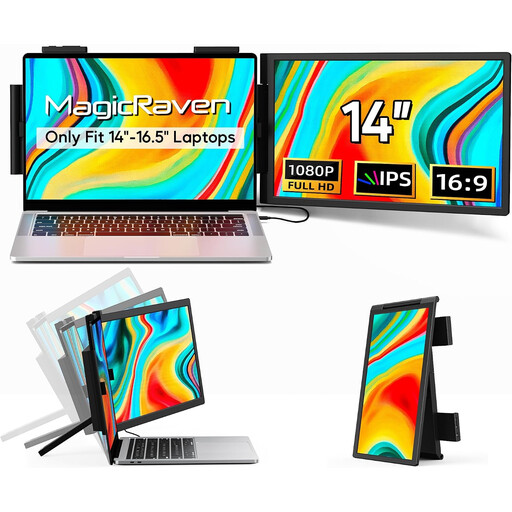
Designed as an additional display for a laptop with two screens. Specifications include a 14-inch screen, FHD, IPS and 60 Hz.
The title lists HDMI, USB-A and USB-C, plus support for 14–16.5-inch laptops and Windows, Mac and Android.
 No image available
Listed for a laptop workspace with separate displays. This model has a 14-inch IPS display with a resolution of 1920 × 1200 pixels in a 16:10 aspect ratio.
The product title lists Type-C and Mini-HDMI ports.
 No image available
Described as a portable dual-screen monitor for a laptop or other devices listed in the title. Specifications include a 15.3-inch screen, FHD and a weight of 1.2 kg.
The product description lists 100% sRGB and two full-featured Type-C ports.
 No image available
The 27-inch display can serve as a separate screen for calendars and references. The product title lists 4K UHD, IPS and 60 Hz.
The product description lists HDMI, DisplayPort, 10-bit colour depth and VESA compatibility.
 No image available
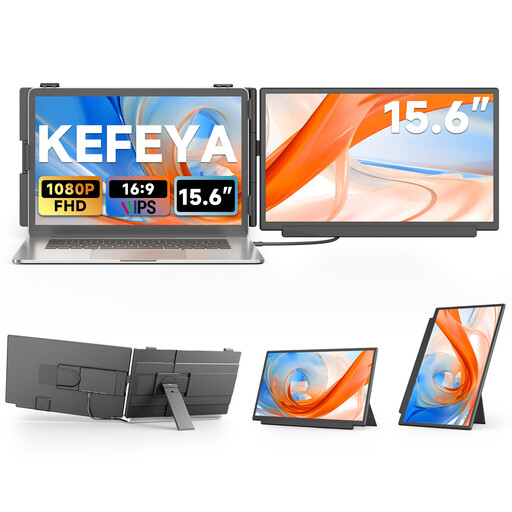
Described as a portable additional monitor for a laptop workspace. Specifications include a 15.6-inch screen, FHD 1080P and an IPS display.
The product title lists USB-C and HDMI; the product description also mentions a built-in stand.
Not without checking the entire connection setup. Lenovo describes a situation with the ThinkVision P27h-30 where a second monitor connected in a daisy chain only reaches its native resolution after the USB data rate has been changed. This is not a general guarantee for other computers or monitors.
First, adjust the text size and screen arrangement to suit your task and viewing distance. If colour accuracy matters, check the displays using your intended colour workflow. A colour-space figure alone doesn’t confirm that both displays will show colours in the same way.
Compare the energy labels and model-specific consumption figures for both devices, rather than estimating the total cost from the efficiency rating of just one monitor. The European Commission uses a scale from A to G for electronic displays, and EPREL provides further model information.
For a qualifying online consumer purchase, you generally have a 14-day cancellation period, although some exceptions apply. If goods are faulty, you have statutory consumer rights, which, according to information from the European Union, generally apply for two years from receipt. A separate manufacturer’s guarantee is different.
ASR A6 sets out requirements for display screen work within its scope, including workplaces and teleworking locations. Personal use outside a teleworking location is excluded. However, its guidance on legibility may still be useful when setting up your workspace, without creating an obligation to buy a particular product for personal use.