What should you look for when buying?
First decide which content you want to see at the same time. Then compare the connections, setup and stated energy consumption of the specific model.
| What to look for |
What to check before buying |
Who should consider it? |
| Code and documentation |
Compare 3:2 and 16:9 formats using your usual text size and planned layout for your editor and documentation. |
If I want to keep longer code and documentation pages in view, available screen height is key for me. Around 36% of consumers who prioritise code and documentation would fall into this group. |
| Editor and preview |
Check your window widths and computer scaling; don’t decide based on the stated resolution alone. |
If I want to review code changes alongside the browser preview, both windows need to remain easy to read. Around 29% of consumers with this priority would fall into this group. |
| Laptop and connections |
Check display output through your laptop’s connection, the charging power you need and the connections for peripherals or networking. |
If I want to connect my laptop at my desk and possibly charge it, the connection needs to work with my computer. Around 21% of consumers who prioritise laptop docking would fall into this group. |
| Space and energy consumption |
Measure the space available and compare the EU energy label with the product specification sheet for the specific model. The European Commission includes computer monitors among the displays covered by relevant labelling rules. |
If my desk has limited space or I want to factor in running costs, a suitable setup matters more than extra screen space. Around 14% of consumers with this priority would fall into this group. |
Joybuy monitors for coding and documentation
This selection includes 4K and QHD monitors for working with code, previews and local documentation, as well as models with a wider workspace or USB-C docking.
 No image available
Samsung ViewFinity S7 S70H, 27-inch 4K UHD IPS monitor
A possible 27-inch option if you want to arrange code, a preview and local documentation on one screen.
Listed in the product name: 4K UHD and IPS.
View at Joybuy
 No image available
CRUA 49-inch DQHD curved ultrawide monitor
A wide workspace may suit you if you want to arrange several windows side by side and have enough room for the monitor.
Listed in the product name: 49 inches, 32:9, 5120 × 1440 pixels, 165 Hz and a height-adjustable stand.
View at Joybuy
 No image available
INNOCN CB27U1, 27-inch 4K UHD monitor
A possible choice if you’re looking for a 27-inch 4K display with USB-C and charging; check compatibility with your laptop.
Listed in the product name: 3840 × 2160 pixels, IPS, 120 Hz and USB-C with 90 W Power Delivery.
View at Joybuy
 No image available
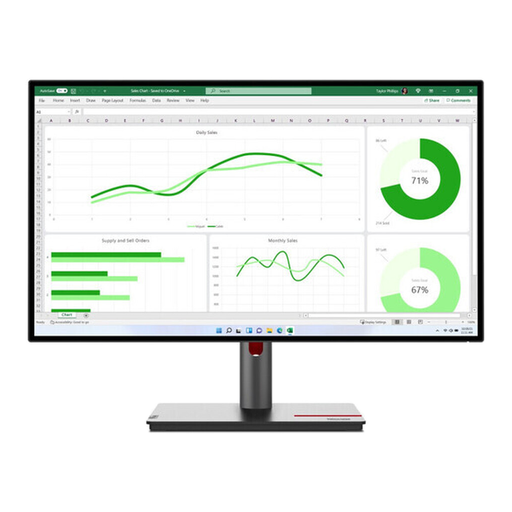
Lenovo ThinkVision P27q-30, 27-inch QHD monitor
A 27-inch QHD option if you’re looking for a workspace at this resolution for code and documentation.
Listed in the product name: 2560 × 1440 pixels, 60 Hz, IPS, HDMI and DisplayPort.
View at Joybuy
 No image available
MSI PRO MP275QPDGDE, 27-inch WQHD docking monitor
A possible option if you want to connect a laptop and bring together several work devices or peripherals; check the display output your laptop needs.
Listed in the product name: WQHD, USB-C with 98 W Power Delivery, daisy chaining, KVM and an integrated webcam.
View at Joybuy
Frequently asked questions
Does a monitor need to support offline documentation?
No. For this workflow, the documentation needs to be stored locally on your computer; the monitor displays your computer’s output. Choose a monitor based on readability, window layout and a suitable display connection.
Can I connect my laptop with a USB-C cable?
This will only work if your laptop’s connection supports the display output you need and the monitor’s charging power is suitable for your device. EIZO lists DisplayPort Alt Mode and a maximum of 94 W for the EV2740X; Lenovo lists charging up to 100 W for the P27h-30. Also check that the cable supports the features you need.
How do I compare monitors’ energy consumption?
Compare the energy labels and product specification sheets for the specific models, and take your usage time and electricity price into account. The European Commission includes computer monitors among the displays covered by relevant labelling rules.
Can I return a monitor bought online?
For online consumer purchases in Germany, you generally have a 14-day right to cancel from the day you receive the goods. You must notify the seller that you wish to cancel; check the terms of your specific purchase. The right to cancel is separate from your rights if the goods are faulty.
How do I dispose of an old monitor in Germany?
Take it to a collection point separately from your household rubbish. The German Environment Agency lists recycling centres and suitable take-back options at retailers, among other possibilities; whether a retailer is required to take it back depends on the legal requirements.


