What should you look for when buying?
When choosing a monitor for an exhibition catalogue, focus on your main priority – from judging print colours to fitting it on a small desk.
| Priority |
What to check |
Who should consider this? |
| Judging print colours |
Check the colour gamut of the specific model, whether it can be profiled, and the print provider’s output profile. |
If I’m judging catalogue images for print myself, I need to consider the monitor profile, paper and output profile; around 36% of consumers put print colours first. |
| Making the most of desk space |
Compare the available desk space with the monitor’s dimensions, including its stand and adjustment range. |
If I need to leave room for a keyboard and materials as well as the monitor, its actual footprint matters; around 29% of consumers prioritise the space it takes up. |
| Viewing pages and details |
Check the native resolution, aspect ratio and legibility at your preferred scaling. |
If I’m working on catalogue pages and image crops on a compact display, I need a picture that works with my scaling settings; around 21% of consumers prioritise layout details. |
| Connecting a laptop |
Check that the laptop port supports video and compare its charging requirements with the monitor’s USB-C specifications. |
If I work on a laptop and want to reduce the number of cables on my desk, the connection and power delivery need to be compatible; around 14% of consumers prioritise laptop connectivity. |
Monitors at Joybuy
The Joybuy options below range from portable and compact Full HD models to a 27-inch monitor for detail-focused image work. Before choosing, check that the footprint, laptop connection and print-colour requirements suit your workspace.
 No image available
MSI MAG 274UPDFDE E16M, 27-inch UHD Mini-LED Rapid IPS monitor
This model could suit detail-focused image work if you have room for a 27-inch monitor on your desk; the product specifications list a resolution of 3840 × 2160 pixels and 100% Adobe RGB.
According to the product description, the stand is height-adjustable and supports pivot, swivel and tilt. The colour gamut specification alone doesn’t guarantee a match to the final print.
View at Joybuy
 No image available
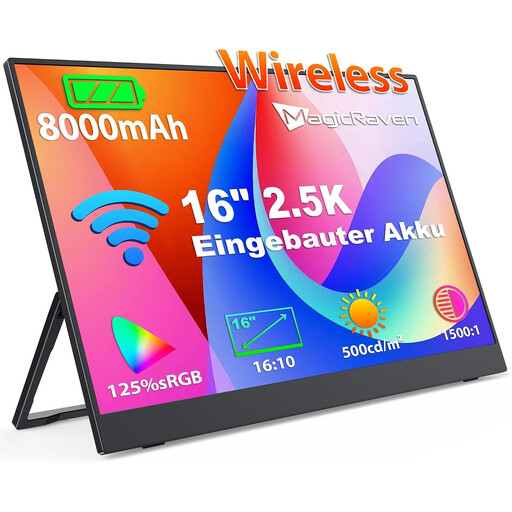
Portable 16-inch monitor with 2.5K resolution
The portable 16-inch format could be useful if desk space is limited; check that the setup and connection work for your catalogue workflow.
The product description lists 1600p, 125% sRGB, a built-in 8000-mAh battery, AirPlay and Miracast. The colour gamut specification alone doesn’t demonstrate a match for print.
View at Joybuy
 No image available
Blackview DCM6 PRO, portable 14-inch monitor
This model is designed as an extension for your laptop, whether you’re working on a catalogue while travelling or need extra screen space; the product name states that it’s for laptops from 13 to 17.3 inches.
The product specifications list a Full HD display with a resolution of 1920 × 1080 pixels. Check that it’s compatible with your laptop before buying.
View at Joybuy
 No image available
KOORUI MB24V29FS4, 24-inch Full HD IPS
This 24-inch model could suit layout work and digital reviews if its footprint, including the stand, fits on your desk.
The product name lists Full HD, an IPS panel and 99% sRGB. The product description gives a depth of 185.1 mm with the stand and a 100 × 100 mm VESA mounting option.
View at Joybuy
 No image available
KTC H24B9S, 24-inch Full HD IPS
The product name describes this model as suitable for office work and PC use. Compare its Full HD resolution with the workspace you need for catalogue pages and image details.
The product name lists a resolution of 1920 × 1080 pixels, 116% sRGB, 144 Hz and a tilting stand. The colour gamut specification alone doesn’t guarantee a match for print.
View at Joybuy
Frequently asked questions
Do I need an Adobe RGB monitor for a printed exhibition catalogue?
No, not simply because it’s for print. If you’re judging images yourself as part of a print workflow, compare the colour gamut and profiling, and take the relevant output profile and viewing conditions into account. You could also consider an sRGB-focused monitor for layout and digital approvals. Adobe describes colour management as a combination of several factors.
How can I maintain usable colour reproduction once the monitor is set up?
Profile and calibrate the specific monitor using a suitable measuring device, and aim for consistent ambient lighting. Adobe recommends recalibrating after significant changes to the lighting or monitor settings; a factory specification is no substitute for an individual profile.
What should I check before connecting a laptop via USB-C?
Check that the laptop port supports video and compare its charging requirements with the monitor’s specifications. Manufacturers list different maximum USB-C power outputs for the models described here; a compatible connector alone doesn’t confirm that a single-cable setup will work.
Which labels and rights are relevant when buying in Germany?
Covered monitors must carry the EU energy label; the European Commission provides product information about this. Under EU consumer sales rules, the seller is liable for relevant defects that become apparent within two years of delivery. Online consumer purchases generally come with a 14-day right to cancel. A business purchase for catalogue production isn’t automatically a consumer purchase; in that case, check the terms that apply under your contract.
Is there a recommended screen size for a small desk?
The ASR A6 from the Federal Institute for Occupational Safety and Health sets out requirements for screen-based workstations within its scope. The screen size that will fit on a particular desk still depends on the space available and how you can position it, so measure the space, including the stand.


