What should you consider when choosing?
First, check how you can arrange your manuscript, outline and sources on screen while keeping the text comfortably readable. Then consider adjustability, notebook connections and whether you really need 4K or colour reproduction.
| What matters when buying |
What to look for |
Who is it important for? |
| Multiple text windows |
Compare screen size, native resolution and how you arrange your windows while keeping text easy to read. |
If I need my manuscript, outline and sources visible at the same time, I want to be able to arrange the windows without making the text too small. Around 31% of consumers put having multiple text windows first. |
| Adjustable screen position |
Check how the specific stand can be adjusted and whether it suits your desk and seating position. |
During long writing sessions, I want to be able to adjust the screen position to suit my workspace. Around 25% of consumers prioritise an adjustable position. |
| Connecting a notebook |
Check USB-C video output, the charging power required, and the type and number of ports. |
If I regularly use my notebook at my desk, I want to connect it and the devices I need with as little unplugging and reconnecting as possible. Around 19% of consumers put notebook connectivity first. |
| Viewing illustrations |
Decide whether you simply need to view illustrations or edit them with accurate colour, then choose the resolution and colour specifications accordingly. |
If scientific illustrations are part of my work, I want to assess their detail in a way that suits what I actually do. Around 13% of consumers prioritise how illustrations are displayed. |
| Energy label |
Compare the labels of specific models with similar specifications, and bear in mind the scope of the EU rules. |
When comparing monitors with similar specifications, I want to take the energy label information into account without assuming that a particular efficiency class is essential. Around 12% of consumers make this label a priority. |
Joybuy monitors for working with multiple documents
The Joybuy models below include QHD and 4K options, as well as widescreen displays for working with multiple documents. Selected models also offer USB-C features.
 No image available
INNOCN 2751S PLUS 27-inch QHD monitor
The QHD version could be a good fit if you want multiple text windows on a 27-inch screen.
The product name lists QHD/2K, 275 Hz, 1 ms and a height-adjustable stand.
View at Joybuy
 No image available
INNOCN 40C1U 40-inch ultrawide monitor
If you want to arrange several long documents side by side, the widescreen format gives you room to work.
The product name lists 40 inches, 21:9, 5120 × 2160 pixels, USB-C with 65 W Power Delivery, PIP/PBP and a height-adjustable stand. Whether the charging power suits your notebook depends on its video output and power requirements.
View at Joybuy
 No image available
INNOCN CB27U1 27-inch 4K UHD monitor
This 4K model could be worth considering if you want a 27-inch screen with fine detail and notebook connectivity.
The product name lists 3840 × 2160 pixels, USB-C with 90 W Power Delivery, PIP/PBP and a height-adjustable stand. Your notebook’s video output and power requirements need to be compatible with the USB-C features.
View at Joybuy
 No image available
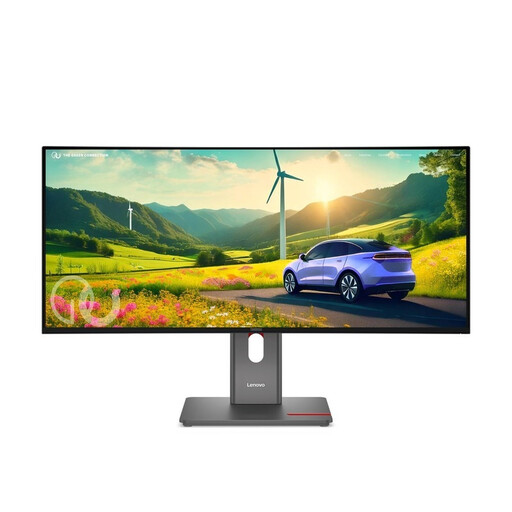
Lenovo ThinkVision P34WD-40 34-inch WQHD monitor
The widescreen format could suit you if you want to work on longer texts and outlines side by side.
The product name lists 34 inches, WQHD, IPS, 21:9 and 120 Hz.
View at Joybuy
 No image available
MSI PRO MP275QPDGDE 27-inch WQHD docking monitor
This WQHD docking option could suit you if you want to work with multiple documents on a 27-inch screen and connect a compatible notebook.
The product name lists WQHD, 100 Hz, 1 ms MPRT, USB-C with 98 W Power Delivery, daisy-chain, KVM and an integrated webcam. Check that the video output and charging power are compatible with your notebook.
View at Joybuy
Frequently asked questions
How should I set up my monitor for long writing sessions?
Start with a comfortable text size and arrange your screen, seat and desk to suit you. The German ASR A6 guidance from the Federal Institute for Occupational Safety and Health covers screen work in relation to the task and working environment. It applies to certain workplaces and teleworking setups, not every home desk as a general rule.
Can I connect and charge my notebook with a single USB-C cable?
Only if the notebook port you’re using supports video output and the specific monitor provides enough charging power. BenQ lists DisplayPort Alt Mode and 65 W Power Delivery for the GW2790QT; EIZO specifies a maximum of 94 W for the EV2740X.
What should I check after setting up and connecting the monitor?
Set the native resolution, then check the text size, window layout and screen position using your actual documents. If you’re using USB-C, also check that video transmission, connected devices and charging all work as needed.
Are a manufacturer’s guarantee and statutory rights the same thing?
No. If a product you’ve bought is faulty, the retailer is generally responsible for your statutory rights. The German consumer advice centre states that for newly purchased goods, the period is two years from delivery. A manufacturer’s guarantee is an additional voluntary service with its own terms.
Does a monitor sold in Germany need an energy label?
The European Commission includes computer monitors within the scope of energy labelling for electronic displays, subject to the regulation’s exemptions. The label uses an efficiency scale from A to G and provides information to help you compare specific models; it doesn’t require you to buy a particular class.


