Layout designers using a second screen
You want to work on magazine pages on one display while keeping tools or references close at hand on the other. Adobe explains how to arrange applications across multiple monitors.


If you mainly want to spread pages, type and tool panels across two displays, prioritise a clear, readable workspace, suitable scaling and the right connections. If you need to assess a specific magazine print, calibration and the correct output profile matter more than a high colour gamut figure alone. Adobe describes colour management and a proof matched to the output conditions as part of the print workflow. Neither 4K resolution nor extensive Adobe RGB coverage proves on its own that the print will be reproduced accurately.
You want to work on magazine pages on one display while keeping tools or references close at hand on the other. Adobe explains how to arrange applications across multiple monitors.
You also assess colours for a specific print job. Adobe explains colour management for printing, while EIZO Germany notes that colour management and the specific output conditions should be considered when choosing a monitor.
You want to add another monitor to your existing workspace, so you’ll need to consider connections, positioning and the space required for both displays.
First decide whether you mainly need the new screen for layout work or whether you’ll also use it to assess a specific print job.
| Buying priority | What to check | Who is it important for? |
|---|---|---|
| A clear, readable layout workspace | Compare screen size, native resolution and text size at your preferred scaling setting. | If I want to keep pages, type and tools in view at the same time, a clear, readable workspace matters most. Around 33% of consumers would prioritise the available screen space above all else when buying. |
| Colours for print | Check the colour gamut specifications for the exact model, how it can be calibrated and the print provider’s output profile. | If I need to assess images and colours for a specific print job, I need a coordinated colour workflow, not just a high colour gamut figure. Around 27% of consumers would put print colour assessment first. |
| Laptop connection | Check that your laptop and monitor support the video connections needed to run both displays, as well as the required charging power. | I want to connect a second screen to my laptop, so I also need to take its available connections into account. Around 20% of consumers would choose laptop connectivity as their top buying priority. |
| Space and positioning | Measure the available space, including the stands. Compare height adjustment, rotation and, where relevant, the VESA specifications for the model. | If I want two displays on my desk, I need to be able to position them comfortably. Around 20% of consumers would prioritise space requirements and positioning. |
A monitor’s colour gamut specification doesn’t automatically show how a particular print job will look. Colour management and the output conditions also play a part.
Check the output profile with your print provider and find out how the exact monitor model can be calibrated.
Calibration and profile matching take time. You may also need a measuring device for objective colour assessment.
A USB-C port on a monitor doesn’t prove that your laptop can drive both displays as you want or charge through that connection.
Before buying, check the signal path for both monitors, the capabilities of your laptop’s port and your computer’s charging requirements.
Depending on the connections you already have, you may need a different cable, an adapter or an additional power supply.
With two displays, scaling, stands and adjustment options also affect how easily you can arrange your pages and second screen.
Check the text size you plan to use and measure the space for both monitors, including their stands.
The ProArt PA279CRV is a specific example of a 27-inch 4K screen with USB-C for a layout workspace.
The ColorEdge CS2740 is an example of a primary monitor designed with colour management in mind.
The PD2732U and PD2725U have different colour gamut and connectivity specifications, so it’s best to consider them separately.
The UltraFine 27UP850K-W is a 27-inch 4K option with USB-C for layout work and digital content.
The UltraSharp U2725QE is a 27-inch 4K monitor with Thunderbolt hub features.
The models listed are portable additional displays for a laptop workspace with two screens. Before buying, check that the connections, positioning and screen format will work with your existing device and workspace.
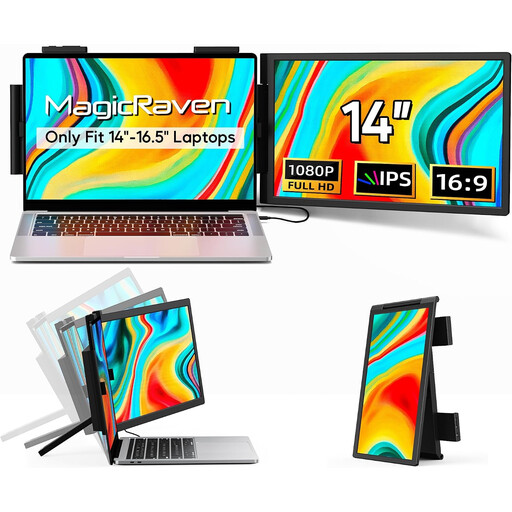 No image available
Listed as an additional screen for a laptop workspace with two displays; the stated compatible laptop size is 14 to 16.5 inches.
FHD 1080p, 60 Hz and IPS; connections: HDMI, USB-A and USB-C. Listed as compatible with Windows, Mac and Android.
 No image available
A portable additional display for a laptop workspace; the stated 16:10 format offers more vertical screen space than 16:9.
14 inches, 1920 × 1200, IPS and 16:10. Connections: USB-C and Mini-HDMI.
 No image available
Designed as a portable second screen for a laptop; check that your source device supports the required USB-C functionality before buying.
15.3 inches and FHD; a one-cable USB-C setup, 4.5 mm thickness and 1.2 kg weight are listed for this model. Listed display modes: Mirror, Extend and Portrait.
 No image available
Listed as a portable extension for a laptop screen; stated compatibility includes laptops from 13 to 17.3 inches.
14 inches and Full HD. The model is described as a triple-screen extender for laptops.
 No image available
An additional external display for a laptop workspace; you can plan your setup around the Smart Cover stand or a VESA mount.
15.6 inches, FHD 1080p and IPS. Connections: USB-C and HDMI; a Smart Cover stand and VESA mounting are listed.
No. You can customise InDesign workspaces and arrange windows or applications across multiple monitors. Set things up around the tools and views you need to use at the same time while working on a layout.
No. Colour management and a suitable output or proof profile are part of the process for a specific print job. A colour gamut specification alone doesn’t describe the final print.
Check the calibration and profiling options for the specific monitor, and use the appropriate output profile. Adobe describes a colour measurement device as one way to achieve objective colour settings; the output conditions also matter when previewing a print.
Depending on your existing equipment, you may also need a suitable cable, a mount or a device for colour measurement. For comparing the energy use of specific screens, the European Commission recommends using the EU energy label and EPREL.
EU energy labelling rules apply to electronic displays; the European Commission explains how to use the label to compare specific models. For distance contracts with consumers, section 312g of the German Civil Code (BGB) generally provides a right to cancel. Section 355 BGB specifies a 14-day period; the start of that period and statutory exceptions should be considered on a case-by-case basis. This is not a general returns promise for every business purchase.