For working with a manuscript and historical sources side by side, an adjustable 27-inch QHD monitor is a sensible starting point, provided both windows fit on screen at your preferred text size. Dell Germany lists the P2725DE as having a resolution of 2560 × 1440 pixels. A 27-inch 4K model may suit detailed scans, while an ultrawide gives you more room to arrange windows horizontally but takes up more desk space. Before buying, check the scaling, your window layout and your laptop’s ports. Microsoft Support explains how to snap windows in Windows, but you should also check that everything displays properly in your editor.
Which monitor sizes suit different needs?
Writers working with multiple sources
If you often have your manuscript, timeline and historical evidence open at the same time, you’ll want to fit the windows side by side at a comfortable text size. Dell Germany lists the P2725DE as a 27-inch QHD monitor with a resolution of 2560 × 1440 pixels.
Writers working with image archives
If you check scanned maps or documents for fine details, consider the resolution alongside your preferred text scaling. LG Germany lists the 27UP850K-W as a 27-inch monitor with a resolution of 3840 × 2160 pixels; more pixels alone don’t guarantee a more comfortable viewing experience.
Writers with limited desk space
When space is tight, consider the monitor’s dimensions, stand and the ports you actually need. Lenovo lists the ThinkVision T24i-30 as a 23.8-inch Full HD monitor with an adjustable stand. Also check that it has enough room for your windows side by side.
What should you look for in a monitor for manuscripts and sources?
27-inch QHD
A good fit if: Your manuscript and a source or notes window remain easy to read side by side at your preferred text size.
Trade-off: QHD has fewer native pixels for detailed scans than the 4K models mentioned. USB-C is not included on every QHD monitor.
27-inch 4K
A good fit if: Alongside text, you regularly check fine details in digitised maps or documents.
Trade-off: Scaling and window layout both affect how easy text and on-screen controls are to read.
34-inch ultrawide
A good fit if: You want your manuscript, source and other wide notes windows to stay visible side by side.
Trade-off: A wide screen and its stand need more space. At 3440 × 1440 pixels, it has fewer vertical pixels than the 4K monitors mentioned.
Compact Full HD monitor
A good fit if: Your desk is small and you usually work on one text window at a time.
Trade-off: You’ll have fewer native pixels for displaying two windows at once than with the QHD and ultrawide examples mentioned.
| What matters when buying |
What to check |
Who it matters most to |
| Readable windows side by side |
Arrange two typical documents side by side in your own editor and check them at your preferred text size. |
If I want to read my manuscript and historical evidence side by side, I need enough room without making the text smaller. Around 36% of consumers put readable side-by-side windows first. |
| Readability and screen position |
Test the text size and scaling in your editor, then check the height adjustment and viewing position at your desk. |
During long writing sessions, I want to be able to adjust the text size and screen position. Around 29% of consumers prioritise readability and screen position. |
| Details in historical scans |
Open a typical scan alongside your manuscript at your preferred zoom level. |
If I’m checking fine print or details on a map, I want to be able to view them alongside my manuscript. Around 21% of consumers put scan details first. |
| Laptop connection and desk space |
Check the width and depth, including the stand, and make sure the video connection, cable and any charging power you need are suitable. |
If space is limited or I use a laptop, I want to know in advance whether the monitor and its connections will suit my workspace. Around 14% of consumers prioritise connections or desk space. |
Which buying mistakes should you avoid?
-
Choosing based on pixel count alone
A higher resolution alone won’t tell you whether your manuscript and source will fit side by side and remain easy to read at your preferred text size.
Before buying, open a typical manuscript and scan at your intended scaling and check how the windows fit on screen.
-
Assuming USB-C guarantees a one-cable setup
A USB-C port on a monitor doesn’t automatically mean your laptop can output video through it or charge sufficiently.
Check video output, charging requirements and cable compatibility against the specifications for your laptop and the specific monitor model.
Depending on your laptop, you may also need a suitable cable or a separate connection solution.
-
Choosing an ultrawide without planning your window layout
A wide 21:9 screen gives you more options for arranging windows horizontally, but needs enough space and doesn’t automatically offer more vertical workspace than QHD.
Measure the available space, including the stand, and sketch out how you’ll arrange your manuscript, source and notes.
Which brands are worth considering?
The brands below offer specific monitor ranges and models. The features mentioned apply to the model named, not necessarily to the entire range.
Dell
According to Dell Germany, the Pro Plus P2725DE is a 27-inch QHD option with a USB-C hub for a laptop-based writing setup.
- Dell lists the P2725DE as having a resolution of 2560 × 1440 pixels and an adjustable stand.
- Check that your laptop supports the video output and charging features you need over USB-C.
LG
According to LG Germany, the 27UP850K-W is a 27-inch 4K model for working with text and occasionally checking fine image details.
- LG lists a resolution of 3840 × 2160 pixels, USB-C and an adjustable stand.
- The resolution alone won’t tell you whether windows and text will be comfortable to read at your chosen scaling.
Philips
The B-Line 346B1C/01 is a 34-inch ultrawide option for working with multiple windows side by side.
- Philips lists a resolution of 3440 × 1440 pixels, a 21:9 aspect ratio and an adjustable stand.
- How useful the extra width is depends on your window layout and the space available.
Lenovo
The ThinkVision T24i-30 is a more compact 23.8-inch Full HD option.
- Lenovo lists an adjustable stand, along with HDMI and DisplayPort.
- Check whether Full HD gives you enough room for the side-by-side window layout you want.
EIZO
According to EIZO, the FlexScan EV2740X is a 27-inch 4K office monitor with USB-C docking.
- EIZO lists a resolution of 3840 × 2160 pixels and maximum USB-C power delivery of 94 W.
- The maximum figure doesn’t guarantee compatibility with every laptop, so check your device’s requirements.
Joybuy products for working with windows side by side
This selection of Joybuy products includes 4K and ultrawide options for viewing manuscripts and sources side by side. For each model, check text size, desk space and whether its connections are compatible with your laptop.
 No image available
INNOCN 40C1U 40-inch 5K ultrawide monitor
The wide display may suit you if you want room for a manuscript and several source windows at once, and have enough desk space.
- 40 inches, 21:9 and 5120 × 2160 pixels
- USB-C with 65 W Power Delivery, plus PIP and PBP
- Height-adjustable stand; stated width including the stand is 944.1 mm.
View at Joybuy
 No image available
INNOCN CB27U1 27-inch 4K UHD monitor
A 27-inch 4K option if you check details in historical scans alongside your manuscript. Try your preferred scaling to see how the text size and window layout work for you.
- 3840 × 2160 pixels and IPS panel
- PIP and PBP for split-screen viewing
- USB-C with 90 W Power Delivery and height-adjustable stand
- Check that your laptop supports video output and the charging power you need over USB-C.
View at Joybuy
 No image available
ASUS TUF Gaming VG34VQ3B 34-inch UWQHD monitor
The 21:9 format may suit a manuscript and wide source windows, provided the screen and stand fit on your desk.
- 34 inches and 3440 × 1440 pixels
- 21:9 format and curved design
- DisplayPort, HDMI and USB
- Plan for both the space available and the window layout you want.
View at Joybuy
 No image available
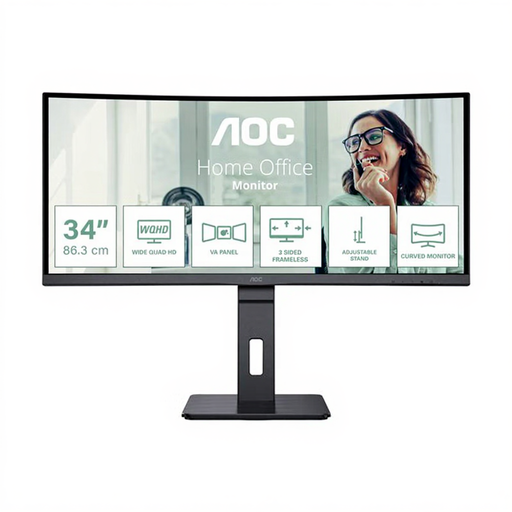
AOC Pro-Line CU34P3CV 34-inch curved ultrawide monitor
The wide workspace may suit you if you want your manuscript, source and other wide windows visible side by side.
- 34 inches, 21:9 and 3440 × 1440 pixels
- USB-C with up to 65 W Power Delivery
- KVM and height-adjustable stand
- USB-C features and charging power require a compatible laptop. Also allow for the space needed by the ultrawide format.
View at Joybuy
 No image available
Philips 345B1C 34-inch curved ultrawide monitor
This ultrawide model is worth considering if you can arrange your manuscript and sources side by side and have enough desk space.
- 34 inches, 21:9 and 3440 × 1440 pixels
- USB hub and height-adjustable stand
- Check that your preferred window layout fits the space available on your desk.
View at Joybuy
Frequently asked questions about monitors for historical writing projects
Do I need a monitor with a built-in split-screen feature to view two documents?
No, not necessarily. As Microsoft Support explains, you can use the snap feature in Windows to arrange windows side by side. Also check whether your particular editor supports viewing two documents at once; the operating system feature alone doesn’t guarantee that it does.
How should I set up my monitor for longer writing sessions?
Adjust the text and display settings to suit your task and viewing distance, making sure they’re sharp and large enough. Check your viewing position and look out for distracting reflections. Germany’s Federal Institute for Occupational Safety and Health sets out requirements for its area of application in ASR A6; these don’t apply universally to every home writing setup.
What should I know about power consumption and faults?
Check the EU energy label for the specific monitor. The European Commission explains the efficiency scale for electronic displays. In Germany, statutory consumer rights against the seller are distinct from a voluntary guarantee, as the Verbraucherzentrale explains.
Does German workplace safety law require a particular monitor for my home writing desk?
ASR A6 does not impose a blanket requirement to use a particular monitor model or resolution for purely private screen use outside its area of application. Germany’s Federal Institute for Occupational Safety and Health explains the limits of where the rules apply. If your setup is a covered workplace or teleworking arrangement, the specific circumstances need to be assessed separately.


